
died 4th century·Feast September 2
St. Elpidius the Cappadocian
Desert abbot of Cappadocia whose relics named an Italian town
Overview
Elpidius the Cappadocian, honored in Italian as Sant'Elpidio or Santo Abate Elpidio, was an abbot of Asia Minor who flourished in the fourth century. The tradition preserved of him is brief but vivid: he withdrew to a cave in his native Cappadocia and lived there as a hermit for twenty-five years, until the example of his holiness drew disciples to his retreat. Among those who gathered around him were Eustace, remembered in Italian as Eustachio, and Ennesius, or Ennesio, who shared his ascetic life and his later cult. After his death his veneration crossed the Adriatic. In the seventh century the village of Cluana, on the coast of the Marche in central Italy, acquired his relics together with those of Eustace and Ennesius, paying for them by ceding a parcel of land in return. The remains were handed over to the townspeople, and the settlement took the saint's name, becoming Sant'Elpidio a Mare, which remains his principal shrine. Later tradition credits those same relics with saving the town from a Lombard siege, recalling that the saint appeared in the sky to urge the inhabitants to defend their walls. His feast is kept on September 2, and he is represented in art by a vine in leaf in winter, an image of life flourishing against expectation.
The Complete Life
Twenty-five Years in the Rock
The tradition of the desert fathers made the hermit's cave a school of the spirit, and Elpidius of Cappadocia belonged wholly to that school. His native province of Cappadocia, in the highlands of Asia Minor, had already produced some of the most celebrated ascetics of the fourth century, and in their company Elpidius withdrew to a cave and remained there for twenty-five years. The number is the tradition's own, and it marks a lifetime measured not by offices held or books written but by persistence in one place of prayer. What the hermit learned in those years is unknown, but the fruit of the retreat became visible when disciples began to gather: Eustace and Ennesius came to share his life, and from their common discipline Elpidius emerged as an abbot, a father of monks rather than a solitary alone. The title by which the Church remembers him, Santo Abate Elpidio, preserves exactly this. A man who began by fleeing human company ended by drawing it to himself, and the cave that had been his refuge became the founding place of a community. Of his teaching no words survive; his authority rested on the silent testimony of a life spent in the rock.
§ Elpidius the Cappadocian
A Cult Born of Relics
Elpidius belonged to the countless saints of the first centuries whose recognition needed no decree: he was honored because the faithful never stopped honoring him. The Roman Catholic Church keeps his memory on September 2 and counts him among its pre-congregation saints. The decisive act of his cult came in the seventh century, when the village of Cluana on the Adriatic coast of the Marche acquired his relics, ceding a grant of land in return. The remains of the abbot were consigned to the inhabitants together with those of his companions Eustace and Ennesius, so that the three who had shared one ascetic life now shared one shrine. The transaction, part land-grant and part solemn translation, bound the distant Cappadocian to an Italian shore forever: Cluana took his name and became Sant'Elpidio a Mare, the town that keeps his principal shrine to this day. Few saints have given their name to a place so literally, and the town's identity has remained inseparable from the man in the cave a continent away. The endurance of that devotion across thirteen centuries says more about the abbot than any surviving biography could.
§ Veneration
The Saint in the Sky over Sant'Elpidio
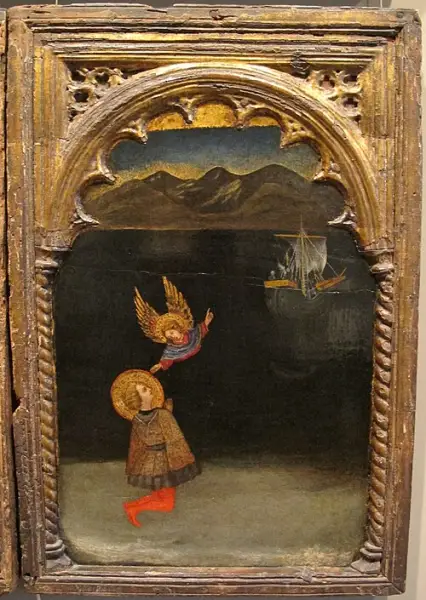
The presence of Elpidius's relics at Sant'Elpidio a Mare became, in the town's memory, a protection no wall could equal. When a Lombard army laid siege to the settlement, the inhabitants came to believe that the saint himself fought for them. Tradition relates that Elpidius appeared in the sky above the village, asking the inhabitants to defend it, and that the siege was broken and the town saved. Whatever the historical kernel of the story, it fixed the abbot of Cappadocia as the living defender of his adopted people, a heavenly patron who had traveled farther for them than they ever traveled for him. His iconography preserves the theology of that rescue in a single image: a vine in leaf in winter, life putting out green shoots in the season of frost, as the saint's intercession brought rescue in the town's darkest hour. The festival of September 2 has kept his memory alive in the Marche, where his name stands over the town itself, and where the three relics of abbot and companions remain the heart of the local devotion. The hermit who renounced the world ended by belonging to it more lastingly than most who never left it.
§ Veneration
The Record
- Major works
- The eremitical community he led at his Cappadocian cave, which formed disciples such as Eustace and Ennesius
- Patron of
- Patron of Sant'Elpidio a Mare
- Symbols
- A vine in leaf in winter
- Canonization
- Pre-congregation; venerated in the Roman Catholic Church from antiquity
Prayer
Bibliography
Show 1 sources
- Paradise Possible Le Marche - Sant'Elpidio a Mare.
Profile text adapted from the Wikipedia article, licensed CC BY-SA 4.0.
Pray with this saint every day
Save St. Elpidius the Cappadocian to your favorites, read the full profile, and get feast-day reminders in the Saints app.
Get the Saints AppFree on the App Store for iPhone and iPad