
c. 468 – 6th century·Feast 1 August
St. Eluned
Virgin Martyr of Slwch Tump in Breconshire
Overview
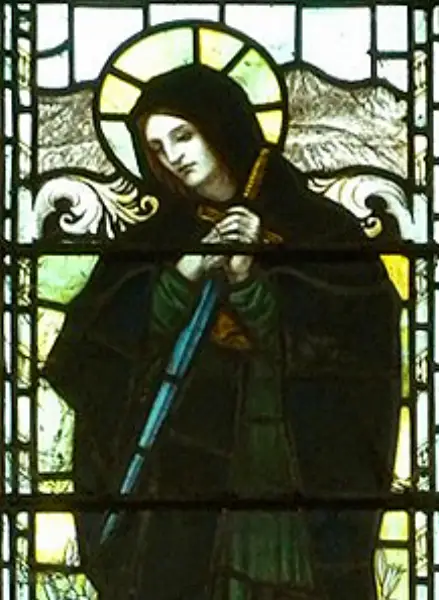
Eluned, whose Welsh name is Eiliwedd and whose Latin forms include Almedha and Elevetha, was a fifth- or sixth-century virgin martyr of the country around Brecon in what is now Powys. Born around the year 468, she was one of the many daughters of King Brychan of Brycheiniog, the sub-Roman ruler who had accepted the Christian faith and whose children and grandchildren populate the calendars of Wales. Eluned embraced her father's new religion young, and when a pagan prince demanded her hand she refused him and fled. Her flight became a circuit of refusals: driven from Llan Ddew and then from Llanfilo on a false charge of theft, expelled again from Llechfaen, she found shelter only at Slwch Tump, where the local lord granted her protection. There her pursuer found her, and when she ran from him he cut off her head on the hillside; from the stone where it fell a healing spring burst forth, as it had done at the martyrdom of Saint Winefride. Her remains were later honored in the priory church at Usk, her well at Slwch drew pilgrims for centuries, and her feast is kept on 1 August, the day of the old harvest festival.
The Complete Life
A Daughter of Brychan's Great House
Eluned was born into the most fertile saint-making family in Wales. Her father, Brychan, ruled Brycheiniog in the generation after the Romans left Britain, and he had accepted the new faith of Christianity; his many children and grandchildren appear across the dedications of Wales, Cornwall and Brittany as founders, virgins and martyrs. Eluned, whose name takes the forms Eiliwedd in Welsh and Almedha or Elevetha in Latin, with Aled and other variants besides, was one of this company. George Phillips, writing in the Catholic Encyclopedia, caught the imaginative reach of her story when he identified her with the Luned of the Mabinogion and the Lynette of Tennyson's Gareth and Lynette, linking the martyr of Breconshire to the literary heroines who carry an echo of her name. She came to the Christian faith young, in a household where the faith of the fathers was still fresh and contested. Around her the old religious world of the Britons was dissolving, and among its remnants stood princes who still worshiped the older gods and who considered a Christian king's daughter a fit bride. Against that world her conviction would soon be tested.
§ Legend
The Flight from a Pagan Suitor
The crisis of Eluned's life came when a pagan prince sought her in marriage. She refused him, and, like many women of her time who found themselves pursued for the sake of land or alliance, she ran. Her vocation as a consecrated virgin could not be reconciled with the marriage, and flight was the only protection the age offered. The legend marks her route with the names of villages that still stand in Breconshire. She went first to Llan Ddew, where the residents drove her out; she moved on to Llanfilo, where the inhabitants expelled her again, on the pretext that she was a thief; from there she made her way to Llechfaen, and was thrown out a third time. The triple rejection has struck every reader of her story: the wandering virgin, carrying nothing, was refused by three Christian or half-Christian settlements before the earth itself received her. At last she reached Slwch Tump, a rounded hill east of Brecon, and there the local lord, more hospitable than the villages, gave her the protection she had sought across the whole countryside. On that hill she settled to the life of prayer she had chosen.
§ Legend
Martyrdom on Slwch Tump
The refuge of Slwch Tump held only briefly. Eluned's pursuer discovered where she had settled, and when she fled from him once more, he pursued her down the slope and struck off her head. The legend continues in the pattern familiar from the martyrdoms of other Welsh virgins: her head rolled down the slope and struck a stone, and from the spot a healing spring burst forth, exactly as a well had risen where Saint Winefride suffered at Treffynnon. The spring made the place holy in the memory of the countryside, and the hill became her shrine. Her bodily remains were not left undistinguished either; William Worcester, writing in the fifteenth century, records that the saint's relics were housed in the priory church at Usk, where a community of Benedictine nuns, established before 1135 by Richard de Clare, kept her memory among their treasures. The woman who had been driven from three villages thus came to be carried in honor through two, her body at Usk and her blood's spring at Slwch, and the marriage she had refused was forgotten beside the witness she had kept.
§ Legend
Well, Chapel and Harvest Day
Eluned's cult lived on in the landscape long after the historical details had faded. When the Normans arrived in the eleventh century, her well at Slwch was already known as a place of healing and other miracles, and pilgrims continued to seek it as they sought her namesakes' wells across Wales. Like so many such sites, the holy well and the chapel above it were destroyed at the Reformation, yet the memory proved stubborn. In 1698 the Welsh historian Hugh Thomas described the chapel as still standing, roofless and unused, on its eminence about a mile east of Brecknock, known to the local people as St. Tayled or St. Aled's, with only low traces of the walls and an aged yew tree marking the spot, and a well at the tree's foot. Her feast day, 1 August, falls on the same date as the old pagan harvest festival of Lughnasadh, called Lammas in England, a coincidence that has made her one of the saints at the meeting of the church's year and the country's. Her story survives likewise in literature, in the Luned of the Mabinogion and the Lynette of Tennyson, and in the modern recovery of Wales's women saints.
§ Veneration
Timeline
- 468
Was born around this time into the family of King Brychan of Brycheiniog.
§ Legend
- 1698
The historian Hugh Thomas recorded her ruined chapel on the eminence east of Brecon, still known to local people as St. Aled's.
§ Veneration
In Their Own Words
standing, though unroofed and useless; the people thereabouts call it St. Tayled [St. Aled]. It was situated on an eminence, about a mile to the eastward of Brecknock
The Record
- Major works
- The holy well and chapel at Slwch Tump
- Canonization
- Pre-congregation; venerated from the early Welsh church as a virgin and martyr.
Prayer
Bibliography
Show 5 sources
- David Nash Ford, "EarlyBritishKingdoms.com: St. Eiliwedd", Nash Ford Publishing
- George Phillips, "St. Elined", The Catholic Encyclopedia, Vol. 5, New York: Robert Appleton Company, 1909
- Gary R. Varner, Sacred Wells, Algora Publishing, 2009
- Jane Cartwright, "Dead virgins: feminine sanctity in medieval Wales", Medium Aevum, 2002
- Gerald of Wales, The Itinerary of Archbishop Baldwin through Wales, Book I, Ch. 2, Oxford, Mississippi, 1997
Profile text adapted from the Wikipedia article, licensed CC BY-SA 4.0.
Pray with this saint every day
Save St. Eluned to your favorites, read the full profile, and get feast-day reminders in the Saints app.
Get the Saints AppFree on the App Store for iPhone and iPad