
1285 – 1323·Feast September 27
St. Elzéar of Sabran
Franciscan tertiary count who ruled as a model of Christian virtue
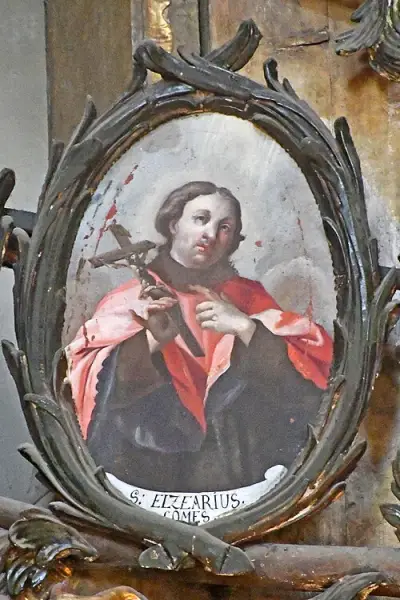
Overview
Elzéar of Sabran, Baron of Ansouis and Count of Ariano, was born in 1285 at the castle of Saint-Jean-de-Robians, beside Cabrières-d'Aigues in Provence. Educated in faith and learning by his uncle William of Sabran, abbot of St. Victor in Marseille, he was betrothed at the age of ten, at the wish of King Charles II of Naples, to the twelve-year-old Delphine of Glandèves, heiress of the Count of Puy-Michel. They married three years later, and on their wedding night Delphine revealed her private vow of chastity; Elzéar, who had grown up with her as a brother, chose to honor it and made the same vow himself. The two joined the Third Order of Saint Francis and made their castle at Ansouis a school of prayer, mortification, and care for the poor, later moving to Puimichel for greater solitude and drawing up rules of conduct for their servants. On his father's death in 1309 he became Count of Ariano in Italy, winning over subjects who despised their Norman rulers by kindness. In 1312 he led the army of King Robert of Naples to Rome against Emperor Henry VII. In 1317 he became tutor to Duke Charles, son of King Robert, and later his castellan. Sent as ambassador to France in 1323 to arrange Charles's marriage to Marie of Valois, he died in Paris on September 27 of that year, shortly after completing the mission.
The Complete Life
Formation at St. Victor
Elzéar was born in 1285 at the castle of Saint-Jean-de-Robians, beside Cabrières-d'Aigues in Provence, into the noble house of Sabran, whose barony of Ansouis and later county of Ariano marked the stations of his life. His earliest formation was entrusted to his uncle William of Sabran, who ruled as abbot of the Abbey of St. Victor in Marseille, and under that supervision the boy received a thorough training both in the Christian faith and in the sciences of the day. The arrangement joined the two inheritances that would define him: a nobleman's preparation for command and a monk's grounding in prayer and doctrine. His future was shaped almost as early by the dynastic calculations of the Neapolitan court. King Charles II of Naples wished to bind the Provençal nobility to the crown, and at the king's wish Elzéar, aged ten, was betrothed to Delphine of Glandèves, twelve years old and daughter and heiress of the Count of Puy-Michel. The betrothal of two children, decreed by royal policy rather than affection, might have produced a merely political marriage; instead, through the vows the couple would later embrace, it became one of the most celebrated spiritual partnerships of the fourteenth century.
§ Biography
A Marriage of Two Vows
Three years after the betrothal, Elzéar and Delphine were wed in the castle of Puy-Michel, still little more than children. On their wedding night Delphine told her new husband that she had already taken a private vow of chastity. The two had grown up together and thought of one another as siblings rather than as spouses, and Elzéar faced a choice that canon law left entirely in his hands: he had the right to compel her to abandon the commitment, and no authority could have reproached him for exercising it. He chose instead to honor her wish for a life of virginity, and went further, copying her example by making the same vow himself. Together the couple joined the Third Order of Saint Francis, binding their noble state to the penitential spirituality of the Franciscans. They settled at the castle of Ansouis, where the two vied with one another in prayer, in mortification of the flesh, and in charity toward the unfortunate. At twenty, Elzéar left Ansouis with his wife for Puimichel in search of deeper solitude, where he composed a code of conduct for his servants that turned an entire noble household into a pattern of Christian virtue, a domestic legislation as much a part of his sanctity as any battlefield or embassy.
§ Biography
Count, Soldier, and Tutor of Princes
The public career of Elzéar began in earnest with the death of his father in 1309, when he became Count of Ariano in Italy. The county had been won by the Normans centuries before, and his subjects still despised the memory of their conquerors; Elzéar gained their trust and support not by force but by kindness, governing as a Christian lord rather than an occupying race's heir. In 1312 he marched on Rome leading the host of King Robert of Naples, raised to help drive out Emperor Henry VII from the city, and so took his place among the soldier-diplomats of the age without, so far as can be known, surrendering the discipline of his Franciscan vocation. Returning to Provence after the war, he once more organized a household in which devotion and faithful observance of the Catholic faith were expected of every member. In 1317 he was called to Naples to become tutor to Duke Charles, the son of King Robert, and when Charles was made Vicar General of the Kingdom of Sicily, Elzéar served him as castellan. The tutor of a prince and the governor of his castles carried into the Neapolitan court the same rule of virtue he had written for his servants at Puimichel.
§ Biography
Ambassador and Death in Paris
The final charge of Elzéar's life took him back across the Alps. In 1323 he was sent as envoy to the French king to seek the hand of Marie of Valois in marriage for Duke Charles, his former pupil and the lord whose castellan he had been. The French court was a worldly one, and Elzéar edified it by his heroic virtues, a Provençal count in the Franciscan third order moving through the business of dynastic marriage without losing the reputation of a saint. He accomplished the mission, and died at Paris on September 27, 1323, shortly afterward, in the thirty-ninth year of his age. His body was returned to his own domain and laid to rest clothed as a Franciscan tertiary in the church of the Friars Minor at Apt in Vaucluse, that habit of penance claiming in death the man who had worn the count's crown in life. There he rested until the French Revolution destroyed his tomb, scattering what politics and armies had never touched. The reverence that survived the revolution is the measure of the man: a diplomat and military leader remembered not for the marriages he arranged or the campaigns he marched in, but for the virtue he carried intact from a Provençal castle to the courts of Naples and Paris.
§ Biography
Raised to the Altars by His Godson
Elzéar's canonization carried a personal signature. The decree was signed by Pope Urban V, who was his godson, and the canonization itself was carried out by Urban's successor, Gregory XI, about 1371, more than four decades after the count's death in Paris. At the same time Urban also beatified Delphine, honoring the partnership of their common life and acknowledging that the vows they had made together on their wedding night belonged to the story of both. Their liturgical feast, common to both, is observed by the Franciscan Third Order each 26 September, while Elzéar's own feast of 27 September, the day of his death, is kept in the Roman Catholic Church, where he is venerated with the attributes of a crown and royal attire, the emblems of the nobility he sanctified rather than renounced. His cult has remained attached to the places of his life: Ansouis, where the Franciscan church keeps reliquaries of the count and his wife, and Apt, where he was buried in the habit of the Friars Minor until the Revolution. A saint who was at once baron, count, soldier, tutor, and ambassador, he stands in the Franciscan tradition as proof that rule and poverty, court and cave, need not be enemies.
§ Elzéar of Sabran
The Saint Who Did Not Renounce the World
Elzéar of Sabran left no writings, founded no order, and shed no blood for the faith, yet the Church raised him to its altars within a generation of his death. His legacy lies in the demonstration that every station of a noble life can be lived as a vocation. As a husband he honored a vow not his own and made it his own, giving the Church one of its great models of married chastity alongside Delphine, whom the same pope beatified. As a count in Ariano he showed that authority exercised with kindness could win what conquest never had, and as a tutor and castellan he brought a servant's rule of conduct into the education of a prince. As a diplomat in a worldly court he edified it simply by the practice of heroic virtue, asking no dispensation from Franciscan simplicity to do the work of a royal ambassador. The Third Order of Saint Francis, whose habit he wore in his tomb at Apt, has kept his memory on 26 September together with Blessed Delphine, and the couple's reliquaries remain in the Franciscan church of Ansouis. For the Franciscan penitents who claim him, he remains the standing answer to the question of whether the Gospel can be lived amid titles, armies, and courts: it can, when the heart has first made the vow.
§ Biography
Timeline
- 1285
Born at the castle of Saint-Jean-de-Robians, beside Cabrières-d'Aigues in Provence.
§ Elzéar of Sabran
- 1309
Succeeded his father as Count of Ariano in Italy and won the trust of his subjects through kindness.
§ Biography
- 1312
Marched to Rome at the head of King Robert of Naples's army, mobilized to expel Emperor Henry VII from the city.
§ Biography
- 1317
Went to Naples as tutor to Duke Charles, son of King Robert, later serving as his castellan when Charles became Vicar General of the Kingdom of Sicily.
§ Biography
- 1323
Sent as ambassador to the King of France to obtain Marie of Valois as bride for Duke Charles.
§ Biography
- 27 Sep 1323
Died in Paris, shortly after completing his diplomatic mission, and was buried in the Franciscan habit at Apt.
§ Biography
- 15 Apr 1369
His godson Pope Urban V signed the decree of his canonization and at the same time beatified Delphine.
§ Elzéar of Sabran
- 1371
Pope Gregory XI, successor of Urban V, carried the canonization to completion.
§ Elzéar of Sabran
The Record
- Major works
- Rules of conduct for his household and servants, formulated at Puimichel·His governance of Ariano and tutorship of Duke Charles of Naples
- Patron of
- Franciscan Third Order·Married couples living in chastity
- Symbols
- Crown·Royal attire·Franciscan habit in burial
- Canonization
- Canonized by Pope Urban V (decree signed 15 April 1369), with the canonization carried out by his successor Gregory XI about 1371
Prayer
Bibliography
Show 4 sources
- Carr, Gregory. "St. Elzéar of Sabran." The Catholic Encyclopedia Vol. 5. New York: Robert Appleton Company, 1909.
- Baring-Gould, Sabine. The Lives of the Saints, J. Hodges., 1875, p. 403.
- "St Elzear of Sabran & Bl Delphine", Secular Franciscan Order - USA. Archived from the original on 2021-10-01.
- "Saint Elzéar", The Met.
Profile text adapted from the Wikipedia article, licensed CC BY-SA 4.0.
Pray with this saint every day
Save St. Elzéar of Sabran to your favorites, read the full profile, and get feast-day reminders in the Saints app.
Get the Saints AppFree on the App Store for iPhone and iPad