
died c. 304·Feast January 23
St. Emerentiana
Virgin martyr stoned at the tomb of St. Agnes
Overview
Emerentiana was a Roman virgin and martyr who died around the beginning of the fourth century, honored since antiquity in both the Catholic and Eastern Orthodox traditions. The legend of Agnes of Rome makes her the foster sister of Agnes, the rich heiress martyred for refusing an engagement on account of her Christian faith; Emerentiana's own mother was the wet nurse and nanny who raised Agnes. Emerentiana was still a catechumen, learning the faith before her baptism, when she went a few days after Agnes's death to pray at her tomb. Attacked there by a pagan crowd, she professed her faith and acknowledged her kinship with the martyred girl, and was stoned to death on the spot. For this the Church has counted her among those who receive a baptism of desire or of blood. A real Roman martyr of her name stands behind the story, though even the year of her death is lost to history; her cult is attested by the ancient martyrologies of Jerome and Bede. Her crypt in the Roman catacombs was rediscovered in the nineteenth century by Mariano Armellini, and her tomb is venerated in the basilica of Sant'Agnese fuori le mura in Rome. She is invoked against colic and stomach ailments, and her feast is kept on January 23.
The Complete Life
Foster Sister of Agnes
The story of Emerentiana is told inside the legend of Agnes of Rome, one of the most beloved narratives of the early Roman Church. By that account Emerentiana was Agnes's foster sister, bound to the famous martyr not by blood but by the intimacy of the household: Emerentiana's mother had nursed and reared Agnes as her own child, so that the two girls grew up under one roof and in the same care. Agnes was a rich Roman heiress whose life ended when she refused an engagement because of her Christian religion, and her execution made her one of the great martyrs of the city. Emerentiana thus belonged to the family of a martyr before she belonged to the Church by baptism, a catechumen still under instruction in the faith and not yet formally received into it. That situation gives her story its poignancy: she stood at the threshold of the faith, instructed in its story and drawn to its Lord, but not yet sealed by the sacrament. When Agnes died, the ties of the household drew Emerentiana to the tomb on the Via Nomentana, and it was there, praying among the graves, that the faith she had only begun to learn would demand of her the price her sister had already paid.
§ Legend
Baptism of Blood at the Tomb
A few days after Agnes's death, Emerentiana went to the tomb to pray. The pilgrimage of a catechumen to a martyr's grave was an act of devotion, but it also marked her publicly as a Christian in a city still ruled by pagans. She was suddenly attacked by a hostile crowd, and in the moment of danger she did not conceal herself. Having declared herself a Christian and owned her kinship with Agnes, she met a mob that answered her confession by stoning her to death at the very grave she had come to honor. The Church has read in her death a doctrine the Catholic tradition holds dear: the Church can count her among those who gain a baptism of desire or of blood, receiving through martyrdom what water had not yet given her, since dying for Christ supplies what the sacrament had not yet given. The account carries the marks of legend, and scholarship distinguishes it from the historical martyr whose cult the ancient calendars certainly record. Yet the Church has never separated the two harshly. The story of the catechumen who died at her sister's tomb, asking nothing and renouncing nothing but simply refusing to hide, has remained for centuries the way the faithful have understood who Emerentiana was.
§ Legend
Martyrdom and Burial
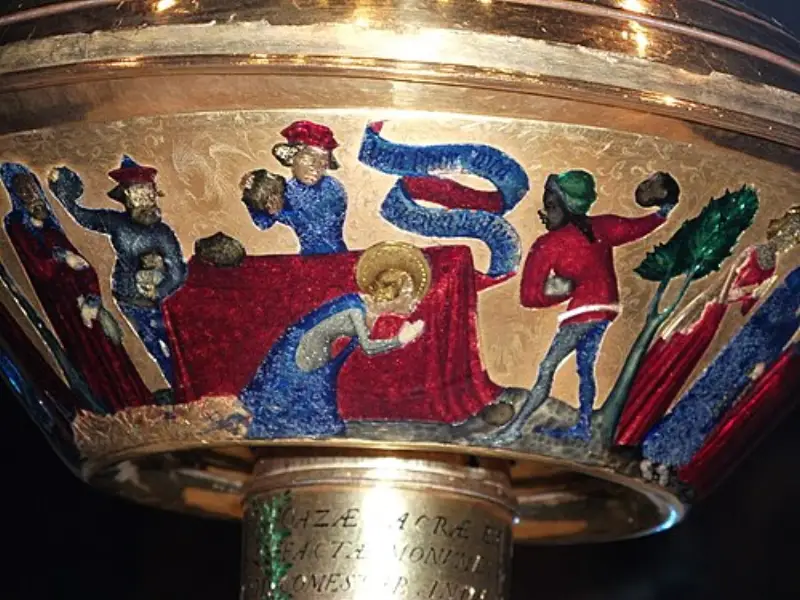
Emerentiana died around the year 304, at the start of the fourth century, though the ancient records preserve no certain date for her death. What the archaeology of Rome has confirmed is her tomb. She was buried among the Christian dead near Agnes, and her crypt in the catacombs survived the centuries until the nineteenth century, when the archaeologist Mariano Armellini, a successor in the tradition of Giovanni Battista de Rossi, discovered it and restored the material memory of the martyr to the Church. Her body is honored today in the basilica of Sant'Agnese fuori le mura in Rome, the great church that rises over the cemetery of her foster sister, so that the two girls who shared a Roman household in life share a sanctuary in death. In the church of Sant'Agnese in Agone on the Piazza Navona, an altar honors her, bearing a marble relief by Ercole Ferrata that portrays her martyrdom, showing the stones falling on the young catechumen as the baroque artists imagined it. Her likeness also appears on the Royal Gold Cup, one of the treasures of medieval goldwork, evidence of how far her cult traveled from the catacombs where it began.
§ Veneration
An Ancient and Documented Cult
Emerentiana was never canonized by decree; she belongs to the pre-congregation saints whose recognition rests on the unbroken memory of the Church. Behind the legend stands a real Roman martyr, whose cult is of very ancient date, witnessed by the old martyrologies of Jerome, Bede, and others. Jerome's martyrology formerly commemorated her feast on September 16, a date later displaced by the January 23 observance that became her standard feast in the Roman calendar. The Eastern churches also received her cult: she is venerated in Eastern Orthodoxy, including the Antiochian Orthodox Church, which keeps her memory with its own liturgical tradition. In the Western reform of 1969 her cult was confined to local calendars, so that she is now honored where her devotion has historically taken root rather than on the universal Roman calendar. The literary tradition kept her memory as well: in Cardinal Nicholas Wiseman's novel Fabiola, she makes a small appearance, seen mourning for Agnes immediately after the martyrdom, a detail that shows how naturally the sorrowing foster sister entered the imagination of later ages. From Jerome's martyrology to a nineteenth-century novel, the witness to her honor has never entirely ceased.
§ Veneration
The Saint of the Aching Body and the Young Soul
Emerentiana's legacy lives in images, places, and small devotions rather than in institutions. In art she appears as a girl with the stones of her martyrdom heaped in her lap and the lilies of her purity gathered in her other hand, both carried together in one figure, or as a maiden dying beneath a mob's stones, the moment of her witness frozen in paint and marble. The altar with Ercole Ferrata's relief in Sant'Agnese in Agone made her martyrdom part of the theatrical piety of baroque Rome, while her presence on the Royal Gold Cup carried her cult into the treasury of northern Europe. To the faithful she has been invoked for centuries against colic and stomach ache, a patronage that gave a martyr of the fourth century a place in the domestic prayers of ordinary households, and popular devotional indexes still list her against stomach problems. Her tomb in Sant'Agnese fuori le mura keeps her beside the sister whose death drew her to hers, and the discovery of her crypt by Mariano Armellini ensured that the devotion rests not only on legend but on the stone and soil of the Christian city. For catechumens and for all whose faith is real but unfinished, she remains the saint of the baptism completed by desire.
§ Veneration
Timeline
- 304
Around the start of the fourth century, stoned to death by a pagan crowd at the tomb of St. Agnes in Rome after professing her faith as an unbaptized catechumen.
§ Legend
- 1969
Her cult is confined to local calendars in the liturgical reform of that year.
§ Veneration
The Record
- Patron of
- Against stomach problems·Against colic and stomach ache
- Symbols
- A young woman with stones in her lap and lilies in her hand·A young lady being stoned to death·Her likeness on the Royal Gold Cup
- Canonization
- Pre-congregation; her cultus is very ancient, attested by the martyrologies of Jerome and Bede
Prayer
Bibliography
Show 5 sources
- Kirsch, Johann Peter. "St. Emerentiana." The Catholic Encyclopedia Vol. 5. New York: Robert Appleton Company, 1909.
- "St. Emerentiana of Rome", Antiochian Orthodox Christian Archdiocese of North America.
- Broderick, Bona F. (1897). "Mariano Armellini: De Rossi's Successor". Catholic World. 64: 84–96.
- David Farmer, Oxford Dictionary of Saints (Oxford University Press, 1996) p157.
- "St Emerentiana", The British Museum.
Profile text adapted from the Wikipedia article, licensed CC BY-SA 4.0.
Pray with this saint every day
Save St. Emerentiana to your favorites, read the full profile, and get feast-day reminders in the Saints app.
Get the Saints AppFree on the App Store for iPhone and iPad