
c. 1007-1031·Feast November 5 (September 4 in Hungary, burial of his relics)
St. Emeric of Hungary
Prince and heir to the Hungarian throne
Overview
Emeric, known in Hungarian as Szent Imre and in Latin as Emericus, was the son of Stephen I, the first Christian king of Hungary, and of Queen Giselle of Bavaria. Born around 1007, he was the only one of Stephen's sons to reach adulthood, and from boyhood he was groomed for the throne: the king composed his Admonitions as a mirror for the son he hoped would rule after him, and a Venetian Benedictine, the future Bishop Gerard, oversaw the young prince's formation in a severely ascetic spirit. In 1022 Emeric married, though the bride's identity has never been settled, with candidates proposed from Byzantine, Croatian, and Polish courts. None of the succession planning came to anything: on 2 September 1031, at about twenty-four years of age, the prince died gored by a boar during a hunt, an event presumed to have taken place at Hegyközszentimre. His body was laid to rest in the basilica of Székesfehérvár, where wonders and conversions were soon reported at his tomb. In November 1083 King Ladislaus I raised the bones in a solemn ceremony, and Emeric was declared a saint alongside his father and Bishop Gerard, honored for the innocence and piety of a life that had ended before it could reign. He is usually shown in knight's armor with a crown and a lily, and is invoked as a patron of young people and of Hungarian Americans.
The Complete Life
Family and Name
Emeric belonged to the founding generation of the Christian Hungarian kingdom. His father, Stephen I, had turned the Magyar principality into a Christian monarchy, and his mother, Giselle, came from the Bavarian ducal house that had been allied to the German emperors. The sources believe Emeric was Stephen's second son, and he was the only one to survive to manhood, which made him by default the hope of the dynasty. He bore the name of his mother's brother, Emperor Henry II, and the Hungarian form Imre is understood to descend from the Latin Henricus, a word said to carry the sense of a ruler of the household. A popular tradition links the explorer Amerigo Vespucci, and with him the naming of the Americas, to this same saint, though the evidence for such an etymology is acknowledged to be lacking.
§ Family
Formation and Marriage
The education of the heir was placed in the hands of Gerard, a Benedictine monk from Venice who would later meet his own martyrdom as bishop of Csanád. From about his fifteenth year until his twenty-third, the prince was trained in a severe, ascetic register of Christianity, an unusual schooling for a future monarch. Stephen took care to supplement it with written instruction: the Admonitions which the king addressed to his son became one of the classics of medieval Hungarian literature, and the king also worked to have Emeric acknowledged as co-ruler while he still lived. In 1022 the prince married, but the marriage is one of the puzzles of his biography, for the chronicles allow several irreconcilable brides: a relative of the Byzantine emperor Constantine IX Monomachos, a woman of the Argyros family, Patricissa daughter of King Krešimir III of Croatia, or Adelaide, also called Rixa, of Poland, or one of her sisters.
§ Education
Death and Canonization
On 2 September 1031 the heir to Hungary was gored by a boar in the course of a hunt and died at about twenty-four years of age. The place is presumed to have been Hegyközszentimre, in what is now Romania. He was buried in the Székesfehérvár Basilica, the royal church of the dynasty, and there, the tradition records, several healings and conversions took place at his tomb. On 5 November 1083 King Ladislaus I brought the bones to light in a great public rite, and in the same ceremony the pope, Gregory VII, canonized Emeric together with his father Stephen and with Bishop Gerard. The grounds given were the pious life and purity of the young prince, whose sanctity rested not on episcopal office or martyr's death but on the chastity and obedience of a layman.
§ Death and sainthood
Iconography and Memory
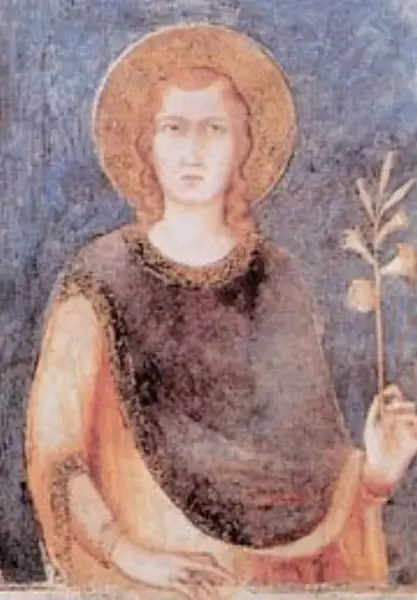
In art Emeric appears most often as a knight in armor, crowned, with a lily in his hand, the flower that marks virgin saints; his other attributes are the boar that killed him and the sword of the princely warrior. His cult has remained alive in Hungary, where a second feast on 4 September keeps the memory of the burial of his relics alongside the principal celebration of 5 November. A major shrine is dedicated to him at Székesfehérvár, and among Hungarian emigrants, particularly in the United States, he has been taken as a special patron. With his father and Bishop Gerard he forms the trio of early Hungarian saints through whom the kingdom told its own founding story of faith, and his short life has made him, across nine centuries, the archetype of the young Christian layman called to holiness in the world.
§ Death and sainthood
Timeline
- 1007
Born at Székesfehérvár, apparently the second son of King Stephen I of Hungary; he received the name of his mother's imperial brother, Henry II, and in the Hungarian form Imre the name preserves the Latin Henricus.
§ Introduction
- 1022
Educated in his youth in a strict ascetic mold by the Venetian Benedictine Gerard, from roughly his fifteenth to his twenty-third year, while his father wrote the Admonitions to ready him for the crown and sought to have him accepted as co-heir.
§ Education
- 1022
Married; historians have never agreed on the bride, proposed candidates including a kinswoman of the Byzantine emperor Constantine IX, a daughter of Krešimir III of Croatia, and Adelaide or a sister of hers from the Polish court.
§ Education
- 1031
On 2 September, while hunting, he was killed by a boar at about twenty-four years of age, assumed to be at Hegyközszentimre; the plans of his father for the succession died with him, and he was buried in the basilica at Székesfehérvár.
§ Death and sainthood
- 1083
After healings and conversions were reported at his grave, King Ladislaus I exhumed the relics on 5 November with great ceremony, and Pope Gregory VII enrolled Emeric among the saints together with Stephen I and Gerard of Csanád, in recognition of his pure and devout life.
§ Death and sainthood
The Record
- Major works
- Honored as a model of princely purity; his father's Admonitions were addressed to him as heir to the kingdom
- Patron of
- Youth·Hungarian Americans
- Symbols
- Boar·Lily stem·Sword·Knight's armor and crown
- Canonization
- Canonized in 1083 at Székesfehérvár by Pope Gregory VII
Prayer
Bibliography
Show 5 sources
- Stracke, Richard (2015-10-20). "Hungarian Saints: Adalbert, Martin, Stanislas, Emeric and Stephen". Christian Iconography.
- Sauser, E., Biographisch-Bibliographisches Kirchenlexikon, Vol. XXI, pub. Bautz, 2003, ISBN 3-88309-038-7
- "Saint Emeric, Patron Saint of Hungarian Youth". HungarianConservative.com.
- W. Swoboda, Emeryk, Słownik Starożytności Słowiańskich, t. 8, cz. 1, 1998, s. 112
- Jonathan Cohen. "The naming of America: Fragments we've shored against ourselves"
Profile text adapted from the Wikipedia article, licensed CC BY-SA 4.0.
Pray with this saint every day
Save St. Emeric of Hungary to your favorites, read the full profile, and get feast-day reminders in the Saints app.
Get the Saints AppFree on the App Store for iPhone and iPad