
died 302 (or 304)·Feast January 28
St. Emilianus of Trevi
First bishop and martyr of Trevi
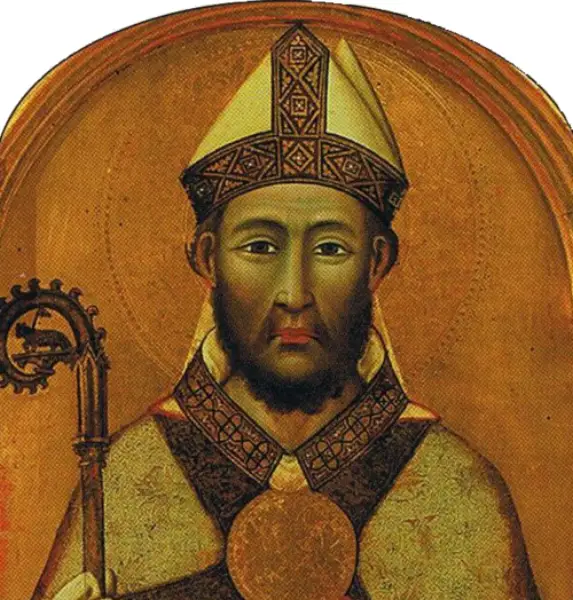
Overview
Emilianus of Trevi, known in Italian as Emiliano or Miliano and sometimes called Æmilianus, was the first bishop of the Umbrian town of Trevi and a martyr of the Diocletian persecution. A native of Armenia, he was consecrated in 296 by Pope Marcellinus to head the newly established see of Trevi. When the great persecution broke out, he refused to offer sacrifice to the Roman gods, and for this constancy he was subjected to repeated torments before being put to death on January 28, 302, or 304 by another reckoning, together with three companions. He was beheaded three kilometers from Trevi at Bovara, then a pagan sanctuary, bound to an olive tree said to endure to this day. His life is told in the Passio Sancti Miliani, preserved in manuscripts going back to the ninth century with possible witnesses from the fifth or sixth. His body was carried to Spoleto and buried there; the relics, lost during the disorders of the Middle Ages, came to light again in 1660 during restoration of Spoleto Cathedral, where they remain. He is patron of Trevi, and his feast on January 28 is kept with an eve-night torchlit procession.
The Complete Life
From Armenia to an Umbrian See
Almost everything known of Emilianus comes from a single narrative, the Passio Sancti Miliani, an account of his passion whose textual history is itself remarkable. Two complete manuscripts transmit it: one copied in the ninth century and kept at Montecassino, the other written in the twelfth century and preserved in the archives of Spoleto Cathedral. Alongside these stand fragments that may descend from an even older document of the fifth or sixth century, suggesting that the story of the martyr reaches back close to the events it records. According to this tradition Emilianus was originally from Armenia, the mountain kingdom beyond the empire's eastern frontier that would soon become the first Christian nation. How he traveled from there to central Italy the Passio does not plainly say, but by 296 he stood before Pope Marcellinus in Rome and received episcopal consecration as the first bishop of Trevi, a hill town in Umbria. The office itself was newly established, and Emilianus held it without predecessor, governing the young community through the final, most dangerous decade of the third century, as the emperor Diocletian's resolve to destroy the Church hardened toward the storm of 303.
§ Life
The Refusal and the Torments
When the persecution of Diocletian reached Umbria, Emilianus was summoned to perform sacrifice to the Roman gods, the test by which the authorities separated compliant citizens from stubborn Christians. He refused. What followed, the Passio records as a sequence of torments that failed to kill him before the sword did. The martyr's trial and execution are preserved in stone as well as text: a five-panel sculpture of the late twelfth century, cut into reworked blocks of late-antique column shafts and kept today in the Museo Nazionale del Ducato at Spoleto, tells the whole story. On it the proconsul pronounces the death sentence; the bishop undergoes the lash; his tormentors then ready a fire to burn him, but frost stiffens their fingers and snuffs their torches; wild beasts are set upon him, yet instead of attacking they kneel; and at the last he is fastened to an olive tree and beheaded. The death came on January 28, dated 302 in one tradition and 304 in another, three kilometers from Trevi at Bovara, a place then sacred to pagan worship. Three companions were executed with him. The olive tree to which he was tied, the account affirms, is said still to exist.
§ Life
Burial, Loss, and Rediscovery
After the execution the martyr's body was transported from Bovara to nearby Spoleto and buried there, beginning a second, quieter phase of his cult in the larger neighboring city. The Middle Ages were unkind to his remains: amid the tumult of those centuries the relics were forgotten, whether hidden by careful hands or carried off by thieves no record now determines, and for generations the martyr's grave was unknown. The silence ended in 1660, when restoration work on Spoleto Cathedral brought the lost remains to light once more. They have been preserved in the cathedral ever since, and their rediscovery reconnected the modern city with its ancient patron. The memory of the execution itself stayed fixed at Bovara, where tradition locates the very olive tree of the beheading; the image of the bishop bound to that tree and beheaded became the saint's standard iconography, rendered in the fourteenth century by Meo di Siena and reproduced in the panels of the Spoleto sculpture. Trevi and Spoleto thus divide between them the two halves of his story, the death and the burial, each guarding its own relic of the martyrdom.
§ Life
Patron of Trevi
Emilianus remains the principal patron of Trevi, where his feast is kept on January 28 with celebrations the sources describe as reaching back to remote antiquity. The centerpiece of the observance is the Processione dell'Illuminata, a nocturnal procession held on the eve of the feast, January 27, which turns the winter streets of the town into a river of light in honor of the bishop who refused the empire's darkness. Beyond Trevi the saint is honored also at Ripa, a district of Perugia, where his feast is transferred to the Sunday nearest January 28 so that the community may keep it together. Devotion to him joined his name to a wider roll of early martyrs of the Italian peninsula, and his story traveled through the Passionaries alongside those of the other Diocletian-era bishops. For the modern visitor his presence is still tangible: in the cathedral of Spoleto where his relics rest, in the museum panels that narrate his torments, at Bovara beneath the ancient olive, and each January in Trevi, when a town of a few thousand people walks at night behind the lights, as it has for as long as anyone can remember.
§ Cult
Timeline
- 296
Originally from Armenia, he was consecrated by Pope Marcellinus as the first bishop of Trevi.
§ Life
- 28 Jan 302
Martyred under Diocletian: after refusing sacrifice to the Roman gods he was beheaded at Bovara, bound to an olive tree, with three companions (some sources say 304).
§ Life
- 500
Copies, possibly from the fifth or sixth century, preserve an older account behind the surviving Passio Sancti Miliani.
§ Life
- 1180
Late in the twelfth century a five-panel sculpture of his trial and execution was carved from re-used late-antique columns.
§ Life
- 1660
His forgotten relics were rediscovered during restoration work on Spoleto Cathedral and remain preserved there.
§ Life
The Record
- Patron of
- Trevi
- Symbols
- bishop tied to an olive tree at the moment of beheading
- Canonization
- Pre-congregation; martyred under Diocletian and venerated from antiquity
Prayer
Bibliography
Show 3 sources
- Spellani, Franco (2003). "Sant'Emiliano di Trevi". Santi e Beati (in Italian). Retrieved 6 January 2025
- Benigni, Umberto (1911), "Spoleto", The Catholic Encyclopedia, New York: Robert Appleton Company
- "Processione dell'Illuminata o di Sant'Emiliano". Pro Trevi (in Italian). 2011. Retrieved 6 January 2025
Profile text adapted from the Wikipedia article, licensed CC BY-SA 4.0.
Pray with this saint every day
Save St. Emilianus of Trevi to your favorites, read the full profile, and get feast-day reminders in the Saints app.
Get the Saints AppFree on the App Store for iPhone and iPad