
c. 975 – 1038·Feast April 19 or December 3
St. Emma of Lesum
Saxon countess beloved for her good works
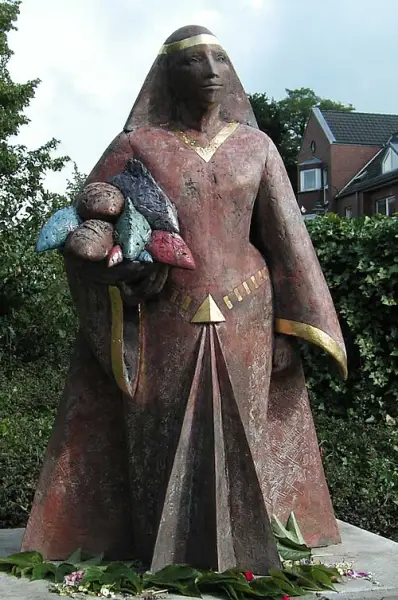
Overview
Emma of Lesum, also called Emma of Stiepel and known in various records as Hemma or Imma, was a Saxon countess of the tenth and eleventh centuries whose charity earned her a lasting place among the beloved holy women of northern Germany. Born around 975 to 980 in the Duchy of Saxony, she married Liudger of Saxony and spent her life in the region around Lesum, today part of Bremen-Burglesum. She died there on December 3, 1038. Though no formal process of canonization was ever conducted, the people of the region honored her as a saint on account of her good works, and her memory took root in both the Roman Catholic and Eastern Orthodox traditions. Her remains were venerated at Werden Abbey and at Bremen Cathedral, which served as centers of her cult. Emma holds a particular distinction in the history of her adopted city: she is the first female inhabitant of Bremen known to us by name, a quiet pioneer whose generosity, rather than rank or power, preserved her memory across nearly a millennium.
The Complete Life
A Countess of Saxony
Emma came into the world in the closing decades of the tenth century, around 975 to 980, in the Duchy of Saxony, one of the great principalities of the German kingdom. Of her family and childhood the surviving records say little; her story, as later generations preserved it, begins with her marriage to Liudger of Saxony, a man of the same noble Saxon world. Through this union she belonged to the aristocracy that dominated the lands between the Rhine and the Elbe in the age of the Ottoman emperors. Her principal seat and the scene of her widowhood was Lesum, an estate on the Weser that now forms part of Bremen-Burglesum. There, in the shadow of the cathedral city, her reputation for charity took root and grew. In that place, on the edge of the growing city of Bremen, she spent her mature years. It is a measure of how early her life falls in the city's recorded history that Emma stands as the first female inhabitant of Bremen whose name has come down to us, a distinction owed entirely to the reputation for holiness that grew around her memory after her death.
§ Emma of Lesum
The Saint of Good Works
Emma died at Lesum on December 3, 1038. No pope ever inscribed her name in the catalogue of the saints, and none was needed: the faithful of the region venerated her spontaneously as a saint on account of her good works, the old and unforced form of recognition by which the Church first honored its heroes. Her cult took root in both the Roman Catholic and the Eastern Orthodox churches, and her memory was kept on two dates, April 19 and December 3, the second being the day of her death. Her remains drew pilgrims to two centers of devotion, Werden Abbey and the cathedral of Bremen, both of which preserved her as a local patroness. That a countess remembered for deeds of charity, rather than for martyrdom or miraculous founder ship, should have been so honored tells us much about the faith of medieval Saxony, which saw in her generosity the Gospel made visible. Nearly a thousand years later she remains Bremen's first recorded Christian woman and one of its most enduring intercessors, remembered for kindness rather than for rank, and loved for it all the more.
§ Emma of Lesum
Timeline
- 975
Born in the Duchy of Saxony between about 975 and 980.
§ Introduction
- 3 Dec 1038
Died at Lesum, now Bremen-Burglesum, on 3 December.
§ Introduction
The Record
- Canonization
- Popularly venerated as a saint for her good works; never formally canonized
Prayer
Bibliography
Show 2 sources
- Schwarzwälder, Herbert, 2003: Das Große Bremen-Lexikon. Edition Temmen. ISBN 3-86108-693-X
- Ekkart Sauser (1999). "Emma of Lesum". In Bautz, Traugott (ed.). Biographisch-Bibliographisches Kirchenlexikon (BBKL). Vol. 16. Herzberg: Bautz. cols. 453–454. ISBN 3-88309-079-4
Profile text adapted from the Wikipedia article, licensed CC BY-SA 4.0.
Pray with this saint every day
Save St. Emma of Lesum to your favorites, read the full profile, and get feast-day reminders in the Saints app.
Get the Saints AppFree on the App Store for iPhone and iPad