
died 375·Feast May 30
St. Emmelia of Caesarea
Mother of the Cappadocian saints
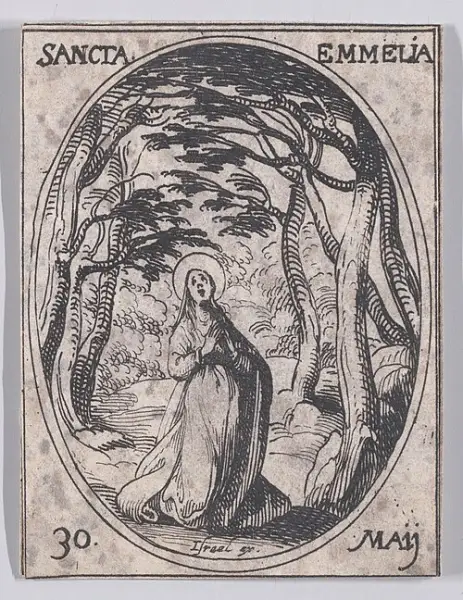
Overview
Emmelia of Caesarea, whose name survives also as Emilia or Emily, was born in the late third or early fourth century in Caesarea of Cappadocia, in the era when Christianity's rapid spread was beginning to challenge the pagan order of the Roman state. She became the wife of Basil the Elder, and the Roman Martyrology records that the couple endured banishment to the solitudes of Pontus under the emperor Galerius Maximian before returning in peace after the persecution. Emmelia bore nine or ten children, and her motherhood became one of the most fruitful in the history of the Church: among her offspring were Basil the Great, Gregory of Nyssa, Peter of Sebaste, the virgin Macrina the Younger, and Naucratius. Widowed in due course, she spent her later years in her daughter Macrina's household, where the two women led an ascetic life, treating their servants as equals and drawing a community of women into a convent-like fellowship. Emmelia died on May 30, 375, at Caesarea, and is honored as a saint in both the Catholic and Orthodox churches, under her ancient title of Mother of Saints.
The Complete Life
A Christian Home in Cappadocia
Emmelia was born in the late third or early fourth century, in the city of Caesarea in Cappadocia, at a moment when the Christian faith, spreading quickly across the empire's eastern provinces, had begun to unsettle the Roman state and its ancestral pagan order. The Christianity of her upbringing was thus a faith under pressure, tested by suspicion and periodically by open persecution. She became the wife of Basil the Elder, a Christian of the same provincial nobility, and with him she raised an extraordinarily large family, nine or ten children in all. The Roman Martyrology, in its entry for May 30, preserves the memory that the holy spouses were driven from their home in the days of Galerius Maximian and lived as exiles in the wildernesses of Pontus, returning only after the persecution had passed. That trial did not break the family; the same ancient text says that the couple left their children heirs of their virtues and died in peace. Of Emmelia's own parents less is recorded, though the sanctity of her connections ran deep on all sides, for her mother-in-law Macrina the Elder is likewise honored as a saint.
§ Emmelia of Caesarea
Mother of Saints
The great work of Emmelia's life was her family, and few mothers in Christian history have produced such a harvest. Her eldest children included Basil of Caesarea, born around 330, who would become Basil the Great, doctor of the Church and father of Eastern monasticism; Gregory, who as Gregory of Nyssa became one of the most penetrating theologians of the ancient church; Peter, who served as Bishop of Sebaste; and Macrina the Younger, the virgin and teacher whose holiness shaped them all. Another son, Naucratius, is also counted among her children. The Martyrology of 1749, quoting the old Latin tradition, names these very children as the blessed progeny of Basil and Emmelia, a testimony to how completely the family came to symbolize Christian nurture. Veneration of Emmelia herself followed naturally in both East and West, where she is honored under the expressive title Mother of Saints. Her daughter Theosebia, a deaconess, is celebrated as a saint in Eastern Orthodoxy and as a blessed in the Catholic Church, extending the family's witness into a third generation of honored holiness alongside her grandmother Macrina the Elder.
§ Emmelia of Caesarea
The Ascetic Household at Annisa
After the death of her husband, Emmelia's life took on a new and quietly radical shape. She went to live with her eldest daughter, Macrina the Younger, whose influence over her mother the sources describe as profound. Together the two women dedicated themselves to a Christian life of renunciation, and they insisted on treating the servants around them as equals, dissolving within their household the usual barriers between mistress and slave. Their manner of living attracted a following of women, and the household grew into something like a convent, a community in which wealth was reckoned in a new currency: among them the richest woman was the one whose life was pure and devout, while possessions and passing pleasures counted as nothing. In this atmosphere Emmelia passed her final years, the matriarch of a domestic monastery that had sprung from her own family. She died on May 30, 375, at Caesarea in Cappadocia, the city of her birth, leaving behind her a family whose sanctity would instruct the Church for centuries, and a memory honored every May 30 in the West and on other days among the Eastern churches.
§ Emmelia of Caesarea
Timeline
- 300
Born in the late third or early fourth century, when Christianity was spreading in defiance of Roman pagan rule.
§ Introduction
- 330
Bore Basil, the future Basil the Great, around this time, one of her nine or ten children.
§ Introduction
- 30 May 375
Died at Caesarea in Cappadocia on 30 May, after ascetic years with her daughter Macrina the Younger.
§ Introduction
The Record
- Patron of
- mothers
- Symbols
- Mother of Saints
- Canonization
- Pre-congregation; venerated since antiquity by both East and West
Prayer
Bibliography
Show 5 sources
- Brown, Peter (2008-07-03) [1988]. The Body and Society: Men, Women, and Sexual Renunciation in Early Christianity. Columbia Classics in Religion (Twentieth-anniversary ed.). Columbia University Press. ISBN 978-0231144070
- Velimirovic, Nikolai (2002). The Prologue from Ohrid: Lives of Saints, Hymns, Reflections and Homilies for Every Day of the Year (Volume 1: January to June). Serbian Orthodox Eparchy of Western America. ISBN 9780971950504
- Bowersock, Glen Warren; Brown, Peter; Grabar, Oleg, eds. (1999). Late Antiquity: A Guide to the Postclassical World. Harvard University Press. p. 336. ISBN 978-0-67451-173-6
- Pope Benedict XIV (1749). "Martyrologium Romanum - 30 May"
- Gregory of Nyssa: The Life of Macrina, trans. by W.K. Lowther Clarke, (London: SPCK, 1916)
Profile text adapted from the Wikipedia article, licensed CC BY-SA 4.0.
Pray with this saint every day
Save St. Emmelia of Caesarea to your favorites, read the full profile, and get feast-day reminders in the Saints app.
Get the Saints AppFree on the App Store for iPhone and iPad