
died 652·Feast September 22
St. Emmeram of Regensburg
Missionary bishop and martyr of Bavaria
Overview
Emmeram of Regensburg, known by many name forms from Emeramus to Heimeran, was a bishop born at Poitiers in Aquitaine who became one of the apostles of Bavaria. Hearing reports of idolatry in the duchy, he set out sometime after 649 for the court of Theodo I at Regensburg, traveling up the Loire, across the Black Forest, and down the Danube. The duke received him warmly, and for three years Emmeram preached through the region, winning a reputation for piety and founding the monastery that later bore his name. His death came on a journey toward Rome. At the village now called Kleinhelfendorf, below Munich, Lantpert, Theodo's son, fell upon him, tortured him, and left him to die; he perished soon after at Aschheim on September 22, 652. The legend connects his fate with the pregnancy of the duke's daughter Uta, a tale that later writers judged largely invented. His remains were laid in Aschheim, then, by the famous story of the raft on the Isar, carried to Regensburg, where they rest today in St. Emmeram's Abbey. Gregory XVI canonized him in 1833; Bavaria honors him as a martyr under his emblem of a ladder.
The Complete Life
A Noble of Aquitaine
Emmeram was born at Poitiers in Aquitaine into a noble family, though the date of his birth has not survived. The principal source for his life is the Vita Sancti Emmerami, written around 750 by Arbeo of Freising, roughly a hundred years after the saint's death; all later accounts rest on this narrative, and its pious embellishments are freely acknowledged even by those who treasure it. According to Alban Butler and the other traditional biographers, Emmeram rose to be Bishop of Poitiers, though the claim cannot be verified, and some scholars have speculated that if he held the office at all it was briefly, in the gap between the death of Bishop Dido and the accession of Ansoaldus. Whatever his exact rank, he stood high in the Frankish church of his day. The story of his vocation turns on a rumor: word reached him of idolatry in Bavaria, the still only half-Christianized duchy east of the Lech, and the report decided the course of his life. Rather than remain in comfort among the churches of Aquitaine, he resolved to carry the Gospel to the Danube, a journey of many weeks across rivers and forests.
§ Life
Three Years at the Court of Theodo
Setting out some time after the year 649, Emmeram made his way toward Regensburg, the Ratisbon of the sources, where the Agilolfing duke Theodo I held court. The itinerary preserved by tradition has a pilgrim's shape: he traveled up the Loire, crossed the Black Forest, and then followed the Danube downstream to the ducal capital. Theodo welcomed him, and the wandering bishop found his field of labor. For three years he carried out missionary work in the duke's lands, and during that time he gained a reputation as a man of conspicuous piety. His most lasting foundation was a monastery that later took his own name, the house known to history as St. Emmeram's Abbey in Regensburg, which would grow into one of the great religious and scholarly centers of southern Germany. The mission years represent the fruitful middle of his life, the period the Bavarian church remembered when it called him its apostle. Yet the sources insist that he did not end his days among his converts: restless for the sources of his faith, he determined to make a pilgrimage to Rome, and it was on that journey that he met his death.
§ Life
The Legend of Uta and the Road to Martyrdom
Arbeo's narrative ties the martyrdom to a family secret. Theodo's daughter Uta came secretly to Emmeram and confessed that she had conceived a child outside marriage; the father, she admitted, was Sigipaldus of her father's court. Moved to compassion, the bishop counseled her to name himself, a man whom everyone respected, so that her shame might be lightened. Soon afterward Emmeram left abruptly on his pilgrimage to Rome, and Uta, whether from fear or obedience to his counsel, named him as the father. When Theodo and his son Lantpert learned what had been said, Lantpert pursued the bishop and overtook him at Helfendorf, beside the Roman highway that once ran from Salzburg to Augsburg — the Via Julia Augusta — and hailed him with the words bishop and brother-in-law. Popular tradition holds that Emmeram, wanting to shield the real culprit, offered no defense. Lantpert and his followers tied him to a ladder, tortured him, and beheaded him; his companions Vitalis and Wolflete found him lying in his blood and carried him toward Aschheim, where a walled church of the Apostle Peter stood. He died there on September 22, 652. Later writers judge these dramatic details historically untrue, embellishments added to the glory of a martyr whose genuine circumstances remain unknown.
§ Legend
Ever Green: The Cult of the Place
Popular devotion surrounded the martyr's death with images of paradise restored. Arbeo of Freising described the spot where he died as a lovely place that stayed green through every season, where a spring broke from the ground and the local people in time raised a little church. A Munich devotional book of 1743, offering daily prayers to the Bavarian apostle and blood-witness of Christ, told of the two hundred men and women who followed the dying saint's cart with prayer, of his halt half an hour from Aschheim because his heavenly reward stood before him, and of the meadow where he gave up his spirit, a place where wonders, the text claimed, still occurred. The same piety marked his burial. When the truth of the Uta affair came to light, legend says, rain fell over Aschheim for forty days; the body was exhumed, laid upon a raft on the Isar, and borne against the current to the Danube and so to Regensburg, where Emmeram found his resting place in the church of St. George — a story with a close cousin in the legend of Lubentius of Dietkirchen. Whatever the historian makes of these accounts, they record a devotion that fastened on springs, meadows, and rivers as much as on tombs.
§ Veneration
The Abbey and the Relics
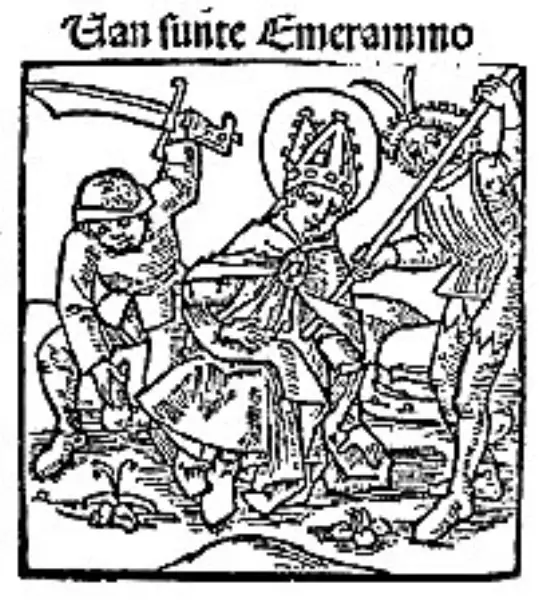
In the end the martyr's bones found a home in a church that bore his own name as its dedication, the beginning of the great St. Emmeram's Abbey in Regensburg, one of the most important monastic centers of medieval Germany, so celebrated that its library drew scholarly notice into modern times. Fire struck that church in 1642, but in 1645 the saint's bones were uncovered beneath the altar, and they were translated to the abbey, where his leg bones lie in a silver reliquary set below the altar at its eastern end; that church, raised since to the rank of minor basilica, remains the chief shrine of his cult. Memory of the martyrdom persisted in the countryside south of Munich as well: a chapel was erected in 1842 at the spot where he died, the church of St. Lorenz at Oberföhring keeps a side altar in his honor, and a plaque at the church of Saints Peter and Paul in Aschheim memorializes his first grave with an inscription. Pope Gregory XVI canonized him in 1833 at Regensburg. He is invoked as patron of Regensburg and of Bavaria, and artists from the 1484 woodcut in the incunabula of Steffen Arndes to the 1774 high altarpiece by Franz Xaver König have fixed his emblem: the bishop carrying a ladder.
§ Veneration
Timeline
- 649
Set out some time after this year from Poitiers for Bavaria, reaching the court of Duke Theodo I at Regensburg.
§ Life
- 22 Sep 652
Attacked and tortured by Lantpert at Kleinhelfendorf, he died of his wounds at Aschheim on 22 September.
§ Legend
- 750
Arbeo of Freising composed the Vita Sancti Emmerami, roughly a century after the saint's death.
§ Life
- 1642
The Regensburg church holding his remains burned down.
§ Veneration
- 1645
His bones were found beneath the altar and moved to St. Emmeram's Abbey.
§ Veneration
- 1743
A Munich-printed prayer office, the Officium oder Tageszeiten, attested popular devotion at his shrine.
§ Veneration
- 1833
Canonized at Regensburg by Pope Gregory XVI.
§ Introduction
- 1842
A small chapel was erected at Helfendorf, the spot where he died in 652.
§ Veneration
In Their Own Words
men and women of two hundred persons with great sympathy and prayer
bishop and brother-in-law
The Record
- Major works
- Monastery later known as St. Emmeram's Abbey, Regensburg
- Patron of
- Regensburg·Bavaria
- Symbols
- carrying a ladder
- Canonization
- Canonized in 1833 at Regensburg by Pope Gregory XVI
Prayer
Bibliography
Show 6 sources
- Clugnet, Léon. "St. Emmeram." The Catholic Encyclopedia Vol. 5. New York: Robert Appleton Company, 1909
- Butler, Alban. "Saint Emmeran, Bishop of Poitiers, Martyr". Lives of the Fathers, Martyrs, and Principal Saints 1866. CatholicSaints.Info
- Kyle, Joseph D. "The Monastery Library at St. Emmeram (Regensburg)." The Journal of Library History (1974-1987), vol. 15, no. 1, University of Texas Press, 1980, pp. 1–21
- "Sant'Emmerano di Ratisbona su santiebeati.it". Santiebeati.it. Retrieved 14 September 2020
- "Internet History Sourcebooks: Medieval Sourcebook". sourcebooks.fordham.edu
- Röhrer-Ertl, O. (1981). "Observations on the identification of Holy Emmeram at St. Emmeram's Church in Regensburg. Critical comparison". Anthropologischer Anzeiger. 39 (3): 173–188. PMID 7034635
Profile text adapted from the Wikipedia article, licensed CC BY-SA 4.0.
Pray with this saint every day
Save St. Emmeram of Regensburg to your favorites, read the full profile, and get feast-day reminders in the Saints app.
Get the Saints AppFree on the App Store for iPhone and iPad