
c. 279 – c. 309·Feast August 5
St. Emygdius
Bishop and protector against earthquakes
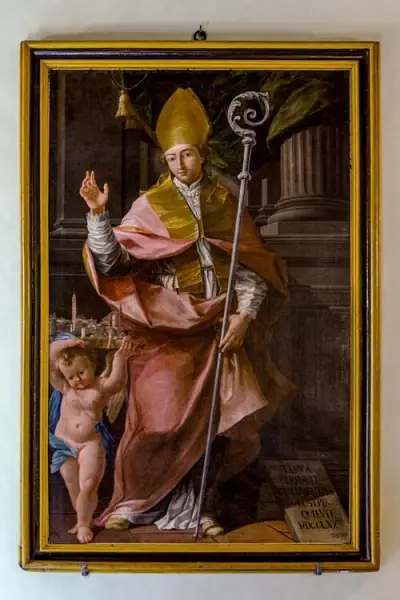
Overview
Emygdius, in Italian Sant'Emidio, was a bishop and martyr of the early fourth century, tradition placing his death in the persecution of Diocletian. His hagiography took its present shape most likely in the hands of a Frankish monk of the eleventh century, working once the saint's relics had been found again, and it bears the name of his companion Valentius; it recounts that a pagan born at Trier embraced the Christian faith and made his way to Rome, and there cured the paralyzed daughter of his host Gratianus and a blind man besides. The Romans, supposing him a son of Apollo, carried him to the Temple of Asclepius on the Tiber Island, where he healed many, declared himself a Christian, and smashed the pagan altars. Consecrated a bishop by Pope Marcellus I, or Marcellinus, he was sent to Ascoli Piceno, converting multitudes and giving baptism to Polisia, the governor Polymius's daughter, in the waters of the Tronto. The enraged governor beheaded him on the spot where the Sant'Emidio Rosso temple now stands, together with his companions Eupolus, Germanus, and Valentius. His bones were brought up to the crypt of Ascoli's cathedral around the year 1000, and after the earthquake of 1703 spared the city, he became Italy's great protector against earthquakes.
The Complete Life
A Convert from Trier
Emygdius began life as a pagan of Trier, the imperial city on the Moselle, around the year 279. His conversion to Christianity transformed him into a healer and evangelist whose reputation quickly traveled beyond his homeland. The story of his call unfolds in Rome, where he took lodging with a man named Gratianus on the Tiber Island. Finding the household's daughter paralyzed, Emygdius cured her, and Gratianus and his whole family accepted the Christian faith as a result. A second miracle, the healing of a blind man, fixed the city's attention on the young stranger. The Romans of the legend, still thinking in the categories of their temples, concluded that he must be a son of Apollo, and by force they carried him off to the Temple of Asclepius on the island, expecting the god's son to exercise his healing craft there. He cured many of the sick who crowded the shrine, but then he did what no son of Apollo would do: he declared himself a Christian, tore down the pagan altars, and destroyed the statue of Asclepius itself. His conversions multiplied, and the fury of the city prefect fell upon him.
§ Life
Bishop and Wonderworker at Ascoli
From the turmoil in Rome the story moves to an episcopal commission: Emygdius was made a bishop by Pope Marcellus I, though another tradition names Marcellinus, and sent to Ascoli Piceno in the Picene Apennines. The journey there became a procession of conversions. Along the way he performed the miracle for which his cult is best remembered in the region: striking a cliff, he made water gush from the mountain. At Ascoli the local governor Polymius tried to win him over with honors rather than threats, urging him to worship Jupiter and Angitia, the goddess who was Ascoli's own patroness, and offering him the hand of his daughter Polisia in marriage. Emygdius answered the offer in a fashion the governor never intended: he gave the young woman baptism in the Tronto's flowing water, and with her a great company of other converts. The baptism of the governor's daughter was the last provocation. Enraged, Polymius condemned the bishop to death, and the place of execution is still shown to pilgrims: the spot now occupied by the round temple of Sant'Emidio Rosso above the city.
§ Life
Martyrdom and the Legend of the Head
The Passion relates that Polymius had Emygdius beheaded on the mountainside, together with three faithful companions: Eupolus, Germanus, and Valentius. With the martyrdom comes the legend that defines the saint's iconography in Ascoli. Emygdius, it is said, stood up after his beheading, gathered his own head in his hands, and carried it to a spot on the mountain where he had built an oratory, the site of the present church of Sant'Emidio alle Grotte. The tale belongs to the old family of cephalophore legends, in which the martyrs' bodies testify to the injustice of their deaths, and it fixed forever the image of the saint holding his head. The violence did not end with the execution. Emygdius' followers, the account continues, attacked the palace of Polymius and pulled it down, a rare notice of the Christian community taking vengeance of a kind. The disciple Valentius, martyred at his side, was later named as the author of the saint's hagiography, though scholars judge the surviving text the work of a Frankish monk of the eleventh century, writing after the rediscovery of the relics conserved in a Roman sarcophagus.
§ Life
Protector Against the Shaking Earth
The distinguishing devotion to Emygdius grew out of catastrophe. In 1703 a violent earthquake devastated the Marche, but Ascoli Piceno stood unharmed, and the city attributed its deliverance to its bishop and martyr. From that day Emygdius has been invoked against earthquakes, and his attributes record the office: in art he supports a crumbling wall or building, holding the falling masonry apart by his intercession. Ascoli dedicated a church to him in 1717, and other towns appointed him patron in the following decades, raising statues in their churches at L'Aquila in 1732, Cingoli in 1747, San Ginesio in 1751, and Nocera Umbra in 1751. His protection crossed the ocean: all Catholic churches in the State of California are required to commemorate his feast day, asking his protection against earthquakes, and he is named co-patron of Los Angeles and patron of Guardiagrele and Naples. The older traditions of deliverance remained alive beside the newer one. In 409, men said, a blinding apparition of the saint turned Alaric away from Ascoli's walls, and when the troops of Conrad II brought plague through the region in 1038, Bishop Bernardo I's invocation of Emygdius was credited with stopping it. In 1943, during the Second World War, the city again credited him with its safety.
§ Veneration
The Cult of Sant'Emidio
The cult of Saint Emygdius is ancient and uninterrupted, documented by churches bearing his dedication from the eighth century onward. His relics, preserved after the martyrdom in a Roman sarcophagus and kept in the catacomb beneath the church of Sant'Emidio alle Grotte, were probably translated around the year 1000 by Bernardo II, bishop of Ascoli Piceno, to the crypt of the city's cathedral, where they remain the heart of the diocese's life. The eleventh-century hagiography that carried his story through the Middle Ages was attributed to Valentius, the companion martyred with him, giving the narrative the authority of an eyewitness. Ascoli built its sacred topography around him: the Sant'Emidio Rosso temple marks the place of execution, Sant'Emidio alle Grotte the oratory to which the legend says he carried his head, and the cathedral crypt the resting place of the relics. Artists of the Renaissance gave his cult enduring images, most famously Carlo Crivelli's Annunciation with St. Emygdius of 1486. His feasts are kept on August 5 and August 18, and from the Marche to California the trembling earth has a patron whose own steadfastness, the faithful believe, no catastrophe can shake.
§ Veneration
Timeline
- 279
Born at Trier, into paganism, around this date.
§ Introduction
- 309
Beheaded at Ascoli Piceno by order of governor Polymius, together with companions Eupolus, Germanus, and Valentius, tradition placing his death in Diocletian's persecution.
§ Introduction
- 409
A dazzling vision of Emygdius was credited with turning Alaric I away from destroying Ascoli.
§ Veneration
- 1000
His bones were carried out of the Sant'Emidio alle Grotte catacomb into the cathedral crypt, most likely under Bishop Bernardo II.
§ Veneration
- 1038
The troops of Conrad II passing through with the plague were stopped, it was believed, after Bishop Bernardo I invoked his aid.
§ Veneration
- 1703
A violent earthquake devastated the Marche but left Ascoli Piceno unharmed; the city attributed its survival to him and thereafter invoked him against earthquakes.
§ Veneration
- 1717
Ascoli Piceno dedicated a church to Emygdius in thanksgiving.
§ Veneration
- 1732
L'Aquila erected a statue in his honour, appointing him patron.
§ Veneration
- 1747
Cingoli erected a statue in his honour, appointing him patron.
§ Veneration
- 1751
San Ginesio erected a statue in his honour, appointing him patron.
§ Veneration
- 1751
Nocera Umbra erected a statue in his honour, appointing him patron.
§ Veneration
- 3 Oct 1943
Credited with protecting Ascoli Piceno from German movements against Italian partisans during the Second World War.
§ Veneration
The Record
- Patron of
- Ascoli Piceno·Guardiagrele·Naples (co-patron)·Los Angeles·invoked against earthquakes
- Symbols
- episcopal robes·palm·supporting a crumbling wall or building
- Canonization
- Pre-congregation; ancient cult documented by churches dedicated to him from the eighth century
Prayer
Bibliography
Show 4 sources
- "Sant'Emidio Martire"
- Comune di Ascoli Piceno
- Abruzzo Heritage
- "Sant'Emidio"
Profile text adapted from the Wikipedia article, licensed CC BY-SA 4.0.
Pray with this saint every day
Save St. Emygdius to your favorites, read the full profile, and get feast-day reminders in the Saints app.
Get the Saints AppFree on the App Store for iPhone and iPad