
c. 450 – c. 530·Feast March 21
St. Enda of Aran
Warrior-king turned patriarch of Irish monasticism
Overview
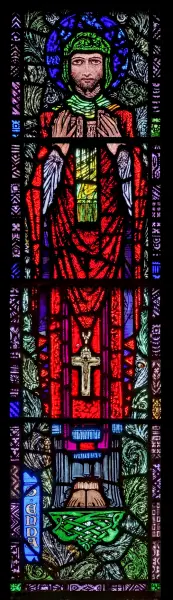
Enda, whose Irish name is given as Éanna, Éinne or Endeus, was an Irish saint of the fifth and sixth centuries, remembered as the father of Irish monasticism. A prince of Oriel in Ulster and son of Conall Derg, he took up arms and succeeded his father as a warrior-king, until his sister Fanchea, an abbess, persuaded him to abandon conquest for Christ. After studying for the priesthood at Ailbe's monastery at Emly and taking vows at the great monastic centre of Rosnat in Britain, he returned to Ireland ordained. Around the year 484 his brother-in-law Aengus, King of Munster, granted him land on the Aran Islands, where he founded the monastery of Killeaney on Inis Mór, regarded as the first Irish monastery. The settlement imitated the austerity of the Egyptian desert fathers: monks lived in stone cells, slept on the ground, ate in silence and supported themselves by farming and fishing. Enda divided the island among religious houses, and Aran became a school of saints, counting Brendan the Navigator, Jarlath of Tuam, Finnian of Clonard and Columba among those connected with it. He died in old age around 530 and is buried at Tighlaghearny on Inishmore.
The Complete Life
A Prince of Oriel
Enda came of royal blood. The Martyrdom of Oengus records that he was an Irish prince, son of Conall Derg of Oriel, a kingdom in the north of Ireland that older writers call Ergall. When his father died, the story runs, the young man succeeded him as king and rode out to wage war on his enemies, a warrior accustomed to command. His home territory lay in Meath and the northern provinces, a world of rival dynasties, cattle raids and shifting alliances, in which the Christian faith was still establishing its hold over the old order. Into this world of arms came a very different influence: his sister Fanchea, who had given her life to God as an abbess. The tales told of Enda's early years and of his sister belong, as the tradition itself admits, to legend rather than sober history; more authentic accounts of his life survive at Tighlaghearny on Inishmore, where his grave was honoured. Yet the outline they preserve has shaped his memory for fifteen centuries: a king's son, trained to fight, whom God claimed for a kingdom not of this world.
§ Early life and conversion
The Corpse That Changed a King
Fanchea never ceased trying to persuade her brother to lay down his arms. On one visit Enda bargained with her: he would renounce his dreams of conquest if she would give him a young girl from her convent in marriage. She consented, but the girl proved to have just died, and the abbess led her warrior brother to view the corpse, forcing him to look upon what his bride had become, so that he might learn what he himself must one day face: death and judgment. The lesson struck home. Confronted with the reality of mortality and softened by his sister's pleading, Enda resolved to study for the priesthood. He began at the monastery of St Ailbe at Emly in Tipperary, one of the great schools of the early Irish Church. Fanchea then sent him on to Rosnat, a celebrated school of the religious life across the sea in Britain; there he received the habit and, in due course, priestly orders. The man who had once led fighting men now bent all his energies toward prayer, discipline and Scripture, readying himself for the achievement that would make his name immortal: the planting of monastic Ireland.
§ Early life and conversion
The First Irish Monastery
Once back on Irish soil he first raised a church at Drogheda, yet his destiny called him out among the Atlantic breakers. Around the year 484 his brother-in-law Aengus, King of Munster, granted him land in the Aran Islands, three limestone outcrops stretching across the mouth of Galway Bay. There, at Killeany on Inis Mór, Enda established the monastery that tradition regards as the first Irish monastery, and with it a movement that would define Irish Christianity for centuries. He placed the settlement under a severe and orderly rule, dividing the day into fixed periods of prayer, labour and sacred study. A house in the valley of the Boyne and several more foundations besides were also his work, and he ordered the island itself for God: first splitting it between Killeany and the foundations of his disciples, then dividing it into eight parts, each with its place of refuge. Along with Finnian of Clonard he is honoured as a father of Irish monasticism, and the settlement he planted became a miniature Mount Athos, a dozen monasteries strong, drawing future saints across the sea to learn at his feet.
§ The monastic school of Aran
Men of the Caves, Men of the Cross
Aran's monks took as their model the severe simplicity of the first hermits of Egypt. Every community possessed its own church and its cluster of stone cells; within them the brothers lay down to sleep on bare earth or on a straw bundle beneath a rug, still dressed in their daytime clothes, and no hearth was lit whatever the cold or the fury of the sea. Food was eaten without a word, the whole company gathered in one refectory and served from one kitchen. Nothing was bought that hands could provide: some of the brethren fished the surrounding waters, some tilled little plots of oats or barley hidden in sheltered hollows among the rocks, some milled the grain, made and baked the bread, or clothed the house with cloth spun from the undyed fleece of the community's sheep. No fruit would ripen on those storm-battered islets; the table knew neither wine nor mead nor meat, save perhaps a morsel for the infirm. Enda schooled his men to cherish the flinty rock, the dripping cave and the wind-scoured ground; men of the caves, their contemporaries called them, and men of the Cross as well. One tale of the parceling of the land between Enda and St Brecan, settled when Brecan's feet were held fast in the sand at Kilmurvey, shows how surely heaven was believed to favour the elder saint's claim.
§ The monastic school of Aran
Old Age and Holy Wells
Enda governed Aran into extreme old age and died around the year 530, his monastery by then established as a school of holiness. His grave at Tighlaghearny on Inishmore became the goal of pilgrims. Memory of the saint gathered around water as well: at Barna in County Galway, on the road to Silver Strand, a holy well marks the spot where tradition says he spent a night in prayer on his way to the islands, a spring rising as he prayed. On Inis Oírr the well called Tobar Éinne, or Tobar Éanna, stands near the west coast; locals still perform a pilgrimage known as the Turas to the Well of Enda, and the water is reputed to have healing powers and never to run dry. Another story, of St Brendan's stone, has the returning voyager lay at Enda's abbey a carved gift from his travels, kept thereafter in a silk purse by the abbot. When the bell of Enda's own church rang out, the Eucharist commenced simultaneously in every church across the island, a custom of unity that endured long after his death.
§ St Enda's well
Aran of the Saints
Enda was never formally canonized; he belongs to the pre-congregation age, when the holiness of a founder was recognized by the cult that grew at his tomb. His veneration spread in both the Roman Catholic and Eastern Orthodox churches, and his feast is kept on 21 March. The surest proof of his sanctity in Irish eyes was the harvest of saints his island produced. Pilgrims sought out the Aran settlement while its founder still lived, and it radiated evangelization through the neighbouring lands; no fewer than two dozen saints of the calendars are reckoned to have had ties with Aran of the Saints. There Brendan the Voyager received the blessing that sent him over the ocean; the schools of the island trained Jarlath of Tuam and Finnian of Clonard; and Columba of Iona, hailing it as the Sun of the West, venerated it from a distance. Ciarán of Clonmacnoise arrived first as a boy set to grinding corn, and wished never to depart, had not Enda declared that God had other labours in store for him; the monks lined the shore as their father blessed him for departure. Finnian went out from Aran to establish Moville, and Carthach the Elder likewise sojourned beneath Enda's discipline. The tolling of his bell gathered the island's churches in one act of worship.
§ Influence on early Gaelic Church
A Name in Irish Memory
The abbey Enda established prospered down to the era of the Norse raids, and although soldiers of Cromwell in the 1650s quarried much of its masonry for their fortifications, scattered ruins and coastal towers still crown the island where cattle and horses now shelter among the old walls. His deeper legacy lies in what he began: a tradition of austerity, holiness and learning that made Aran the nursey of Irish monasticism, and a model of the hard, prayerful, self-sufficient community that spread from Inis Mór across the island of Ireland. Modern Ireland has kept his name alive in unexpected places. Patrick Pearse, the leader of the 1916 Rising, named his bilingual boys' school Scoil Éanna, St Enda's School, in the saint's honour in 1908. Gaelic athletic clubs carry him as patron: Ballyboden St. Enda's in Dublin, Omagh St Enda's in Tyrone, whose members in 2011 visited his church on Aran and cycled 150 strong from Galway to Omagh in tribute, and St Enda's in Glengormley, County Antrim. Coláiste Éinde, St Enda's College in Galway, continues the name in education, so that the sixth-century abbot still shapes Irish speech, sport and schooling.
§ Legacy
Timeline
- 450
Born around this time in Meath, a son of Conall Derg of Oriel in Ulster.
§ Early life and conversion
- 484
Received land in the Aran Islands from his brother-in-law Aengus, King of Munster.
§ The monastic school of Aran
- 484
Founded the monastery of Killeaney on Inis Mór, counted the first Irish monastery.
§ The monastic school of Aran
- 530
Died in old age around this year and was buried at Tighlaghearny on Inishmore.
§ The monastic school of Aran
- 1650
Cromwell's men ransacked much of the monastery stone for fortifications in the 1650s, leaving scattered ruins.
§ The monastic school of Aran
- 1908
Patrick Pearse named his bilingual boys' school Scoil Éanna, St Enda's School, in the saint's honour.
§ Legacy
- 2011
Members of Omagh St Enda's GAA club visited his church on Aran, then cycled from Galway to Omagh in his honour.
§ Legacy
In Their Own Words
Here are some barrels and sacks of good corn which I would gladly give to save you and these poor men with the shorn heads, from starvation, but your wretched boats could not bear their weight across.
Do not mind that ... let the gift be from your heart—that is the main thing.
Sun of the West
The Record
- Major works
- Monastery of Killeaney on Inis Mór, regarded as the first Irish monastery·A monastery in the Boyne valley and several other houses across the Aran Islands·Division of Inis Mór into eight districts, each with a place of refuge
- Symbols
- Abbot's crozier·Stone clochán cell
- Canonization
- Pre-congregation; venerated in the Roman Catholic Church and the Eastern Orthodox Church
Prayer
Bibliography
Show 8 sources
- Healy, John. Insula sanctorum et doctorum, Benzinger, 1902.
- "St. Enda". EWTN. Eternal Word Television Network. Retrieved 14 June 2025.
- Stevens, Rev. Clifford, "The One Year Book of Saints", Our Sunday Visitor Publishing Division, Our Sunday Visitor, Inc., Huntington, IN.
- Farmer, David Hugh (1997). The Oxford dictionary of saints (4th ed.). Oxford: Oxford Univ. Press. p. 162. ISBN 0-19-280058-2.
- Mann, Benjamin, "St. Enda, irish monastic pioneer remembered March 21", Catholic News Agency, March 18, 2012.
- Healy, John. "The Monastic School of Aran". The Catholic Encyclopedia. Vol. 1. New York: Robert Appleton Company, 1907.
- Fainberg, Denise, On Foot In Inishmore, New York Times, August 1, 1999.
- Kennedy, Patrick. "'Aran of the Saints' and its Patron", Legendary Fictions of the Irish Celts, 1891.
Profile text adapted from the Wikipedia article, licensed CC BY-SA 4.0.
Pray with this saint every day
Save St. Enda of Aran to your favorites, read the full profile, and get feast-day reminders in the Saints app.
Get the Saints AppFree on the App Store for iPhone and iPad