
c. 470 – 6th century·Feast April 29
St. Endelient
Welsh hermit of Trentinney, daughter of King Brychan
Overview
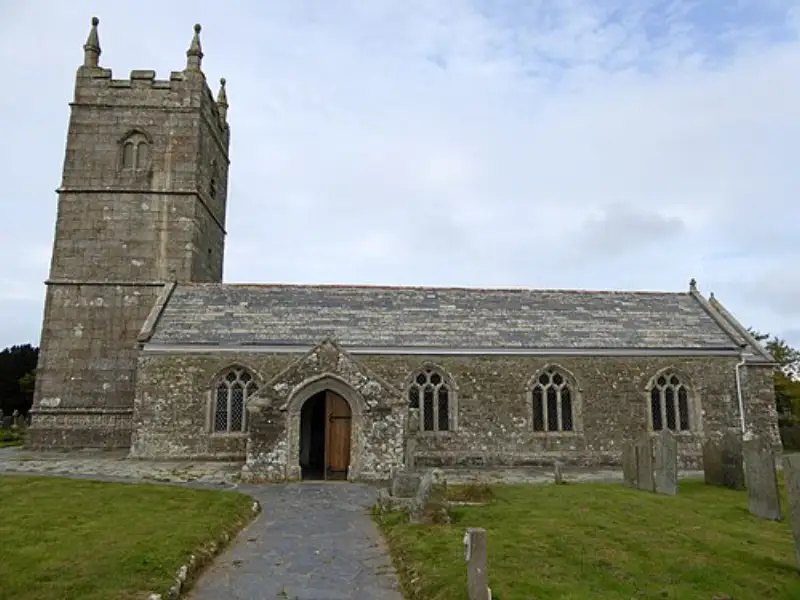
Endelient — her name appears also as Endelienta, Edellienta and Endellion — was a holy woman of Cornwall who lived across the fifth and sixth centuries. Tradition makes her a daughter of King Brychan of Brycheiniog in South Wales, and a goddaughter, in legend, of King Arthur. Like many of Brychan's numerous children she crossed the Bristol Channel to help evangelize North Cornwall. On the way she is said to have landed on Lundy, where she founded a small chapel later rededicated to St Helen, and to have stayed with her brother St Nectan at Hartland before settling as a hermit at Trentinney, south-west of the present village of St Endellion. There she lived on the milk of a single cow and water from two wells, visited by her sister St Dilic along a path whose grass was said to grow ever greener. After the lord of Trentinney killed her straying cow, Arthur's men slew him in revenge; Endelienta, grieving at killing done in her name, restored him to life. Forewarned by a vision of her death, she asked to be buried where a bullock cart carrying her body should stop. She died on 29 April, perhaps at the hands of Saxon pirates, and a church was raised over her grave, where the parish church of St Endellion stands today.
The Complete Life
A Daughter of Brychan
Tradition makes Endelient a daughter of King Brychan, the fifth-century ruler of Brycheiniog in South Wales whose numerous children were remembered across Wales and Cornwall as missionaries and martyrs. In Welsh records she is called Cenheidlon, Endelienta being a Latinised form of her name, and the Cornish rendered it as Endellion. Legend adds a glittering godparent: she is said to have been goddaughter of King Arthur himself. She was a native of South Wales, born around 470 according to the usual reckoning, and grew up in a court that was also a school of sanctity, where siblings took for granted that the faith was worth crossing the sea for. Of her upbringing the sources say nothing more; her story properly begins with the voyage that carried her out of Wales. What the tradition preserves is the pattern of Brychan's family: royal blood exchanged for apostolic labour, daughters and sons alike scattering from Brycheiniog to plant Christianity among the peoples of the western seaboards. Endelient's portion of that inheritance lay to the north, across the Bristol Channel, in Cornwall.
§ Life
Across the Bristol Channel
The purpose of her crossing was apostolic: Endelient came to labour beside her brothers and sisters in bringing the Christian faith to the peoples of north Cornwall. Her journey traced the sea roads of the Celtic Church. First she landed on the island of Lundy, out in the channel, where she is credited with raising a little chapel, a structure afterwards mistaken in its dedication and given to Saint Helen. From Lundy she moved on to the mainland of Cornwall, stopping to stay with her brother Saint Nectan at Hartland, another of Brychan's missionary children. Rather than remain with him, she went on in search of a solitude she could call her own, and found it at Trentinney, a little to the south-west of what is now the village of St Endellion. There she embraced the hermit's life, though family ties held: Lundy saw her again now and then when she withdrew to it for quiet prayer, and her sister St Dilic, whose church stood at Landulph, made her home close by, so that the sisters' meetings along a certain path left that grass, men said, greener for ever after than anywhere round about. Her vocation, then, was doubly rooted: in a family of missionaries and in a landscape made holy by solitude.
§ Life
Hermits and Holy Wells
At Trentinney Endelient lived the hard, spare life of a Celtic hermit. Legend tells that her whole sustenance was a single cow's milk, drunk with water drawn from two springs hard by her cell; of the world she had abandoned she asked nothing more. The two wells near the village of St Endellion came to bear her name, and her presence there, evangelizing the local population, gave the village both its church and its name. Her fame, however, rests less on organized mission than on the stories told of her holiness. When her cow strayed onto his land, the Lord of Trentinney killed it, an act of petty violence against a defenceless woman of God. Arthur, reckoned her godfather in the legend, burned with anger at the outrage and dispatched his men to punish it, and so the lord lost his life. But the tale insists that Endelient grieved that a man should die on her account, and she brought the nobleman back from death to life — a wonder of mercy that undid the vengeance carried out for her sake. The tale captures the spirit the tradition wished to hand on: a saint who valued life over honour and would not have blood shed for her sake.
§ Life
Death and the Bullock Cart
The manner of Endelient's death was foretold to her in a vision. Following it, she directed that her body, once dead, should be laid upon a sledge or waggon hauled by bullocks, and committed to the earth at whatever spot the animals halted — leaving the choice of her grave not to herself but to heaven. Her death is assigned to 29 April at some point during the sixth century, and perhaps came at the hands of Saxon sea-rovers, the scourge of the Cornish coast in those years; if so, she numbers among the saints whose blood, like her brothers', was shed by the invaders. Her body was laid on the cart, and the place where the bullocks halted was the top of a hill. There she was buried, and a church was built over her grave. The present collegiate church of St Endellion stands on that site today, so that the parishioners of the village worship, century after century, directly above the hermit of Trentinney. The hilltop tomb made her memory permanent in the landscape, as her wells and her green path had already made it beloved.
§ Life
Pilgrims at Her Shrine
Endelient was never formally canonized; like the other saints of Cornwall she belongs to the pre-congregation age, and her cult grew where she had died. She is venerated in Roman Catholicism, Anglicanism and Orthodoxy, with a feast on 29 April. Throughout the medieval centuries pilgrims made their way to her shrine in the Church of St Endellion, until the Reformation left it all but demolished; its pedestal endures and may still be seen within the church. The local folklorist Nicholas Roscarrock records that a chapel in her honour remained on the ground of her Trenteney hermitage down to the 1500s, preserving the recollection of the cells and wells she had made holy. Her patronal church at St Endellion remains the centre of her cult, and her name endures in the village itself, Endellion being simply the Anglicised form of the saint. Few Cornish saints can show so continuous a local memory: chapel, wells, shrine and parish church all point back to the solitary woman of Trentinney, remembered on 29 April by three communions of Christians.
§ Legacy
From the Langdale Rosary to St Endellion
Endelient's memory has proved surprisingly durable in English culture. Among the rare early likenesses of her is one in the Langdale rosary, a work of the 1500s thought once to have been Lord William Howard's, today kept in the Victoria and Albert Museum. In 2005 the BBC noted her among the saints of North Cornwall being remembered, and in the same year a local iconographer was commissioned to paint an icon of Saint Endelienta, a delicate task since no known images of her survived on which to base the work. The church that guards her grave has become a living centre of the arts: each Easter and each summer the St Endellion Music Festivals fill the old church with sacred song. And in 2010 her name entered national headlines when Prime Minister David Cameron and his wife Samantha, holidaying in Cornwall at the time of their daughter's birth, named the baby Florence Rose Endellion after the village of St Endellion. A hermit's name, kept alive by a hilltop grave, now sounds in galleries, festivals and family trees alike.
§ Legacy
Timeline
- 470
Born in South Wales around this time; tradition makes her a daughter of King Brychan of Brycheiniog.
§ Life
- 29 Apr 500
Thought to have died on 29 April, possibly killed by Saxon pirates, and buried on a hilltop where a church rose over her grave.
§ Life
- 1500
A chapel dedicated to her at the Trenteney hermitage site survived into the sixteenth century, according to Nicholas Roscarrock.
§ Legacy
- 2005
A local iconographer was commissioned to paint an icon of the saint, though no known images of her survived.
§ Legacy
- 25 Aug 2010
David and Samantha Cameron announced on 25 August that their newborn daughter was named Florence Rose Endellion, after the village of St Endellion.
§ Legacy
The Record
- Major works
- Chapel on the island of Lundy, later rededicated to St Helen·Hermitage at Trentinney, near St Endellion
- Patron of
- St Endellion, Cornwall
- Symbols
- Cow·Bullock cart·Two holy wells
- Canonization
- Pre-congregation; venerated in Roman Catholicism, Anglicanism and Orthodoxy
Prayer
Bibliography
Show 6 sources
- "North Cornwall Saint to be remembered". BBC News. October 2005. Retrieved 25 August 2010.
- "Cornwall, Cornish Saints". Cornwall Calling. Retrieved 25 August 2010.
- Orme, Nicholas. The Saints of Cornwall, OUP Oxford, 2000, p. 113. ISBN 9780191542893.
- Betjeman, John (1984). Betjeman's Cornwall. London: John Murray. p. 50. ISBN 0-7195-4106-9.
- "The Langdale Rosary", Victoria and Albert Museum.
- "Cameron 'proud dad' after wife Samantha has baby girl". BBC News. 24 August 2010. Retrieved 26 August 2010.
Profile text adapted from the Wikipedia article, licensed CC BY-SA 4.0.
Pray with this saint every day
Save St. Endelient to your favorites, read the full profile, and get feast-day reminders in the Saints app.
Get the Saints AppFree on the App Store for iPhone and iPad