
1185/86 – 1225·Feast November 7
St. Engelbert of Cologne
Archbishop, imperial regent and murdered defender of churches
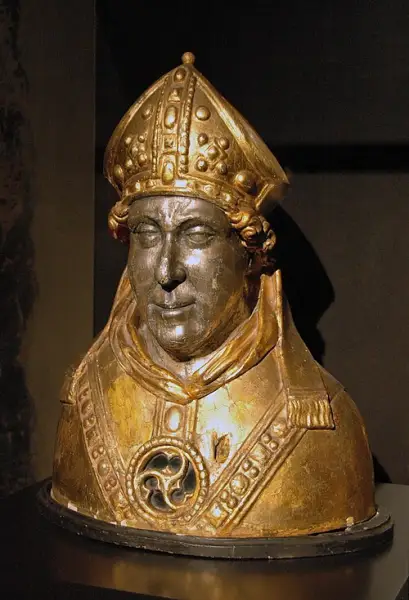
Overview
Engelbert II of Berg, known as Saint Engelbert or Engelbert of Cologne, was Count of Berg and Archbishop of Cologne, murdered in 1225 by nobles of his own kin. Born at Schloss Burg, the younger son of Count Engelbert I of Berg and Margarete of Guelders, he was educated at the cathedral school of Cologne and heaped up provostships from boyhood, holding St. George's and the cathedral provostship there as well as benefices at Aachen, Deventer and Zutphen. Elected Bishop of Münster in 1203, he declined on grounds of youth; excommunicated in 1206 for supporting Adolf of Altena in the imperial quarrel, he was pardoned in 1208 and took part in the Albigensian Crusade in 1212 as penance. Elected Archbishop of Cologne on 29 February 1216 and consecrated in 1217, he won the confidence of Emperor Frederick II, becoming imperial regent in 1220 and tutor and guardian of the young King Henry, whom he crowned at Aachen in 1222. A tireless defender of his archdiocese's rights against the Dukes of Limburg, he protected the nuns of Essen against his cousin Frederick of Isenberg, and was ambushed and killed near Gevelsberg on 7 November 1225, bearing forty-seven wounds.
The Complete Life
A Young Count of Berg
Engelbert was born in 1185 or 1186 at Schloss Burg, the ancestral seat of the Counts of Berg above the Wupper, the younger son of Count Engelbert I of Berg and his wife Margarete of Guelders. The Church claimed him almost from the cradle; schooled at Cologne's cathedral school, he began to pile up ecclesiastical posts with striking precocity: in 1198, a boy of merely twelve or thirteen, he found himself provost of St. George in Cologne, and the provostship of the cathedral itself was his from 1199 until 1216. In time he gathered further provostships in Cologne, Aachen, Deventer and Zutphen, making him one of the great pluralists of his generation in the German Church. His talents were evident early enough that in 1203, still in his teens, he was elected Bishop of Münster, though he declined the honour because of his age. His youth was also entangled in the great imperial struggle between the Welfs and the Hohenstaufen: he backed his cousin Adolf of Altena, the archbishop of Cologne, in the interest of Philip of Swabia against Otto of Brunswick, an allegiance that brought him excommunication by Pope Innocent III in 1206 and pardon only in 1208.
§ Early life
Penance, Pardon and the Pallium
The rebellion of Engelbert's youth taught him the price of taking sides in imperial politics, and his subsequent career bore the marks of expiation. In 1212, to satisfy for having backed the losing side, he took the cross and went south to fight in the Albigensian Crusade. After the Battle of Bouvines in 1214 he gave his allegiance to the young Frederick II, the Hohenstaufen emperor whom that victory had secured, and thenceforth his fortunes and the emperor's rose together. On 29 February 1216 the cathedral chapter elected him Archbishop of Cologne, and he was consecrated on 24 September 1217, holding the see until his death; as archbishop he was also Duke of Westphalia and Angria, and on his elder brother Adolf's death on crusade in 1218 he succeeded as Count of Berg. The mixture of offices, warrior and prelate, would define his vocation: a churchman who governed like a prince, defended his lands like a soldier, and yet was remembered as personally devout. Men of his own day observed that, pious as he was in his private life, he governed as a monarch rather than as a churchman.
§ Archbishop of Cologne and after
Regent of the Empire
Engelbert came to enjoy the deep trust of Frederick II. In 1220 the emperor named him imperial regent and guardian of his son Henry, and in 1222 Engelbert crowned the twelve-year-old as King of the Romans at Aachen, remaining the boy's tutor and protector until his death. Whatever his share in drafting the Confoederatio cum principibus ecclesiasticis, and as Administrator of the German Kingdom he can scarcely have had none, the treaty Frederick signed on 26 April 1220 conceding extensive rights to the ecclesiastical princes; though his personal involvement is unclear, the enlarged powers it gave to church lords clearly benefited the archbishops of Cologne, and building on those new powers formed part of his archiepiscopal strategy. He also had to fight for his inheritance as Count of Berg: Duke Waleran III of Limburg claimed the county through his son's marriage to Adolf's only daughter Irmgard, yet the succession by Salic law belonged to Engelbert. Arms decided it in his favour after two feuds, and in 1220 Waleran's pretensions were bought off with the revenue of a single year. Against Limburg and its ally Cleves he aligned himself with Brabant and Namur, and he granted town privileges to numerous places, among them Wipperfürth, Attendorn, Brilon, Siegen, Werl, Herford, Vianden, Hamm, Neuerburg and Manderscheid.
§ Archbishop of Cologne and after
More Monarch than Churchman, Yet a Churchman Still
Engelbert's religion showed itself less in withdrawal than in the energetic governance of a great archdiocese. When he succeeded, the rights and territories of Cologne had fallen into disorder through long civil unrest in Germany, and he devoted himself at once to winning them back and securing them, by campaigns and alliances fought, as it were, with crozier and sword together. Observers of his own time reckoned the prince in him stronger than the prelate, yet the ends he pursued were not worldly: he strove without pause for the material flourishing of his archdiocese — indeed he can fairly be called the architect of its existence as a considerable state — brought energetic order to the governance of the city of Cologne, and proved an ardent protector of the religious of his province. Because he loved justice and enforced the law relentlessly, his people grew to esteem and love him, and no shepherd of the province laboured more solicitously for the religious houses under his care. The same uncompromising defence of law and of the rights of churches and religious bodies, pursued by every means including military action, won him the hatred of the nobility, including his own family, and set him on the road to martyrdom.
§ Death
The Defile of Gevelsberg
The quarrel that killed Engelbert arose from his protection of nuns. At the root lay the wrong done to a community of nuns. Frederick of Isenberg, Engelbert's cousin, held the advocacy of Essen Abbey and used the stewardship to plunder the sisters. Engelbert was determined to defend the sisters' interests and to bring his kinsman to justice. On 7 November 1225 the two men travelled together from a judicial hearing at Soest toward Cologne, and in a narrow defile near present-day Gevelsberg, close to Schwelm, Engelbert was ambushed and killed, possibly at Frederick's own hand. Behind the ambush, most likely, stood a circle of resentful nobles, and their design may have been to seize the archbishop rather than to take his life; but Engelbert died on the spot, aged about forty. In bitter indignity his corpse was carted home to Cologne on a wagon used for dung; when it was inspected, forty-seven wounds were counted upon it, and that number burned itself into Germany's remembrance of the crime. The shepherd who had fenced his flock with the sword of a prince now lay slaughtered at the hands of those whose violence he had restrained.
§ Death
Declared a Martyr
The Church's response to Engelbert's murder was immediate. Cardinal Conrad of Urach, legate of the Holy See, had the body laid to rest in Cologne Cathedral on 24 February 1226 and pronounced Engelbert a martyr, killed in the discharge of his duty of defending the Church and its weakest members against his own kin. A formal canonization, however, never took place, so that his cult rests on the legate's declaration and the devotion of the people. A Baroque reliquary, commissioned under Ferdinand of Bavaria when he held the see of Cologne, received the martyr's bones, who in 1618 likewise directed that his feast be observed on 7 November, the day of his passion, an observance maintained without interruption since. The shrine remains in Cologne Cathedral today, a destination for the faithful of the Rhineland. In the Church's calendar of martyrs he takes his place among bishop-martyrs killed by their own countrymen, witnesses to the cost of justice. The memory of his death was kept alive in German letters as well, notably in Annette von Droste-Hülshoff's poem on the death of Archbishop Engelbert of Cologne.
§ Veneration
Founder of a Territorial Church
Engelbert's lasting achievement was to make the Archdiocese of Cologne a coherent and defensible state. By recovering its scattered rights after years of civil disorder, by marrying the see's interests to the new privileges the Hohenstaufen conceded to ecclesiastical princes, by his alliances with Brabant and Namur and his charters to a string of rising towns, he laid foundations on which his successors, the prince-archbishops of Cologne, built for centuries. In the County of Berg his victory over Waleran of Limburg secured the succession and preserved the house of his fathers, where his statue by Paul Wynand still stands at Schloss Burg. His violent death also entered the moral imagination of Germany: the sight of the just archbishop's body borne to Cologne on a dung-cart shocked the age and fixed his reputation as a martyr to law and to the protection of the Church's poor. Scholars have continued to study the meaning of his transformation, as one historian has put it, from warrior-prince to victim, and the parish of Altenberg keeps his memory alive in its publications. He is commemorated each 7 November as Engelbert of Cologne, count, archbishop and martyr.
§ Archbishop of Cologne and after
Timeline
- 1185
Born at Schloss Burg, younger son of Count Engelbert I of Berg and Margarete of Guelders; sources give 1185 or 1186.
§ Early life
- 1198
While still a boy of twelve or thirteen, took up the office of provost of St. George in Cologne.
§ Early life
- 1199
Also received the cathedral provostship of Cologne, which he held until 1216.
§ Early life
- 1203
Chosen as Bishop of Münster but declined the see on account of his youth.
§ Early life
- 1206
Excommunicated by Pope Innocent III for backing his cousin Adolf of Altena and Philip of Swabia against Otto of Brunswick.
§ Early life
- 1208
Pardoned and received back into communion.
§ Early life
- 1212
Went on the Albigensian Crusade as penance for the rebellion of his earlier years.
§ Early life
- 1214
Gave his allegiance to the future emperor Frederick II after the Battle of Bouvines.
§ Early life
- 29 Feb 1216
Elected Archbishop of Cologne, taking the name Engelbert I.
§ Archbishop of Cologne and after
- 24 Sep 1217
Consecrated archbishop, the office he would hold until his death.
§ Archbishop of Cologne and after
- 1218
Succeeded as Count of Berg when his elder brother Adolf fell on the Fifth Crusade without a male heir.
§ Archbishop of Cologne and after
- 1220
Named imperial regent and guardian of Emperor Frederick II's son Henry.
§ Archbishop of Cologne and after
- 1220
Concluded peace with Duke Waleran III of Limburg, ending the succession dispute over the County of Berg.
§ Archbishop of Cologne and after
- 1222
Placed the crown on young Henry's head at Aachen, raising the boy to King of the Romans.
§ Archbishop of Cologne and after
- 7 Nov 1225
Killed in a defile near present-day Gevelsberg while travelling from Soest to Cologne, possibly at the hand of Count Frederick of Isenberg.
§ Death
- 24 Feb 1226
Buried in Cologne Cathedral by order of Cardinal Conrad of Urach, who declared him a martyr.
§ Veneration
- 1618
Archbishop Ferdinand of Bavaria ordered his feast kept on 7 November and had a Baroque shrine prepared for his remains.
§ Veneration
The Record
- Major works
- Restoration and defence of the rights and territories of the Archdiocese of Cologne·Town charters granted to Wipperfürth, Attendorn, Brilon, Siegen, Werl, Herford, Vianden, Hamm, Neuerburg and Manderscheid·Alliances with Brabant and Namur against the Dukes of Limburg and Cleves
- Symbols
- Crosier in one hand and an upraised sword in the other, piercing a crescent moon
- Canonization
- Declared a martyr by Cardinal Conrad of Urach, papal legate, at his burial in 1226; no formal canonization took place
Prayer
Bibliography
Show 6 sources
- Meier, Gabriel. "St. Engelbert of Cologne." The Catholic Encyclopedia Vol. 5. New York: Robert Appleton Company, 1909.
- Toch, Michael. "Welfs, Hohenstaufen and Habsburgs", The New Cambridge Medieval History: c.1198-c.1300, Vol. 5, (David Abulafia, ed.) (Cambridge University Press, 1999), p. 384.
- "St Engelbert of Cologne". Catholic News Agency. Archived from the original on December 18, 2018.
- Butler, Alban (1981) [1956]. "St. Engelbert, archbishop of Cologne, martyr". In Thurston, Herbert; Attwater, Donald (eds.). Butler's Lives of the saints. Vol. 4 (Complete ed.). Westminster, MD: Christian Classics. pp. 289-290. ISBN 9780870610455.
- Jung, Jacqueline E. (2000). "From Jericho to Jerusalem: the violent transformation of Archbishop Engelbert of Cologne". In Bynum, Caroline Walker; Freedman, Paul H. (eds.). Last things: death and the Apocalypse in the Middle Ages. Philadelphia: University of Pennsylvania Press. pp. 60-82. ISBN 9780812217025.
- Kreuzzug gegen die Albigenser. Engelbert I of Berg, Archbishop of Cologne, pages 183, 198, 299, 300, 373. Pierre des Vaux de Cernay. Wissenschaftliche Buchgesellschaft Darmstadt nr. 13688-8. 1996.
Profile text adapted from the Wikipedia article, licensed CC BY-SA 4.0.
Pray with this saint every day
Save St. Engelbert of Cologne to your favorites, read the full profile, and get feast-day reminders in the Saints app.
Get the Saints AppFree on the App Store for iPhone and iPad