
died c. 303·Feast April 16
St. Engratia
Virgin martyr of Zaragoza and her eighteen companions
Overview
Engratia, known in Portuguese as Santa Engrácia and in Spanish as Santa Engracia, is venerated as a virgin martyr of the early Church. A native of Braga, she was betrothed to a nobleman of Roussillon, and was journeying toward her marriage with her uncle Lupercius at the head of an escort of sixteen gentlemen and a maidservant, Julie or Julia, when the travellers came to Zaragoza. There they learned of the persecution of Christians by the governor Dacian, under the emperors Diocletian and Maximian. Engratia attempted to dissuade him from his cruelty, but, being discovered a Christian, she was whipped and imprisoned, dying of her wounds, while her companions were beheaded. Tradition places her martyrdom around 303 in the Diocletianic Persecution, though modern scholars think it more probable that she died under Valerian, between 254 and 260. She suffered with the great company called the Martyrs of Zaragoza, whose ashes, preserved in white masses known as the santas masas, were kept in the crypt of her church. Prudentius, a poet of Zaragoza, wrote a hymn in the martyrs' honour and described Engratia's tortures. Declared patroness of Zaragoza in 1480, her cult spread through Spain and the Pyrenees, reaching Lisbon in the great church of Santa Engrácia.
The Complete Life
A Bride from Braga
Engratia was a native of Braga, in what is now Portugal, a city already ancient when Christianity reached the Iberian peninsula. Of her family and childhood the tradition records nothing; her story begins, as so many virgin martyrs' stories do, at the moment an ordinary life was interrupted by extraordinary grace. Her hand had been pledged to a nobleman of Roussillon, in the mild country of the far side of the Pyrenees, and her bridal journey was appointed with all the state befitted her station. For safe conduct the family sent her uncle Lupercius — perhaps the same man as Luperculus, bishop of Eauze — accompanied by sixteen gentlemen of rank and a serving-woman, Julie or Julia by name. The party set out from Braga northward toward Gaul, a journey of many days through the lands between the Douro and the Pyrenees. It was a bride's road, not a martyr's, and no one in the escort can have imagined the fate awaiting them at the halting city on the Ebro. Yet the itinerary of that betrothal journey, preserved with such unusual precision, shows how early and how firmly the Church of Spain cherished the memory of the maiden of Braga.
§ Legend
The Road Through Zaragoza
word reached them of the assault then raging against the city's Christians at the hands of the governor Dacian, an officer serving the emperors Diocletian and Maximian. Here the bride's journey became a witness. Engratia did not pass quietly by the suffering Church of Zaragoza: she went to the governor and attempted to dissuade him from his persecution, pleading with the very man whose courts were condemning the faithful. The attempt revealed her, for it was discovered that she herself was a Christian. The virgin promised to a nobleman of Roussillon was whipped and imprisoned, and she died of her wounds; her companions, Lupercius, the sixteen noblemen and the servant Julie or Julia, were decapitated. Whether the drama unfolded under Diocletian around 303, as tradition holds, or earlier under Valerian, between 254 and 260, as modern scholars judge more probable, the substance is the same: a young woman travelling to her wedding found instead the marriage of martyrdom, and a governor who thought to silence the gospel found in his prisoner a voice that twenty centuries of devotion have never silenced.
§ Legend
The Countless Martyrs of Zaragoza
Engratia did not suffer alone. Many others, called the Martyrs of Zaragoza and also the Countless Martyrs of Zaragoza, were put to death at the same time. The legend of their passion recounts the governor's cunning. To smoke out and destroy every believer in Saragossa, Dacian held out the promise of free worship — if only the faithful would quit the walls together, at an hour appointed, through gates he himself chose. The moment they had emerged, his soldiers cut them down and heaped their bodies on pyres; then, so that none might ever honour the remains, the ashes were mingled with those of executed criminals. Heaven answered with rain: the downpour separated the mingled dust, and the martyrs' ashes gathered themselves into pale mounds, the santas masas or holy masses, which the Christians gathered and laid in the crypt of the church bearing Engratia's name, where they remain to this day. The roll of the company includes — with Engratia, Lupercius and Julia — Caius and Crescentius, who endured torture yet survived, confessors more than martyrs; and the long roll of Martial and Successus; Urban, Quintilian and Publius; Fronto, Felix and Cecilian; Evodius, Primitivus and Apodemius; then four men who all bore the name Saturninus, called by St. Eugenius II of Toledo Jenaro, Casiano, Matutino and Fausto; and Januarius.
§ Martyrs of Zaragoza
The Poet's Witness
The spirituality of Engratia's martyrdom comes to us through a poet of her own city. Prudentius, a native of Zaragoza writing at the turn of the fifth century, composed a hymn in honour of these martyrs, listing their names and describing the terrible tortures suffered by Encratis, as he calls Engratia. His witness is precious evidence that within a century of her passion the story of the maiden of Braga was already fixed in the memory of the Spanish Church, complete with the number of her companions and the detail of her torments. Popular religion took fire from that poetry, and a powerful devotion spread: of all the martyrs of Zaragoza none drew such veneration as Engratia, whose fame travelled over the whole of Spain and into the Pyrenees. Her spirituality is that of the bride-martyr, familiar in the early Church: the woman who refuses or transcends an earthly marriage for the witness of blood, who confronts the powerful with the truth, and whose broken body becomes the seed of a city's faith. The image of the rain-washed ashes, white masses distinguishable from the ashes of criminals, gave her cult its enduring sign: holiness that cannot be hidden or mingled with the world.
§ Veneration
Passion and the Rain from Heaven
Engratia's final days were spent in the prisons and tribunals of Dacian at Zaragoza. Discovered as a Christian while pleading for the persecuted, she endured the lash, and the tradition is unanimous that she did not die by the sword like her companions but succumbed to her wounds, a death of slow suffering that marks her among the martyrs of torture rather than beheading. Her companions paid the forfeit of their escort with their heads. Around them the wider purge of the city's Christians unfolded at the city gates, with fire consuming the slain and their ashes deliberately confounded with those of criminals. The heavenly answer, in the legend's telling, was a shower of rain: the waters separated the martyr's ashes into white masses, las santas masas, which Christians gathered and treasured, depositing them in the crypt of the church that bore her name, where they were still preserved in modern times. Over the ground itself — the very place, tradition said, of Engratia's passion and that of her companions — the church of Santa Engracia de Zaragoza arose, and from the first Christian centuries her shrine there drew the hearts of the faithful.
§ Martyrs of Zaragoza
Patroness of Saragossa
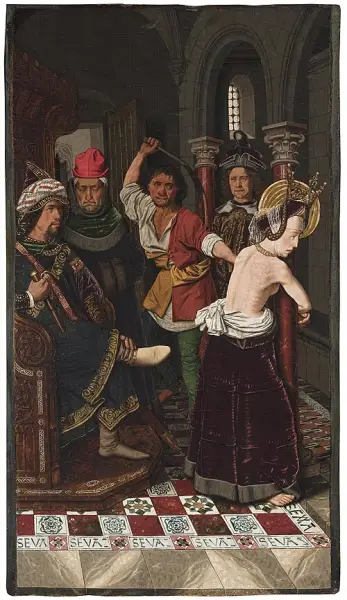
Engratia was never formally canonized; she belongs to the pre-congregation age of the Church, and her veneration in the Roman Catholic Church and the Eastern Orthodox Church rests on the immemorial cult of the martyrs. That cult flourished early and grew strong. Prudentius's hymn fixed her memory in the liturgy of the city; an important devotion arose around the martyrs of Zaragoza, with Engratia the most venerated of them all, her fame spreading throughout Spain and the Pyrenees. Saragossa in 1480 formally acclaimed her as the city's patroness. The church of her dedication at Zaragoza received a new consecration at the city's synod of 592, an event commemorated on 3 November, a date that sometimes stood beside her chief feast of 16 April as a second observance. The shrine grew with the city: the church on the site of her martyrdom, the crypt guarding the santas masas, the images of her flagellation painted by masters such as Bartolomé Bermejo and the workshop of Zurbarán. No decree of a pope was needed; the blood of the virgin of Braga and the devotion of twenty centuries of Spaniards and Portuguese were her canonization.
§ Veneration
From Zaragoza to Lisbon
Engratia's legacy lives above all in stone and worship. Santa Engracia de Zaragoza, the church raised over the ground where she won her crown, fell to the wreckers during the Spanish War of Independence; nothing was spared but its crypt and its doorway. Later generations — in the closing years of the nineteenth century or the first of the twentieth — put the building up again, and it remains a parish church today, its crypt still drawing pilgrims. In Lisbon, the Church of Santa Engrácia is dedicated to her, carrying her name in Portugal, the land of her birth, where it became one of the city's great monuments. Her story has drawn artists across the centuries: Bartolomé Bermejo painted her flagellation and arrest for the Altarpiece of Santa Engràcia in 1472-1477, Jerónimo Cosida gave her a place on the Virgin's altarpiece now in the Museum of Zaragoza, painting it in 1560, the workshop of Francisco de Zurbarán painted her in 1650 for the Hospital de las Cinco Llagas, and engravers of the Famous women of Spain and Portugal included her in 1868. Patroness of Zaragoza since 1480, companion of the countless martyrs, she remains one of the great virgin martyrs of the Iberian Church, remembered each 16 April.
§ Veneration
Timeline
- 257
Probably died at Zaragoza during the persecution of Valerian, according to more recent scholarly dating that favors 254-260 over 303.
§ History
- 303
Traditional date of her martyrdom at Zaragoza with eighteen companions during the Diocletianic Persecution.
§ Legend
- 3 Nov 592
At a synod of Zaragoza the church dedicated to her was reconsecrated, an act kept on 3 November as an alternate feast.
§ Veneration
- 1480
The city of Saragossa proclaimed Engracia its patroness.
§ Veneration
- 1900
The church of Santa Engracia de Zaragoza, raised on the spot of her martyrdom, was rebuilt around the turn of the twentieth century.
§ Veneration
The Record
- Patron of
- Patroness of the city of Saragossa (Zaragoza)
- Symbols
- Whips and scourges·Palm of martyrdom
- Canonization
- Pre-congregation; venerated in the Roman Catholic Church and the Eastern Orthodox Church
Prayer
Bibliography
Show 6 sources
- Amadó, Ramón Ruiz (1912). "Saragossa". In Herbermann, Charles (ed.). Catholic Encyclopedia. Vol. 13. New York: Robert Appleton Company.
- Baring-Gould, Sabine, The Lives of the Saints (J. Hodges, 1874), 410.
- "Lives of the Saints, April 16, Saint Benedict Joseph Labre, Saint Engratia and the Eighteen Martyrs of Saragossa". Archived from the original on 2008-05-04. Retrieved 2008-03-31.
- "Santa Engracia", Parish of Saint Engracia, Zaragoza.
- "Santa Engrazia".
- "Januarius (33)", A Dictionary of Christian Biography, Literature, Sects, and Doctrines, p. 341.
Profile text adapted from the Wikipedia article, licensed CC BY-SA 4.0.
Pray with this saint every day
Save St. Engratia to your favorites, read the full profile, and get feast-day reminders in the Saints app.
Get the Saints AppFree on the App Store for iPhone and iPad