
sub-Roman period·Feast March 7
St. Enodoc
Sub-Roman saint of the Cornish coast at Trebetherick
Overview
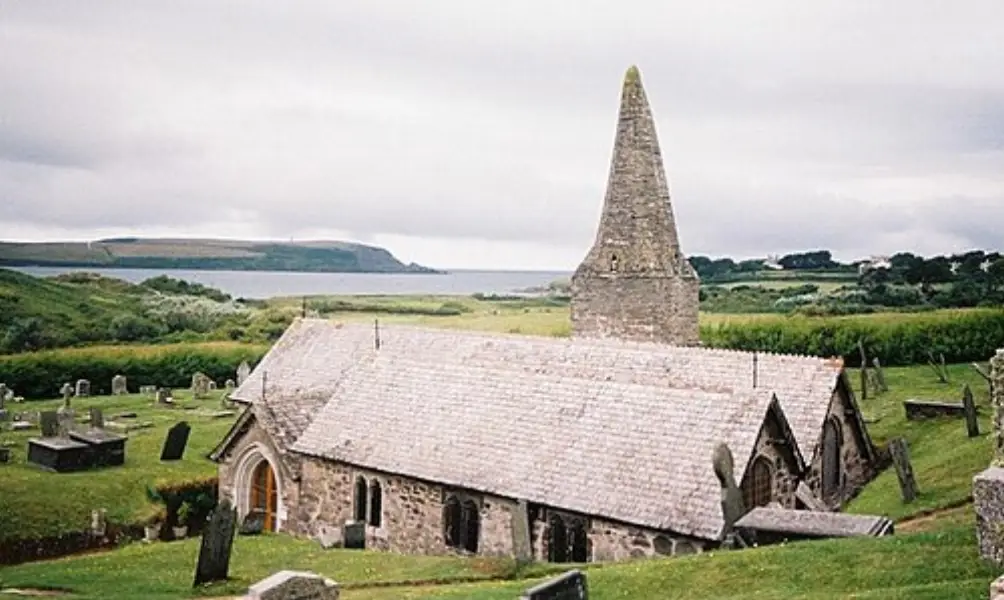
Saint Enodoc, originally recorded under the name Wenedoc, is a saint of sub-Roman Cornwall, belonging to the generations of insular Christians who kept the faith in the southwest peninsula after the withdrawal of Roman administration. His designation was first understood as that of a man, and the historian Nicholas Orme has observed that in the sixteenth century the name was apparently mistaken for that of a woman, a confusion that has clung to the saint ever since. His feast was kept at Bodmin Priory on the seventh of March, one of the observances by which the great Cornish monastery perpetuated the memory of the region's early holy men. His most visible legacy today is the parish church of Trebetherick on the north Cornish coast, dedicated to him, whose churchyard holds the grave of the poet John Betjeman. He must not be confused with Saint Enoder, a separate saint probably a son of King Brychan Brycheiniog, whose original name Wenheden resembles his.
The Complete Life
A Name from the Sub-Roman Age
Enodoc belongs to the sub-Roman age of Cornwall, the generations between the end of imperial rule and the emergence of the early medieval kingdoms, when Christianity endured in the peninsula and produced the constellation of local saints whom the later Cornish calendar commemorated. Nothing is recorded of his family, his formation, or the scene of his ministry; his existence is anchored by his original designation, Wenedoc, preserved in the early records of his cult. The history of that name is itself instructive. It was first understood as belonging to a man, and the historian Nicholas Orme notes that in the sixteenth century the name was apparently misread as that of a woman, so that later tradition sometimes spoke of Saint Enodoc in the feminine. A further confusion has shadowed the saint since the Middle Ages: the similar Cornish designation of Saint Enoder, probably Wenheden, a son of King Brychan Brycheiniog, has invited repeated identification of the two, though the medieval evidence keeps them apart as distinct figures with separate commemorations. What can be affirmed of Enodoc is simply this: an early holy man of Cornwall whose name the church preserved and whose feast the region continued to keep.
§ Enodoc
The Church at Trebetherick
The living memory of Enodoc rests chiefly on two foundations: a monastic observance and a coastal church. His feast day was kept at Bodmin Priory on the seventh of March, a sign that the Augustinian house which dominated Cornish religious life counted him among the local saints worthy of liturgical commemoration. More famously, the parish church of Trebetherick, on the north coast of Cornwall near the Camel estuary, is dedicated to him as St Enodoc's Church, so that his name is spoken daily in one of the most visited corners of the county. The church, half-buried in sand at periods of its history, draws countless visitors, and its churchyard holds the grave of Sir John Betjeman, the poet laureate who loved the Cornish coast and whose burial there has bound the saint's name to English literary memory as well as to Cornish devotion. Pilgrims who come for the poet's grave encounter the saint, and the quiet persistence of the dedication across more than a thousand years testifies to the endurance of the early Cornish cults: a saint of whom almost nothing is known remains, in his church at Trebetherick, better housed in memory than many whose lives are written.
§ Enodoc
The Record
- Canonization
- Pre-congregation; cultus attested in medieval Cornwall
Prayer
Bibliography
Show 3 sources
- "Saint Enodoch" at Saints.sqpn.com.
- Ford, David Nash (2001). "Children of Brychan Brycheiniog". Early British Kingdoms. Nash Ford Publishing. Retrieved 25 July 2021.
- Orme, Nicholas. The Saints of Cornwall. United Kingdom, OUP Oxford, 2000. p. 115. ISBN 9780191542893.
Profile text adapted from the Wikipedia article, licensed CC BY-SA 4.0.
Pray with this saint every day
Save St. Enodoc to your favorites, read the full profile, and get feast-day reminders in the Saints app.
Get the Saints AppFree on the App Store for iPhone and iPad