
early 9th century – c. 833·Feast March 28
St. Enravota
First Bulgarian Christian martyr of the royal house
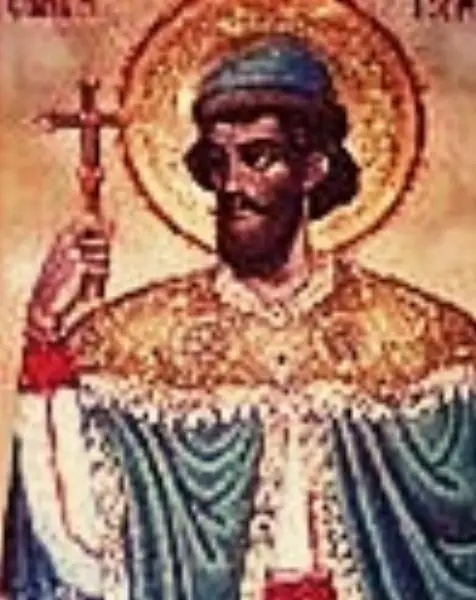
Overview
Saint Enravota, remembered also as Voin, the warrior, and as Boyan, was the firstborn among Khan Omurtag of Bulgaria's sons, and Bulgarian tradition honors him as his nation's first Christian martyr and its saint of longest standing. His birth fell in the first years of the ninth century, and he stood to succeed his father, but when Omurtag died in 831 the throne passed instead to his younger brother Malamir, perhaps because Enravota's sympathy for Christianity alarmed the boyars, who feared the new faith might destabilize the pagan court. After his father's death Enravota asked his brother to free a pious Byzantine prisoner whom Omurtag had confined. The captive's preaching converted the prince, who received baptism. When Malamir learned of this, he pressed Enravota to renounce his new faith; the prince refused, and around 833 the khan ordered his death. An eleventh-century tradition, preserved by the chronicler Theophylact of Bulgaria, records a prophetic speech in which the martyr foretold that the faith he died for would spread across the whole Bulgarian land. Enravota's feast is kept in the Bulgarian Orthodox Church on 28 March, and he remains honored throughout the Orthodox world as the protomartyr of Bulgarian Christianity.
The Complete Life
Eldest Son of the Khan
Enravota was born at the beginning of the ninth century into the ruling house of Bulgaria, the eldest son of Khan Omurtag, one of the most forceful rulers of the early Bulgarian state. As the firstborn he might reasonably have expected the succession, and it is against that expectation that his story acquires its poignancy. When Omurtag died in 831, the throne passed instead to Enravota's younger brother Malamir. The sources suggest a reason bound up with religion: Enravota had shown favor to Christianity, and the boyars, the warrior nobility of the pagan court, are thought to have feared that a Christian ruler might endanger their world. He thus stands at the intersection of two loyalties, the dynastic religion of his ancestors and the faith of the Byzantine Christians whom Bulgarian power had so often fought. The medieval chroniclers who preserve his memory treat this displacement from power not as a misfortune but as providence, for it was precisely his openness to the Christian faith, the very quality that cost him the crown, that would prepare him for the martyr's crown that the Bulgarian church has never forgotten.
§ Enravota
Conversion at a Captive's Word
The turning point of Enravota's life came shortly after his father's death, through an act of simple mercy. Among the prisoners confined by Omurtag was a pious Byzantine captive, and Enravota asked his brother Malamir to set the man free. In the company of this unnamed confessor the prince encountered the Christian faith not as a political danger but as living preaching. The captive's sermons persuaded him, and Enravota asked for baptism, becoming a Christian within the household that had most fiercely guarded the old religion. The pattern is striking and has made the story beloved in Bulgarian memory: the faith that the court feared as a foreign contagion was transmitted through one courageous prisoner, and the first-fruits of Bulgarian Christianity were gathered not by conquest or diplomacy but by the witness of a man in chains. Enravota's conversion was no private inclination. Once Malamir was informed of his brother's baptism, the matter became a public test of loyalty between khan and court, and the prince was called upon to choose openly between his ancestral gods and the Christ he had now confessed, a choice he would not take back.
§ Enravota
The Martyr's Prophecy
When Malamir learned that his brother had accepted baptism, he attempted to turn him from Christianity, but the prince stood firm. Around 833 the khan ordered his death, and Bulgaria gained its first Christian martyr. Tradition, preserved by the eleventh-century chronicler Theophylact of Bulgaria, records that before dying Enravota delivered a prophetic speech in which he foretold the triumph of the faith he was dying for: it would grow throughout the Bulgarian realm until it filled it, the standard of Christ would stand firm, houses of God would rise on every side served by unstained priests, while the idols, their ministers, and their profane shrines would collapse and vanish as if they had never stood. To Malamir himself he addressed a warning: long years on, the khan would forfeit his impious soul, gaining nothing at all in exchange for his brutality. History unfolded in the direction the martyr had indicated: within a generation Bulgaria turned toward Christianity, and in the following century the Bulgarian state received baptism and built the churches Enravota was said to have foreseen. The prophecy, whether composed at the martyrdom or later, became the church's interpretation of the martyr's death.
§ Enravota
The First Bulgarian Saint
Enravota holds a unique place in the sanctity of his nation: he is honored as the first Bulgarian Christian martyr and the earliest Bulgarian saint to be canonized. His commemoration was fixed in the Bulgarian Orthodox Church on 28 March, and he is venerated not only in his homeland but throughout the Eastern Orthodox world, which reckons him among the royal martyrs of the early medieval church. His cult gathers up the themes that later Bulgarian sanctity would repeatedly display: loyalty to Christ within a royal house, resistance to the pressure of kin and court, and the conviction that the faith of the Bulgarians was purchased at the price of blood before it was professed by a tsar. In the calendar of a church whose medieval memory reaches back to the pagan khanate, Enravota stands at the head of the line, the prince who believed before his people could. Every 28 March the Orthodox churches that commemorate him repeat the church's quiet verdict on the events of 833: that the brother who lost the throne of the Bulgarians gained a place in the company of the martyrs that no khan could take from him.
§ Enravota
Memory in Land and Church
The memory of Enravota has traveled far from the ninth-century court where he died. Within Bulgaria his name is carried above all by the Bulgarian Orthodox Church's annual observance on 28 March, which keeps the protomartyr before each generation of the faithful. Beyond the church calendar his remembrance has been written onto the map of the far south: Enravota Glacier, on the Nordenskjöld Coast of Graham Land in Antarctica, bears his name, joining the small company of Bulgarian saints commemorated in the geographic nomenclature of the Antarctic peninsula, where Bulgarian explorers and scientists have worked in modern times. The gestures are disparate, a glacier in the polar south and a feast day in the Orthodox calendar, yet together they mark how a figure about whom nearly no biographical detail survives has remained present to his nation across more than a millennium. Historians of medieval Bulgaria approach him through the chronicle tradition, above all the account attributed to Theophylact of Bulgaria, while the faithful approach him simply as Saint Enravota, Voin the warrior of Christ, or Boyan, the prince who died rather than deny the faith he had received from a captive preacher.
§ Honours
Timeline
- 800
Born in the early ninth century as the eldest son of Khan Omurtag of Bulgaria.
§ Introduction
- 831
Succeeded by his younger brother Malamir on the death of their father Omurtag, possibly because his favor toward Christianity alarmed the boyars.
§ Introduction
- 833
Refused to abandon the gospel at his brother's command and was put to death at Malamir's order around this year.
§ Introduction
In Their Own Words
This faith, which I now die for, will spread and increase across the whole Bulgarian land, although you may wish to oppress it with my death. In any case, the Sign of Christ will establish itself and churches of God will be built everywhere and pure priests will serve the pure God.
The Record
- Canonization
- Earliest Bulgarian saint to be canonized; venerated in Bulgaria and throughout the Eastern Orthodox world
Prayer
Bibliography
Show 2 sources
- Zlatarski, Vasil. Istoriya na balgarskata darzhava prez srednite vekove. Tom I. Istoriya na Parvoto balgarsko tsarstvo (in Bulgarian) (2 ed.).
- "Sv. machenik Boyan — Enravota, knyaz Balgarski" (in Bulgarian). Pravoslavieto. Retrieved 2007-03-09.
Profile text adapted from the Wikipedia article, licensed CC BY-SA 4.0.
Pray with this saint every day
Save St. Enravota to your favorites, read the full profile, and get feast-day reminders in the Saints app.
Get the Saints AppFree on the App Store for iPhone and iPad