
died c. 627 or 632·Feast Not known
St. Eorpwald of East Anglia
First English king martyred for the Christian faith
Overview
Eorpwald, also recorded as Erpenwald or Earpwald, took up his father Rædwald's crown over the East Angles around 624 and became the first early English king to die as a consequence of his Christian faith. A member of the Wuffingas dynasty, named for the semi-historical King Wuffa, he came to the throne still a pagan, after a reign of Rædwald remembered for dominance over the English kingdoms and commemorated, many think, in the ship-burial at Sutton Hoo. The little that is known of Eorpwald comes almost entirely from Bede's Ecclesiastical History of the English People. Under the prompting of Edwin of Northumbria, Rædwald's former client and now his successor as the leading English ruler, Eorpwald received Christian teaching and was baptized, in 627 according to Bede's chronology or 632 according to the Anglo-Saxon Chronicle. His conversion aligned East Anglia with Edwin's Christian alliance but provoked resistance at home: soon afterward he was killed by a pagan noble named Ricberht, and the kingdom reverted to heathen rule for three years until Sigeberht returned from exile in Gaul. The church accounted him a saint and martyr, though his feast day is not known. Whether he rests at Sutton Hoo, where the great mound was uncovered in 1939, remains an open question.
The Complete Life
A Prince of the Wuffingas
Eorpwald was born into the Wuffingas, the royal dynasty of the East Angles named after the semi-historical King Wuffa, at a moment when the Anglo-Saxon kingdoms of southern England were still consolidating their power. His father was Rædwald, the most commanding figure of his generation among the English kings, who until about 624 ruled the East Angles and after his victory over Æthelfrith of Northumbria at the River Idle in 616 stood as the most powerful ruler in England, occupying the position later writers would call Bretwalda. His mother's name has not survived. He had at least one brother, Rægenhere, who was killed in the fighting of 616, and the family records suggest Eorpwald was the younger son, becoming heir only after that loss. A third kinsman, Sigeberht, might likewise have counted as his brother, though it remains disputed whether the two were children of the same father, as Bede took them to be, or of one mother alone, as William of Malmesbury later held; the historian Barbara Yorke has suggested Sigeberht belonged to a rival line of the Wuffings, driven into exile to secure Eorpwald's succession. The boyhood of the prince unfolded in a kingdom of mixed faith, for Rædwald's own religion was a syncretism of pagan and Christian practice, and the aristocracy around him remained largely attached to the old gods.
§ Background and family
Kingdom and Baptism
Eorpwald was still a pagan when he succeeded Rædwald as king of the East Angles around 624. The accession was not uncontested in its consequences: D. P. Kirby maintains that Sigeberht fled to Gaul amid the internal strife that followed it, and that the new king's attachment to the old religion deepened tensions between Christian and pagan factions in the kingdom, diminishing his influence. The decisive turn came through Edwin of Northumbria, the exile whom Rædwald had once sheltered and then restored to power, and who had himself accepted Christianity after a dream promising him surpassing greatness. In 627 Edwin set in hand the evangelization of Northumbria, Lindsey, and East Anglia, and at his prompting Eorpwald, as Bede tells it, was won over to receive the faith and sacraments of the Christians. The date can be fixed at 627 by calculation from the known term of Bishop Felix, though the Anglo-Saxon Chronicle places the baptism in 632 with its laconic entry recording that Eorpwald was baptized. Where the rite was administered is unknown, but N. J. Higham argues it likely took place in Northumbria at Edwin's center of power, administered by Paulinus with Edwin himself as sponsor, a ceremony that confirmed Eorpwald's standing as a subordinate king under a Christian overlord.
§ Accession and conversion to Christianity
A Kingdom Joined to the Christian Alliance
Eorpwald's baptism was more than a private act of faith; it redrew the religious map of eastern England. With the East Anglian king now Christian, Edwin's Northumbrian priests gained the standing to suppress pagan practices in the kingdom and to preach the conversion of the East Anglians, and the political effect was immediate: nearly the whole eastern seaboard from Northumbria down to Kent, Essex alone set apart, stood subject to Edwin and the Christian princes allied with him. Yet the conversion remained shallow in its instruments. Unlike the missions that would follow in later reigns, Eorpwald's accession of faith produced no ecclesiastical infrastructure, no see, no monastery, no bishop within his kingdom; the church in East Anglia existed by royal inclination rather than by institution. This weakness helps to explain how fragile the new order proved. The king had moved his people toward Christianity chiefly through the mechanics of overlordship, and the resentments that gathered against Edwin's dominance could therefore attach themselves to the religion he had imposed. Within the kingdom, Christian and pagan factions had already contended for influence at Eorpwald's court, and the king's personal conversion, achieved without a rooted church, left the faith dependent on a single royal life, a dependence soon exposed as fatal.
§ Accession and conversion to Christianity
Murder and the Pagan Reaction
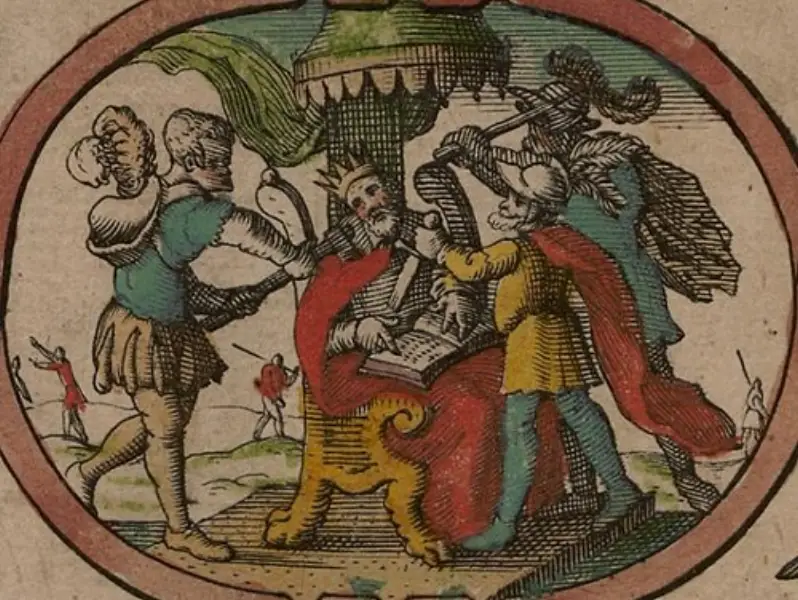
Soon after his conversion Eorpwald was slain by a heathen named Ricberht, and Bede records that after the killing the kingdom reverted to heathen rule for three years. No English king before Eorpwald had been put to death on account of his Christianity. How the deed was carried out went unrecorded, and historians have had to read the murder through its context: Ricberht may have led an internal East Anglian faction opposed to Christian rule, or he may have acted as an emissary from abroad, sent to break Edwin's grip on the East Angles. The return of the kingdom to heathendom, as the record notes, need not mean open conflict between the old cults of the English gods and devotion to Christ; it may instead voice a political backlash among the East Anglians against Edwin's ascent and his lordship over their king, with the new faith bearing the blame for a humiliation felt to be national. Ricberht's ancestry is unknown, and it is unclear whether he ever ruled after the murder, though the succession of Sigeberht three years later, in 630 or 631, when the exile returned from Gaul, marks the pagan interval as brief and its ultimate reversal as decisive.
§ Death and sainthood
Martyr of the English Church
The church received Eorpwald as a saint and martyr, honoring him as the first of the English kings to shed his blood for the Christian faith. His cult, attested by the English church's veneration and recorded in later martyrologies such as Fleming's Complete History of the British Martyrs, rests entirely on the manner of his death rather than on miracles or foundations: a king who accepted baptism at the cost of his independence and died at the hands of a pagan noble within sight of the consequences. His feast day is not known, a silence typical of the earliest Anglo-Saxon royal cults, whose commemorations were sometimes kept locally and imperfectly transmitted. He is remembered within the line of East Anglian saints that runs from his successor Sigeberht, the martyr king of a later generation, to Edmund the Martyr, and his death stands at the head of the long record of English royal martyrdom. The church's verdict on the events of the late 620s inverts the judgment of the assassins: the killing that was meant to return the East Angles to the old gods instead entered history as the founding witness of their Christian faith, and the murdered king is numbered not among the failures of the conversion but among its martyrs.
§ Death and sainthood
The Question of Sutton Hoo
The most famous monument associated with Eorpwald's dynasty is one whose occupant can no longer be named. In 1939 archaeologists uncovered beneath a large mound at Sutton Hoo, near Woodbridge in Suffolk, a magnificent ship-burial, the richest grave of early Anglo-Saxon England, at a site where members of the Wuffingas dynasty are believed to have been entombed under great earth mounds. Rædwald, Eorpwald's father, is usually considered to have been buried in the ship or commemorated by it, but Eorpwald has been proposed as another possible candidate, and it has alternatively been suggested that he may have had a ship-burial of his own nearby. The archaeologist Martin Carver has speculated that regal lists and other sources might one day allow historians to identify the occupants, while conceding that nothing in the material record backs the notion that Eorpwald or his kin occupy the graves there; Carver has used Eorpwald's position as Rædwald's son to place him in relation to Mound 1 or Mound 2. Beyond the excavation, Eorpwald's legacy lives in Bede's narrative, where his conversion and death mark the first chapter of East Anglian Christianity, and in the martyr's place the church has always accorded him, whatever the sands of Suffolk may yet conceal.
§ Death and sainthood
Timeline
- 616
His brother Rægenhere was slain in battle, after Rædwald defeated Æthelfrith of Northumbria at the River Idle and installed Edwin as king of Deira.
§ Background and family
- 624
Mounted his father Rædwald's throne over the East Angles, still unbaptized, around this year.
§ Accession and conversion to Christianity
- 627
At Edwin's prompting he accepted Christian teaching and was baptized, dated 627 by Bede's chronology and 632 by the Anglo-Saxon Chronicle.
§ Accession and conversion to Christianity
- 627
Slain by the pagan noble Ricberht soon after his conversion; the article dates the assassination to c. 627 or 632.
§ Death and sainthood
- 630
In 630 or 631, three years on from Eorpwald's murder, Sigeberht came home from his Gallic exile and took up the kingship of the East Angles.
§ Death and sainthood
- 1939
The ship-burial under Mound 1 at Sutton Hoo was discovered, a burial usually attributed to Rædwald but possibly connected with Eorpwald.
§ Death and sainthood
In Their Own Words
persuaded to accept the Christian faith and sacraments
Her wæs Eorpwald gefullod
The Record
- Symbols
- Crown·palm of martyrdom
- Canonization
- Pre-congregation; venerated as a saint and martyr by the English Church
Prayer
Bibliography
Show 8 sources
- Bede, Historia ecclesiastica gentis Anglorum, ed. and tr. Colgrave, Bertram; Mynors, Roger AB (1969). Bede's Ecclesiastical History of the English People. Oxford Medieval Texts. Oxford: Clarendon Press. ISBN 0-1982-2202-5.
- Carver, Martin (1998). Sutton Hoo: Burial Ground of Kings?. London: British Museum Press. ISBN 0-8122-3455-3.
- Fleming, William Canon (2003). Complete History of the British Martyrs: From the Roman Occupation to Elizabeth's Reign (1904). Kessinger. ISBN 0-7661-7370-4.
- Higham, N. J. (1997). The convert kings: power and religious affiliation in early Anglo-Saxon England. Manchester and New York: Manchester University Press. ISBN 0-7190-4828-1.
- Hoggett, Richard (2010). The Archaeology of the East Anglian Conversion. Woodbridge, Suffolk: The Boydell Press. ISBN 978-1-84383-595-0.
- Plunkett, Steven (2005). Suffolk in Anglo-Saxon Times. Stroud: Tempus. ISBN 0-7524-3139-0.
- Swanton, Michael (1997). The Anglo-Saxon Chronicle. London: Routledge. ISBN 0-415-92129-5.
- Yorke, Barbara (2003). Nunneries and the Anglo-Saxon Royal Houses. London and New York: Continuum. ISBN 0-8264-6040-2.
Profile text adapted from the Wikipedia article, licensed CC BY-SA 4.0.
Pray with this saint every day
Save St. Eorpwald of East Anglia to your favorites, read the full profile, and get feast-day reminders in the Saints app.
Get the Saints AppFree on the App Store for iPhone and iPad