
1st century·Feast Unknown
St. Epaphras
Fellow worker of the Apostle Paul
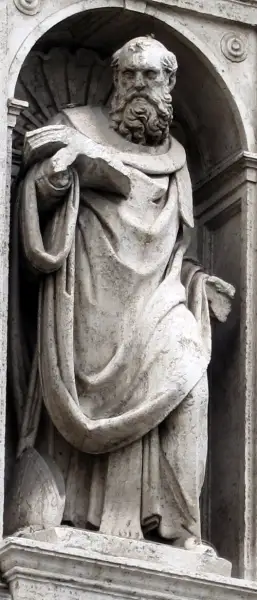
Overview
Epaphras was a Christian worker of the apostolic age, named twice in the Epistle to the Colossians and once in the letter to Philemon. He is counted among the disciples honored as saints of the Catholic Church. The biblical notices are brief but warm: Paul presents him as a trusted collaborator whose service on behalf of the congregation at Colossae deserved public acknowledgment. Modern scholarship, notably Douglas Moo's commentary on Colossians, concludes that Epaphras was a native of Colossae and was probably brought to the faith through Paul's own preaching during the apostle's time in Ephesus. His appearance as a named co-worker at a significant point in a Pauline letter is uncommon, and the strength of the apostle's praise for him stands out. Tradition has attached the crown of martyrdom to his memory, and he continues to be listed among the early witnesses whose sanctity was accepted before any formal process of canonization existed. Though the sources tell us little about his life beyond these Scriptural mentions, his importance lies in the role he played as a bridge between Paul's missionary work and the young church in the Lycus Valley, and in the affection the apostle plainly felt for him.
The Complete Life
A Native of Colossae in the Service of the Apostle
The picture of Epaphras that emerges from the New Testament is drawn with only a few strokes, yet those strokes are telling. He appears in the Epistle to the Colossians on two occasions and once more in the short, personal letter to Philemon, and in each case he stands close to Paul as a proven collaborator. Douglas Moo, in his commentary on Colossians, draws from these notices the reasonable inference that Epaphras belonged to Colossae itself, a city of the Lycus Valley in Asia Minor, and that his conversion may well have taken place under Paul's preaching during the apostle's extended stay in Ephesus. If so, Epaphras was one of those converts who did not remain a hearer only, but became a worker in his turn, carrying back to his own region the faith he had received. Moo also observes how unusual it is for Paul to name a co-worker at the point in the letter where Epaphras appears, and how striking the strength of the apostle's endorsement is, together with the commendation recorded in Colossians 4:12-13. Such language suggests a man whose labor and intercession had cost him something, and whom Paul regarded with complete confidence. In this Epaphras exemplifies the second generation of Christian workers: converted through the apostolic preaching, then entrusted with the care of congregations the apostle himself had not founded.
§ Analysis
Remembrance Among the Saints of the Early Church
Although the Scriptural record of Epaphras is slight, the Church has never treated brevity of testimony as brevity of sanctity. He stands in the ancient catalogue of disciples who are venerated as saints of the Catholic Church, listed alongside companions of the apostles such as Archippus, Aristarchus, Tychicus and Onesimus, the very circle of names that surrounds him in the Pauline correspondence. His memory is likewise fixed within the tradition of the Epistle to Philemon, where he is counted among the persons of that letter together with Paul, Philemon, Onesimus and Archippus. Icons and popular devotion give him the attribute of Christian martyrdom, an indication that early tradition preserved the belief that his service ended in the shedding of blood, as was the lot of so many who carried the Gospel through the first century. Because his sanctity was acknowledged from the Church's earliest days, long before the development of formal canonization processes, he is honored as a pre-congregational saint: raised to the altars not by decree but by the continuous devotion of the faithful. His feast is not fixed in the universal calendar with any certainty, and the ancient sources are silent about the details of his death, yet his name endures wherever the letters to the Colossians and to Philemon are read.
§ Epaphras
In Their Own Words
Little is known about him, though we can infer that he was a native of Colossae and that he was perhaps converted by Paul himself during the apostle's ministry in Ephesus. The mention of a co-worker at this point in a Pauline epistle is unusual, and the strength of Paul's endorsement of him is also striking.
The Record
- Symbols
- Christian martyrdom
- Canonization
- Pre-congregation; venerated from antiquity among the disciples recognized as saints of the Catholic Church
Prayer
Bibliography
Show 2 sources
- The Greek New Testament. Stuttgart: Deutsche Bibelgesellschaft United Bible Societies. 2007. pp. 685, 695 & 740. ISBN 9783438051103.
- Moo, Douglas J. (2008). The Letters to the Colossians and to Philemon. Grand Rapids: William B. Eerdmans Publishing Company. p. 90. ISBN 9781844743414.
Profile text adapted from the Wikipedia article, licensed CC BY-SA 4.0.
Pray with this saint every day
Save St. Epaphras to your favorites, read the full profile, and get feast-day reminders in the Saints app.
Get the Saints AppFree on the App Store for iPhone and iPad