
c. 1st century AD·Feast 22 March (Roman Catholic); 30 March (Eastern Orthodox)
St. Epaphroditus
Envoy of the Philippians and Apostle of the Seventy
Overview
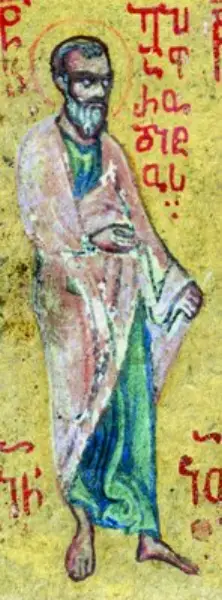
Epaphroditus was a Christian of the first century, a native of Philippi in Macedonia, whom the church of that city chose as its envoy to the Apostle Paul. He appears in the New Testament only in the Letter to the Philippians, where Paul sends him back to his home community with a tribute of remarkable warmth, calling him his brother, his fellow worker, and his fellow soldier. Carrying the Philippians' gift to Paul during one of the apostle's imprisonments, whether at Rome or at Ephesus, he stayed on to serve him, attending to his needs and assisting in the work of evangelization. His devotion exacted a heavy price: he labored so hard that he fell seriously ill and nearly died, news of which alarmed his friends at Philippi. When he recovered, Paul sent him home with the letter that bears the community's name, asking that he be received with joy and honored. Later tradition identifies him as one of the Seventy Disciples and as the first Bishop of Philippi, while other accounts associate him with Andriaca and with Terracina in Italy, though proof that these several titles all describe one individual is scant. East and West alike number him among their saints.
The Complete Life
The Envoy of a Generous Church
Epaphroditus emerges onto the stage of history as the trusted delegate of the Christian community at Philippi, a Macedonian city that had become one of the proudest jewels of Paul's mission. When that church resolved to send material help to the apostle, who was then enduring an imprisonment at Rome or possibly at Ephesus, it was Epaphroditus they entrusted with the sacred task of carrying their gift. The choice of messenger tells its own story: the Philippians would not hand so precious a charge to anyone but a man of proven character. Paul himself, in the letter he later wrote back to Philippi, uses language that rises in intensity as it unfolds. He calls Epaphroditus his brother, acknowledging a shared faith; his fellow worker, acknowledging a shared labor; and his fellow soldier, acknowledging shared danger, toil, and suffering. The commentator Lightfoot observed that these three titles form an ascending scale of intimacy and esteem. The letter also applies to Epaphroditus a word drawn from civic life, leitourgos, the term for a public servant, often a man of means who discharged expensive duties for his city. This suggests that Epaphroditus ranked among the more prosperous members of the congregation at Philippi, a man whose private means could swell what the whole community sent.
§ Biography
Service, Sickness, and the Journey Home
Having delivered the Philippians' gift, Epaphroditus did not treat his mission as complete. He stayed at Paul's side and threw himself into what the apostle calls the work of Christ, acting at once as the prisoner's attendant and as his helper in the preaching of the Gospel. The strain proved greater than his body could bear. He fell gravely ill, and in the plain words Paul uses, he was sick to the point of death. Word of his condition, in those days of slow and uncertain communication, eventually reached the Philippians, and alarm for their messenger spread through the Macedonian community. Mercifully, Epaphroditus recovered, and Paul saw in his restoration a deliverance that spared the apostle sorrow upon sorrow. The letter to the Philippians is, in part, the document that accompanied the convalescent envoy on his homeward journey: Paul sent him back to quiet the anxiety of his friends, and with him he sent instructions that the church should welcome him with joy and hold in honor men like him. The apostle even explains that Epaphroditus had risked his life to make up for the help the Philippians themselves could not personally give. The biblical commentator William Barclay has added a further speculation, suggesting that Epaphroditus may be the most likely candidate for the unnamed arbitrator Paul asked to mediate between Euodia and Syntyche, two women of the Philippian church.
§ Biography
Among the Seventy and the Bishops of Philippi
The memory of Epaphroditus grew in the centuries after his death, though the traditions that surround his name do not always agree with one another. Hippolytus, in his ancient list of the Seventy Disciples whom the Lord sent out beyond the Twelve, includes Epaphroditus under the title bishop of Andriace, one of at least two ancient towns bearing that name, one in Thrace and one in Asia Minor. Other traditions honor him as the first Bishop of Philippi, a natural dignity for the man whom the Philippian church trusted above all its members, while a further line of commemoration makes him first Bishop of Terracina in Italy. Careful scholars caution that there is little evidence these offices belonged to one and the same man; the name Epaphroditus was exceedingly common in the Roman period, derived from Aphrodite and corresponding to the Latin Venustus, and it appears constantly in Greek and Latin inscriptions, sometimes in its contracted form Epaphras. Indeed, some have wondered whether the Epaphras of Colossians and Philemon might be a shortened form of this same name, though commentators judge this a coincidence, noting that the Epaphras of those letters lived in Colossae and was probably a different person. What endures is not the confusion of later titles but the apostle's own threefold witness, and the feast kept for him each year by both East and West.
§ Epaphroditus
In Their Own Words
My brother and fellow-worker and fellow-soldier.
He was ill, and almost died.
The Record
- Canonization
- Pre-congregation; venerated in the Eastern Orthodox Church and the Roman Catholic Church
Prayer
Bibliography
Show 6 sources
- Monks of St. Augustine Abbey. "Epaphroditus (St.)", The Book of Saints, A&C Black Ltd., London, 1921.
- Bruce, Frederick F., 1989, Philippians, New International Biblical Commentary, New Testament Series, edited by W. Ward Gasque (Repr. Peabody, Mass.: Hendrickson, 2002), 99.
- Lightfoot, J.B., Philippians (1868, McGrath ed. 1994) 147.
- Peterlin, Davorin (1997). Paul's Letter to the Philippians in the Light of Disunity in the Church. Supplements to Novum Testamentum. Boston: Brill Academic Publishers. pp. 200-5. ISBN 978-90-04-10305-4.
- John Reumann, Philippians, AB (2008) 13-14.
- John Walvoord, Philippians: Triumph in Christ, Everyman's Bible Commentary (Chicago, Ill.: Moody Press), 1971, 71.
Profile text adapted from the Wikipedia article, licensed CC BY-SA 4.0.
Pray with this saint every day
Save St. Epaphroditus to your favorites, read the full profile, and get feast-day reminders in the Saints app.
Get the Saints AppFree on the App Store for iPhone and iPad