
died 64·Feast July 30
St. Epenetus of Carthage
First convert of Asia and bishop among the Seventy
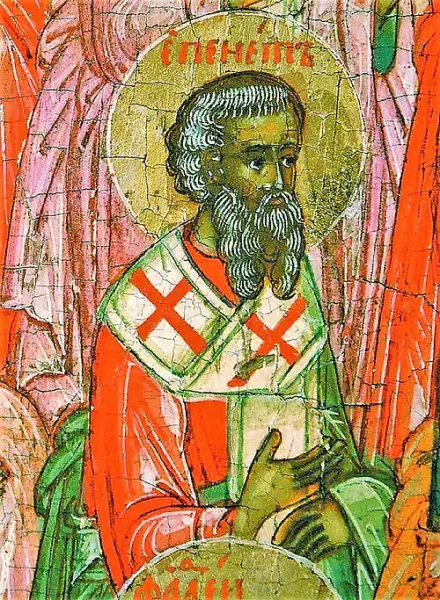
Overview
Epenetus, sometimes written Epaenetus, is a saint of the earliest Christian generation, honored by both the Greek Orthodox Church and the Roman Catholic Church and numbered among the Seventy Disciples. His name appears exactly once in the New Testament, in the sixteenth chapter of Paul's Letter to the Romans, yet the apostle's greeting to him is among the most affectionate in the whole letter: Paul calls him his beloved and grants him a title no other Christian of the region shares: the first of Asia's harvest to believe. His conversion is placed at Ephesus, the great city where Paul ministered, making Epenetus the opening sheaf of what became a rich harvest throughout the Roman province. Later tradition expanded his story: the lists of the Seventy compiled under the names of Pseudo-Dorotheus and Pseudo-Hippolytus present him as Bishop of Carthage, though some accounts give the see as Cartagena. The Greek Orthodox Church keeps his memory on January 4, when it commemorates all the Seventy together, and again on July 30, when he is celebrated alongside the Apostles Silas and Silvanus, Crescens, and Andronicus. He is said to have died in the year 64, and although the surviving record of his deeds is slight, his forever being linked to the apostle's own words has kept his name alive in the canon of the saints.
The Complete Life
The Beloved Firstfruits of Asia
Every great mission has its first convert, and for the evangelization of the Roman province of Asia that person was Epenetus. The New Testament preserves his name in a single verse of Paul's Letter to the Romans, yet within that brief greeting the apostle bestows a double honor. He calls Epenetus his beloved, a word of deep personal tenderness addressed to few, and he hails him as the one from whom the whole Asian harvest began, the great territory of western Asia Minor whose capital was Ephesus. The tradition of the Church locates his conversion precisely in that city, where Paul preached and taught, and it is there that the firstfruits of the Asian mission were gathered in. To be the first is a singular vocation: Epenetus believed before his neighbors, suffered whatever suspicion and danger fell to the earliest Christians of Ephesus, and by his steadfastness prepared the ground for the congregations that would later flourish across the province. Paul did not write his letter to the Romans to praise Epenetus, and yet the apostle's salutations are a gallery of quiet heroes, men and women whose faith had reached the apostle's ear. That Epenetus stands among them, named and honored, is testimony that his conversion was no passing event but a life that bore fruit long after the day he first believed.
§ Epenetus of Carthage
Among the Seventy and the See of Carthage
The memory of Epenetus did not end with the apostolic age. The Church of the early centuries counted him among the Seventy Disciples whom the Lord sent out to preach, and his name passed into the two great lists of that company, those compiled under the names of Pseudo-Dorotheus and Pseudo-Hippolytus. In those catalogs he bears an episcopal title: he figures as Bishop of Carthage, the storied city of North Africa, though some versions of the tradition give the see as Cartagena in Spain, and the two towns have been confused since antiquity. Whichever city claimed him, the title witnesses to an early and widespread conviction that the firstfruits of Asia became in time a shepherd of churches. His cult took firm root in the Greek East. The Orthodox Church remembers him on January 4 in the general synaxis of the Seventy, and keeps a fuller commemoration on July 30, when he is honored in the company of the Apostles Silas and Silvanus, Crescens, and Andronicus. The Roman Catholic Church also venerates him, keeping his feast on July 30. Tradition assigns his death to the year 64, within the lifetime of the apostles. Though his earthly career is thinly recorded, his double commemoration and his place in the apostle's own letter give him a permanence that many better-documented figures have failed to attain.
§ Epenetus of Carthage
In Their Own Words
My beloved.
The Record
- Canonization
- Pre-congregation; venerated in the Greek Orthodox Church and the Roman Catholic Church
Prayer
Bibliography
Show 3 sources
- Richard, Charles Louis (1824). Bibliothèque sacrée, ou Dictionnaire universel historique, dogmatique, canonique, géographique et chronologique des sciences ecclésiastiques. Boiste fils ainé.
- Thomas Kelly Cheyne and John Sutherland Black, ed. (1903). Encyclopaedia Biblica.
- "Apostle Epenetus of the Seventy", Orthodox Church in America.
Profile text adapted from the Wikipedia article, licensed CC BY-SA 4.0.
Pray with this saint every day
Save St. Epenetus of Carthage to your favorites, read the full profile, and get feast-day reminders in the Saints app.
Get the Saints AppFree on the App Store for iPhone and iPad