
1st century·Feast September 21 (Roman Catholic); November 16 (Eastern Orthodox)
St. Ephigenia of Ethiopia
Virgin consecrated by St. Matthew the Apostle
Overview
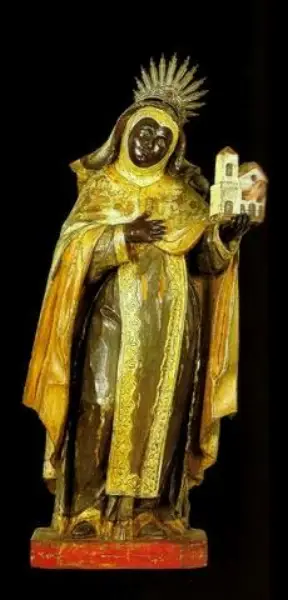
Ephigenia of Ethiopia, also called Iphigenia or Iphigenia of Abyssinia, is a folk saint whose story has been told since the Middle Ages, above all in the Golden Legend compiled by Jacobus de Voragine around 1275. According to the legend, she was a princess, daughter of the Aethiopian king Egippus, who heard the preaching of Matthew the Apostle when he brought the Gospel to the region called Ethiopia. She was converted, baptized, and consecrated to God as a virgin, veiled by the apostle's own hand, and her example drew other virgins to live together under her as their superior in prayer and work. When King Hirtacus succeeded her father, he demanded her in marriage and promised Matthew half his kingdom if he could persuade her. Matthew replied that she had given her hand to a greater spouse than any earthly throne could offer, and the king's fury ended at the church altar, where he had the apostle slain, making him a martyr. Attempts to force Ephigenia and destroy her home by fire were turned back by heavenly intervention, and Hirtacus himself contracted leprosy and came to a miserable end. Her brother then reigned for seventy years, and his son filled Egypt with Christian churches. The Roman Martyrology records that she ended her holy life in peace. Her devotion, carried to Spain, Brazil, and Peru, made her beloved especially among communities of the African diaspora.
The Complete Life
A Princess of Aethiopia
In the story preserved by medieval hagiographers, Ephigenia was born to royalty, the daughter of Egippus, king of the Aethiopians. The Ethiopia of the legend is itself a matter of scholarly care: in ancient usage the name could point to the Africa of the Kushites, but it could also designate a so-called Asiatic Ethiopia, located in the provinces of Mesopotamia or in the region of Colchis near ancient Armenia, which Jerome and Sophronius called a second Ethiopia. However her geography is resolved, the legend is unanimous about her station and her destiny. Into the court of her father came Matthew the Apostle, who had drawn that region as the field of his preaching. There the princess heard the Gospel and believed. She was not merely a convert of convenience: she was baptized, and then consecrated to God by Matthew himself, who veiled her as a virgin dedicated to Christ. The Roman Martyrology preserves this double grace in a single sentence, recording that she was both baptized and consecrated by the blessed apostle. Weninger's nineteenth-century account adds that she had sat often under the apostle's teaching on the surpassing worth of chastity and had purposed in her heart to keep that treasure unsullied. Her father's house thus gave to the Church not a queen but a bride of Christ, and the royal blood that might have governed a kingdom was given instead to the service of a spiritual family of virgins gathered under her care.
§ Hagiographic life
Consecrated by the Apostle's Hand
The vocation of Ephigenia was extraordinary from its first moment, for the legend records no other virgin of the apostolic age whom an apostle personally veiled. According to the account, Matthew the Apostle converted her to Christianity and then consecrated her to God, and her consecration was not a private resolve but a public, ecclesial act: she was set apart, veiled, and recognized as belonging wholly to Christ. Weninger's Lives of the Saints describes the fruit of her example. His preaching on the surpassing worth of chastity, and his appeals that others treasure it, had sunk deep into her heart over many hearings, and with his awareness and approval she made over her virginity to the Most High. Her example drew a whole company of virgins after her, and choosing the princess as their superior, they lived together in community, occupying their time in prayer and work. In this the legend shows one of the earliest portraits of consecrated life: a household of women bound together not by law but by a shared vow, under a superior drawn from their own number, sustaining themselves by labor while their days were ordered by prayer. The Anglican Breviary's account of Matthew's mission, cited by the Anglican Catholic Church, likewise relates that the royal family was converted through the apostle's wondrous deeds, and that Ephigenia, through his teaching, had vowed herself to God. Her vocation thus predates by centuries the great monastic founders, and stands as a witness that the desire for consecrated virginity flourished wherever the Gospel was first preached.
§ Anglican Catholic Church
The Refusal That Cost an Apostle's Blood
The crisis of Ephigenia's life came with the succession of Hirtacus to the throne of Aethiopia. The new king desired the consecrated virgin for his wife and promised Matthew half of his kingdom if the apostle could persuade her to the marriage. Matthew chose instead to teach the king. He bade the king attend mass on the following Sunday, and there set before him the truth: the princess had taken as her spouse the King of heaven, and no earthly union could now be hers. Hirtacus strode out of the church seething, and shortly afterward sent a swordsman to the church, where Matthew was killed standing by the altar, thereby sealing the apostolate with martyrdom. But the story does not end with the apostle's blood. Hirtacus, having failed to bend Ephigenia to his will, attempted to destroy her home with fire. Matthew appeared in spirit and protected the house, turning the flames back upon the royal palace. Then heaven's verdict fell: a demon took possession of the prince, and leprosy fastened on the king, an affliction from which his only escape proved to be self-destruction. With the tyrant gone, the nation set Ephigenia's brother on the throne; his seventy-year reign passed in time to a son who dotted Egypt with churches. In the economy of the legend, the faithfulness of one virgin became the seed of a Christian dynasty: her refusal cost a martyr's life, and that martyrdom won a nation.
§ Hagiographic life
Virginity, Community, and the School of the Golden Legend
The spiritual inheritance of Ephigenia is inseparable from the book that carried her story: the Golden Legend of Jacobus de Voragine, compiled around 1275. Few books did more to form the piety of the Renaissance and the age's very idea of holiness; readers took it up not merely as a gallery of saints but as a vade mecum, a practical guide to the ascetic life, and Ignatius of Loyola used it precisely so, and Teresa of Avila advised her spiritual sisters to use it likewise. Within that tradition Ephigenia stands for a distinct type of sanctity: the consecrated virgin whose holiness is lived in community rather than in the desert or the arena. Weninger's account makes the shape of her spirituality explicit, a life of prayer joined to work, ordered under a superior chosen from among the virgins themselves. The Bollandists, whose whole craft is to set the saints' lives within their historical settings, admitted that Matthew's Ethiopian journey cannot be taken as certain, though they judged the tale to square with the period's other sources and apocrypha, and noted that Ephigenia's story was composed as a companion piece to the absorbing medieval fascination with the apostle's death. Modern academics sound a further note of care: such medieval texts were never meant as documentary reportage, and those who wrote them served purposes other than a neutral registry of their era. Even so, the portrait that survives is spiritually coherent: a soul espoused to Christ, loyal unto blood, radiant enough to gather others into the same consecration.
§ Roman Catholic Church
Ending Her Holy Life in Peace
Unlike the apostle whose preaching converted her, Ephigenia was not called to a martyr's death. The Roman Martyrology, in the entry that has fixed her memory for centuries, records simply that in Ethiopia the virgin Iphigenia, whom the blessed apostle Matthew had baptized and set apart for God, closed her holy life in peace. The Ramsgate Benedictines' Book of Saints retells the same outline while sounding a sober scholarly note: the surviving Acts of St. Matthew are so untrustworthy that nothing said there of her can be credited. Bunson's Encyclopedia of Saints concurs that nothing else dependable about her survives, assigning her death to the first century. The Orthodox tradition preserves a parallel but distinct memory: the Synaxarion according to Nikephoros Kallistos Xanthopoulos tells of Matthew laboring in a city called Mirmena, in a land of cannibals, where he appointed his fellow traveler Platon as bishop and built a little church, though that account does not name Ephigenia directly. Tellingly, the official Greek and Russian Synaxaria pass her over, and so do those of the Copts and the Ethiopians, an absence that has lent support to the suggestion that the Ethiopia of Matthew's mission was the Asiatic region rather than African Ethiopia. Whatever the resolution of these questions, the Church's oldest calendars agree in this: the virgin who stood firm against a king was permitted to die quietly, in the peace she had never surrendered.
§ Roman Catholic Church
From the Golden Legend to the Roman Martyrology
Ephigenia belongs to the company of saints whose veneration rests on immemorial devotion rather than formal decree. The oldest textual source of her Life is the Golden Legend of Jacobus de Voragine, compiled around 1275, and she is listed also in the hagiography of the Venetian Bishop Petrus de Natalibus, who died around 1400. Her name entered the official liturgical books of the West when she appeared in the 1586 edition of the Roman Martyrology of Cardinal Caesar Baronius, the first authoritative edition of that work. The Bollandists, the Jesuit hagiographers of the Acta Sanctorum, included an entry for Saint Iphigenia in their volume for September 21, and she was carried forward in a German-language Bollandist-derived collection of saints published in 1869. The Benedictine compilers of The Book of Saints in 1921 gave her an entry, and Our Sunday Visitor's Encyclopedia of Saints continues her listing in the present day. In the Christian East her commemoration is more fragile: the Greek Orthodox calendar does name a Saint Iphigenia the Virgin-Martyr on November 16, the day kept for St. Matthew, and there the trail ends, and she does not appear in the Prologue from Ohrid, the official Greek or Russian Synaxaria, or the Coptic and Ethiopian Synaxaria. Yet the Antiochian Orthodox Christian Archdiocese of North America does keep her on its calendar, and she is venerated in both the Catholic Church and the Eastern Orthodox Church, a folk saint whose cult proved stronger than the doubts of the learned.
§ Roman Catholic Church
Mother of a Diaspora's Devotion
The longest life of Ephigenia has been lived among the peoples of the African diaspora. Her devotion began its Atlantic journey among the Carmelites of Cádiz, where African blacks organized the Confradía de Nuestra Señora de la Salud, San Bello y Santa Ifigênia at El Puerto de Santa María in 1575; from Cádiz her cult spread to Portugal and thence to Brazil. In 1735 and 1738 the Brazilian-born priest José Pereira de Santana published at Lisbon a definitive two-volume work on Elesbaan and Ephigenia, whom he hailed as the twin pillars of African holiness, clothing them in the habit of his own Carmelite order: in Elesbaan he read the Gospel's victory over Judaism, in Ephigenia Africa's free and early welcome of the faith. On May 7, 1740, free black slaves from Cape Verde, the Coast of the Mine, São Tomé, and Mozambique founded the Venerable Brotherhood of Saint Elesbão and Saint Efigênia in Rio de Janeiro, a devotion the slaves themselves are credited with carrying across the Atlantic. At Ouro Preto in Minas Gerais there rose the Igreja de Santa Efigênia dos Pretos, founded in 1785 and built, according to tradition, from gold dust washed from the hair of devout black women, with artistic collaboration from the mulatto sculptor Aleijadinho. In Peru, the Afro-Peruvian community of Cañete centers its identity on her baroque image at the hacienda La Quebrada, and in 1994 named her Patroness of National Black Art, celebrating her each September 21 with growing processions. Writing in 1922, Gilberto Freyre recorded how the colored community threw itself wholeheartedly into her festival, a kind of black Madonna; even a martyr of the French Revolution, Blessed Sister Iphigénie of Saint Matthew, guillotined in 1794, took her name in religion from the Ethiopian princess.
§ Brazil
Timeline
- 68
After Ephigenia rejected King Hirtacus and remained faithful to her vow, St. Matthew was slain at the altar by the king's order.
§ Roman Catholic Church
- 1275
Jacobus de Voragine compiled the Golden Legend, the oldest textual source of the Life of St. Ephigenia.
§ Roman Catholic Church
- 1400
Ephigenia was listed in the hagiography of the Venetian Bishop Petrus de Natalibus, who died around this year.
§ Roman Catholic Church
- 1575
African blacks in Cádiz formed the Confradía de Nuestra Señora de la Salud, San Bello y Santa Ifigênia at El Puerto de Santa María.
§ Spain
- 1586
Ephigenia appeared in the first authoritative edition of the Roman Martyrology published by Cardinal Caesar Baronius.
§ Roman Catholic Church
- 1735
José Pereira de Santana published at Lisbon the first of his two volumes devoted to Elesbaan and Ephigenia, pillars of African sanctity.
§ Brazil
- 7 May 1740
Free black slaves founded the Venerable Brotherhood of Saint Elesbão and Saint Efigênia in Rio de Janeiro on May 7.
§ Brazil
- 1785
The Igreja de Santa Efigênia dos Pretos was founded in Ouro Preto, Minas Gerais, built largely from gold dust washed from the hair of devout black women.
§ Churches
- 7 Jul 1794
Blessed Sister Iphigénie of Saint Matthew, a Benedictine named in honor of Ephigenia, was guillotined at Orange during the French Revolution.
§ France
- 1809
The Paróquia Nossa Senhora da Conceição - Santa Ifigênia was founded in São Paulo, Brazil.
§ Churches
- Feb 1868
Santa Ifigenia Cemetery was inaugurated in February in Santiago de Cuba, bearing the saint's name.
§ Placenames
- 10 May 1925
Marie-Gabrielle-Françoise-Suzanne de Gaillard de Lavaldène, the nun known as Sister Iphigénie of Saint Matthew, was beatified by Pope Pius XI.
§ France
- 20 Aug 1994
Afro-Peruvian community leader Sabino Cañas founded the Santa Efigenia Association on August 20, naming her Patroness of National Black Art.
§ Peru
- 23 Nov 1996
A congada procession in Belo Horizonte honored Saint Iphigenia alongside Our Lady of the Rosary and Saint Benedict the Moor.
§ Brazil
In Their Own Words
In Ethiopia, St. Iphigenia, virgin, who being baptized and consecrated to God by the blessed apostle Matthew, ended her holy life in peace.
A Virgin converted to Christianity and afterwards consecrated to God by St. Matthew the Evangelist, Apostle of Ethiopia. The extant Acts of St. Matthew are however so untrustworthy that no reliance can be placed on the particulars given therein of St. Iphigenia and others of the first fruits of the Gospel in Ethiopia.
The Record
- Patron of
- against fires of buildings·Patroness of National Black Art (Afro-Peruvian community of Cañete)
- Symbols
- Depicted beside St. Matthew in scenes of his martyrdom·Wooden statues honored by Afro-Brazilian brotherhoods
- Canonization
- Pre-congregation folk saint; listed in the Roman Martyrology since Cardinal Baronius's 1586 edition
Prayer
Bibliography
Show 7 sources
- The Roman Martyrology. Transl. by the Archbishop of Baltimore. Last Edition, According to the Copy Printed at Rome in 1914. Revised Edition, with the Imprimatur of His Eminence Cardinal Gibbons. Baltimore: John Murphy Company, 1916. p. 292.
- The Benedictine Monks of St Augustine's Abbey, Ramsgate (Comp.). THE BOOK OF SAINTS: A Dictionary of Servants of God Canonised by the Catholic Church: Extracted from the Roman and Other Martyrologies. London: A & C Black Ltd., 1921. p. 142.
- Matthew Bunson and Margaret Bunson. Our Sunday Visitor's Encyclopedia of Saints. Second Edition. Our Sunday Visitor, 2014. p. 416. ISBN 978-1612787169.
- Jacobus de Voragine, Archbishop of Genoa, 1275 (Comp.). "Here beginneth the Life of S. Matthew." In: The GOLDEN LEGEND or LIVES of the SAINTS: VOLUME FIVE. Engl. by William Caxton, First Edition 1483. Temple Classics, Ed. F.S. Ellis, 1900, reprinted 1922, 1931.
- Roberto Sánchez. "The Black Virgin: Santa Efigenia, Popular Religion, and the African Diaspora in Peru." Church History 81:3 (September 2012), 631-655.
- José Pereira de Santana. Os dous atlantes da Ethiopia Santo Elesbaõ, emperador XLVII. da Abessina, advogado dos perigos do mar, e Santa Ifigenia, princeza da Nubia, advogada dos incendios dos edificios, ambos carmelitas. Lisboa, A.P. Galram, 1735-38.
- "St. Ephigenia of Ethiopia." The Self-Ruled Antiochian Orthodox Christian Archdiocese of North America. Retrieved: 6 September 2016.
Profile text adapted from the Wikipedia article, licensed CC BY-SA 4.0.
Pray with this saint every day
Save St. Ephigenia of Ethiopia to your favorites, read the full profile, and get feast-day reminders in the Saints app.
Get the Saints AppFree on the App Store for iPhone and iPad