
died c. 1098·Feast January 28; September 28; Second Sunday of Great Lent
St. Ephraim of Pereyaslavl
Bishop of Pereyaslavl and builder of the Russian Church
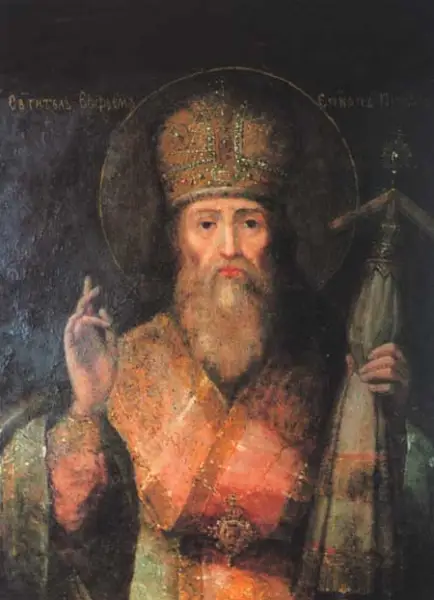
Overview
Ephraim of Pereyaslavl, also called Ephraim of the Caves, was a bishop of Pereyaslavl in Kievan Rus' whose memory the Eastern Orthodox Church keeps as that of a saint. He is thought to have been a Greek by origin, he first served as treasurer and steward of household affairs at the court of Grand Prince Iziaslav Yaroslavich. Weighed down by the noisy bustle of courtly life, he longed for the monastic habit, and found his way to Anthony of Kiev, and on 23 March Nikon, at that time hegumen of the Kiev Pechersk Lavra, gave him the habit. The prince's fury at losing his steward only ended when he feared the wrath of God and withdrew his threats against the monastery. Blessed by Anthony, Ephraim journeyed to Constantinople, where he settled in a monastery and transcribed the Studite monastic rule and brought it to Kiev for Theodosius, who at once enacted it in the Lavra; from there it spread until it governed the Russian monasteries of that whole age. After 1072 he was made bishop of Pereyaslavl with the title of metropolitan, raising churches and civic buildings, girdling the town with Byzantine-style masonry defenses, and opening hospices without charge to the needy and to wayfarers, together with bath-houses for the townsfolk. In 1091 he took part in the solemn transfer of the relics of Theodosius. His death came in 1098, and his resting place is the Church of the Presentation among the Near Caves of the Lavra.
The Complete Life
Steward of a Grand Prince's House
The future bishop of Pereyaslavl entered the world's service before he entered the Church's. He is thought to have been a Greek by origin, a circumstance that may account both for his later journey to Constantinople and for his taste for building after the Byzantine fashion. His documented career begins at the summit of East Slavic society: from 1054 to 1068 he served as treasurer and steward of household affairs at the court of Grand Prince Iziaslav Yaroslavich of Kiev, one of the sons of Yaroslav the Wise. The office made him a man of consequence, entrusted with the wealth and daily governance of a grand prince's establishment. Yet this promotion weighed upon him. The noisy and bustling existence of the court pressed on his soul, and amid the accounting of revenues and the management of a great household he nurtured a single desire: to become a monk. His story belongs to that small company of high officials who, like the tax collectors of the Gospel, heard a call out of the midst of their prosperity. Everything else in his long life, his pilgrimage to Constantinople, his episcopate, his churches and hospices, flowed from that first interior verdict that the palace, for all its grandeur, was no place for a soul that had glimpsed the Kingdom.
§ Life
The Tonsure That Angered a Prince
Ephraim's renunciation of his court office was no quiet departure. Anthony of Kiev, founder of the Kiev Pechersk Lavra, received him into the monastic life, and on 23 March the rite of tonsure was performed by Nikon, at that time the monastery's father superior. When Grand Prince Iziaslav learned that his treasurer had become a monk of the Caves, his anger blazed; he demanded his steward back, swearing to cast him into prison and to raze the Pechersk Lavra itself. The confrontation escalated to the point that Anthony and the brethren abandoned the monastery and resolved to depart for another place rather than submit. At this crisis the prince's heart was changed: the fear of God came upon Iziaslav; on his wife's counsel he pulled his men back from the monastery, discredited. The episode, remembered among the early trials of Russian monasticism, sealed Ephraim's vocation in bloodless martyrdom of a kind: he had counted the loss of a prince's favor, and even the threat of imprisonment, as nothing beside the habit of a monk. With his worldly bonds finally severed, he received Anthony's blessing for a further desire, pilgrimage to the holy places abroad, and set out for Constantinople, where he settled in one of the monasteries of the imperial city and drank deeply of its ancient monastic tradition.
§ Life
The Studite Rule and the Building of Pereyaslavl
Ephraim's mission unfolded along two great lines, one hidden and one visible. The hidden labor was accomplished in Constantinople: while dwelling in one of its monasteries, he transcribed the celebrated discipline of the Studion, and at the request of Theodosius of Kiev he carried it back to the Caves. As soon as Theodosius received the rule he implemented it in the Pechersk Lavra, and from there the Studite rule became the prevailing rule for the Russian monasteries of that time. One steward's copying hand thus shaped the whole of Russian monasticism. The visible labor came after 1072, when Ephraim was made bishop of Pereyaslavl with the title of metropolitan. He governed his see as a builder in stone. Pereyaslavl gained from his hands a host of fine churches and civic structures, and masonry ramparts after the Byzantine pattern closed the city round against the frontier's dangers. His charity took architectural form as well: he erected free hospices for the poor and for travelers, and constructed several public bath-houses for the health and cleansing of his people. A literary work also bears his name, for a tale and encomium in honor of Nicholas the Wonderworker is ascribed to him, evidence of a bishop who cultivated letters as well as stones.
§ Life
Poverty of Spirit in High Office
The spirituality of Ephraim was formed in the school of the Kiev Caves and completed in Constantinople, and its marks are visible throughout his career. From Anthony and Nikon he received the severe, wholly given monasticism of the first Russian hermits; from the capital of Orthodoxy he absorbed the Studite tradition, whose rule joined liturgical splendor to practical discipline and communal order. It is characteristic of the man that when he possessed something valuable he did not keep it: the rule he copied at such pains was handed over at once to Theodosius for the good of the whole Lavra, and through the Lavra to every Russian monastery. As bishop he carried the monk's contempt of comfort into public life. The hospices he built were free, open specifically to the poor and the wayfarer, and the bath-houses answered the bodily needs of ordinary townspeople, works that a merely worldly prelate would not have thought to count among his glories. His devotion found expression too in letters: the tale and encomium of Nicholas the Wonderworker that bears his name witnesses to a love of the great merciful bishop of Myra, another shepherd celebrated for secret gifts to the poor. A Life of St. Ephraim once existed, though it has not survived; his account must be gathered from the Life of St. Theodosius and from the Russian chronicles, which is fitting for a saint whose whole ambition was to serve without display.
§ Life
The Relics of Theodosius and a Quiet Death
Ephraim's last recorded public act joined him to the saint whose rule he had helped install. In 1091 he participated in the opening of the grave and the solemn transfer of the relics of Theodosius of Kiev, the great abbot of the Caves, an event of immense importance in the sanctification of the Russian Church, for it placed the first Russia-born saint publicly in the shrine of his own monastery. The old bishop, who had known Theodosius and served the Lavra's reform, stood among the clergy as the incorrupt body of the hesychast abbot was borne to its new resting place. Soon afterward his own pilgrimage closed. Ephraim's death came in 1098, within the span of years his sources allow, and his body was laid in the Church of the Presentation among the Near Caves of the Kiev Pechersk Lavra — the monastery whose habit he had worn since the day he fled a prince's anger. A Life of St. Ephraim existed in former times but has not survived, so that the details of his final years are lost; what the chronicles preserved suffices. He had been a steward, a monk, a pilgrim, and a bishop, and he ended where he began his true life, in the Caves.
§ Life
Veneration Among the Saints of the Caves
Ephraim has been venerated as a saint in the Eastern Orthodox Church since the earliest generations of Russian Christianity, his sanctity acknowledged before any formal mechanism of canonization existed. His relics rest in the Near Caves of the Kiev Pechersk Lavra, the great necropolis of Kyivan saints, where his burial in the Church of the Presentation made him a neighbor of the monks and bishops whose incorrupt remains made the Caves a Holy Mountain of the north. His principal shrine remains the Lavra itself. The Church keeps his memory on three occasions: on 28 January, on 28 September, and on the second Sunday of Great Lent, when Orthodox Christians commemorate all the venerable fathers of the Kiev Caves together. This triple commemoration places him twice in the general calendars of the Caves fathers and once in the great Lenten synaxis, a pattern of honor usually reserved for monks and bishops of undisputed sanctity. In the hagiographic tradition he is styled Venerable, the title given to monastic saints who conquered the flesh by fasting and prayer, and he appears in the Lives of All Saints of the Orthodox Church. Modern scholarship continues to study him as Ephraim of the Caves, bridging the court of Iziaslav and the desert of Anthony.
§ Life
The Rule That Shaped Russian Monasticism
The enduring legacy of Ephraim of Pereyaslavl rests on foundations both spiritual and material. The most far-reaching was accomplished in a single act of fidelity: his copy of the Studite rule, carried from Constantinople to Kiev for Theodosius, was put in force in the Pechersk Lavra and went on to govern the Russian monasteries of that era. Every subsequent Russian and Ukrainian monastery that prayed, worked, and governed itself by the Studite discipline traces the lineage of its daily order back through Ephraim's travels. In material terms, he left Pereyaslavl transformed: beautiful churches, public buildings, ramparts built after the Byzantine fashion, free shelters for the destitute and for wayfarers, and bathing houses open to the town — a program of urban Christian charity rare in its age and a model of episcopal stewardship. His literary monument, the tale and encomium of Nicholas the Wonderworker ascribed to him, makes him one of the earliest named authors of the Rus' church. The memory of his life was thought important enough that a Life of St. Ephraim was composed, and though that work has perished, his deeds survive in the Life of St. Theodosius and in the Russian chronicles. Historians such as A. V. Nazarenko continue to fix his dates and his place in the generation of Anthony, Theodosius, and Nikon. He is remembered as the treasurer who found a greater treasury, and the builder whose churches outlasted the walls of his prince.
§ Life
Timeline
- 1054
Ephraim began serving as treasurer and steward of household affairs at the court of Grand Prince Iziaslav Yaroslavich, a post he held until 1068.
§ Life
- 1072
After 1072, Ephraim was made bishop of Pereyaslavl, bearing the title of metropolitan.
§ Life
- 1091
He stood among the clergy at the opening of the grave and the solemn translation of the relics of St. Theodosius of the Kiev Caves.
§ Life
- 1098
Ephraim's earthly course ended in 1098; his body rests in the Church of the Presentation among the Near Caves of the Lavra.
§ Life
The Record
- Major works
- Tale and encomium of Nicholas the Wonderworker (ascribed to Ephraim)
- Canonization
- Pre-congregation; venerated as a saint in the Eastern Orthodox Church from earliest times
Prayer
Bibliography
Show 1 sources
- Nazarenko, A. V. (2008). "Ефрем Печерский" [Ephraim of the Caves]. Православная энциклопедия [Orthodox Encyclopedia]. Vol. XIX: Ефесянам послание — Зверев. Православная энциклопедия. pp. 36-40. ISBN 978-5-89572-034-9.
Profile text adapted from the Wikipedia article, licensed CC BY-SA 4.0.
Pray with this saint every day
Save St. Ephraim of Pereyaslavl to your favorites, read the full profile, and get feast-day reminders in the Saints app.
Get the Saints AppFree on the App Store for iPhone and iPad