
died c. 1101/1103
St. Ephrem Mtsire
Georgian monk, translator and defender of church autocephaly
Overview
Ephrem Mtsire — called Ephraim the Lesser in Georgian tradition — was an eleventh-century Georgian monk, theologian, philosopher and philologist who spent his working life in the Greek East. Records of his career survive only in outline. His father, the Tao nobleman Vache Karich'isdze, relocated to Constantinople in 1027, and the boy apparently received there the deep Greek schooling that shaped his later work. As a young man he embraced monastic life at the Black Mountain near Antioch, home to a flourishing Georgian community of roughly seventy monks. Around 1091 he was made hegumen of the Kastana monastery, probably identified with the Castalia spring at Daphne outside Antioch. His lasting importance lies in translation: he was the first to introduce literal, word-faithful rendering into Georgian, opening scholia and lexica to Georgian readers. His versions of the Greek Fathers and his treatise defending the autocephaly of the Georgian Church made him a foundational figure in the nation's literary history.
The Complete Life
A Georgian Noble's Son in Constantinople
Ephrem's origins survive only in the barest outline. Georgian sources name his father as Vache Karich'isdze, a nobleman from Tao, the historic Georgian borderland. In 1027 this man moved to Constantinople, and it is presumably in the imperial capital — the greatest center of Greek learning in the Christian world — that the future monk received the thorough Hellenic education his later career presupposes. Nothing else is recorded of his childhood, his mother, or the circumstances that carried a Georgian noble's son toward the monastic habit. Yet the outline makes plain the unusual double formation that resulted: a writer entirely at home in Georgian, the language of his family and church, and in Greek, the language of the theology he would one day transmit. That combination was rare enough to matter. Eleventh-century Georgia possessed a rich native literary tradition, but much of the patristic inheritance reached it through imperfect channels; a translator formed young in both cultures was precisely what the scholarly circles of the Georgian diaspora at Antioch and on the Black Mountain required. Everything Ephrem later achieved followed from this early grounding in two languages and two literary worlds.
§ Ephrem Mtsire
Monk of the Black Mountain
The setting of Ephrem's mature life was the Black Mountain near Antioch, a ridge that sheltered one of the liveliest monastic colonies of the Georgian diaspora. There a community of about seventy Georgian monks lived within reach of Greek scholarship, copying, studying and translating; it was in this environment that Ephrem took the monastic habit and, in all likelihood, began the translational labors for which he is remembered. His gifts did not long remain hidden. Around 1091, late in his life, he was raised to the leadership of the Kastana monastery, probably to be identified with the site of the Castalia spring at Daphne, just outside Antioch. As hegumen he stood at the head of a house rooted in the same Greco-Georgian frontier culture as the Black Mountain, responsible for the liturgical and intellectual life of his monks. The office tells its own story: the Georgian translation projects of Antioch demanded not only linguistic brilliance but organizational steadiness, and monastic communities did not entrust such authority to untested men. By the last decade of the eleventh century Ephrem had become one of the recognized figures of Georgian monasticism in the East.
§ Ephrem Mtsire
The Father of Literal Translation
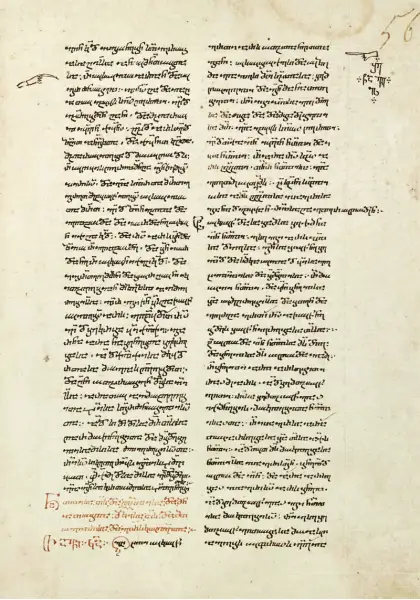
Ephrem's importance to Georgian literature rests on a methodological revolution. Earlier Georgian translators had often worked freely, paraphrasing or expanding their Greek originals; Ephrem introduced literal rendering — a word-faithful technique that treated the source text with exactness — and through him scholia and lexica became reading familiar to Georgians for the first time. The authority of this hellenophile approach proved fundamental for the later development of Georgian letters. Among his notable versions were works of Pseudo-Dionysius the Areopagite, Basil of Caesarea, Ephrem the Syrian and John of Damascus, each opening a major vein of Greek theology to Georgian churchmen; a twelfth-century manuscript preserves his translation of John of Damascus's exposition of the Orthodox Faith. He also wrote as an original author. His Treatise on the Reason Why the Georgians Were Converted entered an eleventh-century quarrel between Georgian and Antiochian churchmen over the autocephaly of the Georgian Orthodox Church, and it stands in the tradition as a manifesto of that church's independence. He died around 1101 to 1103, remembered by the epithet Mtsire — 'the Lesser' — and honored as a saint in Georgian Orthodoxy.
§ Ephrem Mtsire
Timeline
- 1027
His father, the Tao nobleman Vache Karich'isdze, moved with his household to Constantinople.
§ Introduction
- 1091
Late in life he took charge as hegumen of the Kastana monastery, a house probably to be placed at the Castalia spring in Daphne, beyond Antioch.
§ Introduction
- 1103
The monk, philosopher and translator died, honored in Georgian tradition as Ephraim the Lesser.
§ Introduction
The Record
- Major works
- Literal Georgian translations of Pseudo-Dionysius the Areopagite, Basil of Caesarea, Ephrem the Syrian, and John of Damascus·Tale on the Reason for the Conversion of the Georgians·Scholia and lexica introduced to Georgian readers
- Canonization
- Pre-congregation; venerated as a saint in the Georgian Orthodox Church
Prayer
Bibliography
Show 3 sources
- "The Antiochian" (PDF). A Center for Antiochian Orthodox Christian Studies and Research. 4. 2013. Retrieved 19 December 2022.
- Fedwick, Paul Jonathan (ed., 1981). Basil of Caesarea: Christian, Humanist, Ascetic. A Sixteen-Hundredth Anniversary Symposium, p. 499. Pontifical Institute of Mediaeval Studies.
- Chelidze, Edisher. The Two Georgian Translations of the Homilies of St. Gregory Nazianzen, p. 507, in Livingstone, Elizabeth A. (ed., 1997), Studia Patristica vol. XXXIII. Peeters Publishers, ISBN 90-6831-868-3.
Profile text adapted from the Wikipedia article, licensed CC BY-SA 4.0.
Pray with this saint every day
Save St. Ephrem Mtsire to your favorites, read the full profile, and get feast-day reminders in the Saints app.
Get the Saints AppFree on the App Store for iPhone and iPad