
c. 306 – 373·Feast June 9
St. Ephrem the Syrian
Harp of the Spirit, deacon and doctor of the church
Overview
Ephrem the Syrian (c. 306–373) is the greatest poet-theologian of the Syriac-speaking church: a deacon, exegete and hymnographer whose teaching songs permanently shaped the liturgy of Eastern Christianity. Born in Nisibis on the Roman frontier — modern Nusaybin in Turkey — he grew up in a city where Arameans mixed with Arabs, Greeks, Jews, Parthians, Romans and Iranians, under Bishop Jacob, who appointed him a teacher of the community and probably ordained him deacon. He was baptized as a youth and became a 'son of the covenant', a distinctive Syriac proto-monastic vocation. When Shapur II of Persia besieged Nisibis in 338, 346 and 350, Ephrem celebrated the city's deliverances in verse; when the treaty of 363 surrendered Nisibis and expelled its Christians, he withdrew to Edessa, where in his last decade he flooded the confused religious marketplace with hymns defending Nicene orthodoxy against Arians, Marcionites, Manichees, Bardaisanites and gnostics. More than four hundred of his poems survive, in over fifty metrical schemes, famously sung by all-female choirs drawn from the Daughters of the Covenant. He declined a bishopric by feigning madness, tended the victims of a plague in Edessa, and died of it in 373. Pope Benedict XV declared him a Doctor of the Church in 1920.
The Complete Life
Nisibis, City of the Frontier
Ephrem was born around 306 in Nisibis — modern Nusaybin in Turkey — a city newly acquired by the Roman Empire on its Mesopotamian frontier. The religious culture around him was layered: local polytheism, Judaism and several varieties of early Christianity all lived side by side, and the streets carried Aramaic above all, with Greek and Latin reserved for administration. His own people were most likely Aramean speakers of the eastern dialect that would come to be called Syriac; internal evidence from his hymns suggests his parents belonged to the city's growing Christian community, though later hagiographers preferred to imagine his father a pagan priest of Abnil or Abizal. In 308 Jacob became the second bishop of Nisibis — the same Jacob whose signature appears among the fathers of the Council of Nicaea in 325 — and under his leadership Ephrem grew up, was baptized as a youth, and entered the 'sons of the covenant', an unusual Syriac form of proto-monastic life binding baptized believers to a stricter discipline. Jacob gave him the office of teacher — in Syriac, malpānâ, a title Syriac Christians still pronounce with respect — and it was as a teaching deacon that the rest of his life unfolded.
§ Life
Teacher and Deacon of Nisibis
Ephrem's vocation fused three offices: teacher, deacon and poet. Appointed by Bishop Jacob to instruct the community, he exercised that office through hymn-writing and biblical commentary, and in his verse he described the arrangement with pastoral imagery — himself a 'herdsman', his bishop the 'shepherd', his congregation the 'fold'. Tradition names him founder of the School of Nisibis, the establishment that later centuries would know as the Church of the East's foremost seat of learning. His first great themes were the survival of his city: Shapur II of Persia attacked Nisibis in 338, 346 and 350, and Ephrem sang the deliverances as miracles of God — the first siege held, he wrote, by Bishop Jacob's prayers; in the third, the Persians rerouted the River Mygdonius to undermine the walls, only for the Nisibenes to repair them while the elephant cavalry bogged down in the mud, an escape he celebrated by likening the city to Noah's Ark riding out the flood. When the emperor Julian's campaign of 363 ended in disaster and the new emperor Jovian surrendered Nisibis to Persia, the whole Christian population was expelled — and Ephrem, refusing episcopal consecration by feigning madness out of a sense of unworthiness, went into exile with his people.
§ Life
Edessa and the Hymns Against Heresies
Exile brought Ephrem to his second and greater field. After a first stop at Amida, he settled around 363 in Edessa, the ancient Aramaic-speaking city where the dialect of his own writing had been born. Edessa was rich in rival philosophies and religions: Nicene Christians there were simply called 'Palutians' after an early bishop, while Arians, Marcionites, Manichees, Bardaisanites and a host of gnostic groups all claimed to be the church of Christ. Into this confusion the refugee deacon threw himself, now in his late fifties, teaching — perhaps in the School of Edessa — and above all composing. His Hymns Against Heresies set dense doctrinal instruction to the memorable tunes of the rival schools, for he judged the medium of Bardaisan and Mani the right weapon against their claims, and he lamented a faithful 'tossed to and fro with every wind of doctrine'. A later Syriac writer, Jacob of Serugh, records that he drilled all-women choirs to perform his hymns, cast into Syriac folk melodies, out in the open forum of Edessa, the Daughters of the Covenant carrying his defense of the faith into the streets. In 370 he made a pilgrimage of a different kind, visiting Basil the Great at Caesarea and then the monks of Egypt.
§ Life
The Poetry of Symbols
Ephrem's theology is a theology of symbols. He drew at once on three inheritances — the methods of early Rabbinic Judaism, the science and philosophy of the Greeks, and the Mesopotamian and Persian love of mystery symbolism — and out of them built a spiritual vocabulary of startling range. Readers have traced through his works a set of recurring scenarios: the way, the robe of glory, the sons and daughters of the covenant, the wedding feast, the harrowing of hell, and Noah's Ark, which he had already made the emblem of Nisibis. Beneath them run root metaphors that organize his whole vision — the physician and the medicine of life, the mirror, the pearl, the tree of life, paradise itself. His favorite form, the madrāšâ, is built for the congregation rather than the scholar: stanzas of syllabic verse in over fifty different metrical schemes, joined by an antiphon whose melody echoes the opening of the strophe, each poem set to a traditional tune, its qālâ, named from its first line — all of those tunes now lost. In his hands theology became something a city could sing, and particularly its women: he believed women's voices belonged in the church because they were modeled on Mary, whose yes had brought salvation to all.
§ Symbols and metaphors
Plague in Edessa
After ten years in Edessa, Ephrem's life closed as it had been spent, in service. A plague struck the city, and the deacon, now in his sixties, went out to minister to its victims — distributing food and care where others fled, by the account of his tradition — until he caught the disease himself and died in 373. He was buried in Edessa, and the church he had served with verse remembered him as it remembered few others: the Sleeping-place of the dying teacher became a scene painted again and again in the dormition imagery of Syriac art. The man who had refused a bishopric by feigning madness died a deacon, as he had wished, and the titles the tradition gave him — Harp of the Spirit, Deacon of Edessa, Sun of the Syrians, Pillar of the Church — speak of a sanctity of voice and service rather than of office. The date of his death, June 9, became his feast in the Roman Catholic calendar, kept since 1969 on the day itself; for the forty-eight years before, from 1920 to 1969, the West had kept him on June 18, a date still observed in the older form of the Roman rite.
§ Life
Doctor of the Church
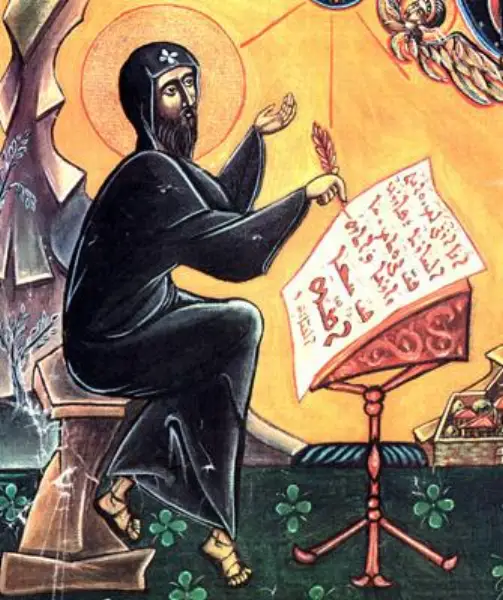
Ephrem was never canonized by process; he belongs to the ancient company of saints the whole church acclaimed. In the East he is counted among the Venerable Fathers, a sainted monk and exemplar of monastic discipline, with feasts on January 28 and on Cheesefare Saturday before Lent in the Byzantine calendar; the Syriac Orthodox keep him on the seventh Saturday before Easter, the Indian Orthodox on the first Saturday of Great Lent, the Assyrian Church of the East and the Church of England on June 9, the Copts on Epip 15, and Ethiopian Christianity twice, in remembrance of the translocation of his relics. The West added its own seal: on October 5, 1920, Benedict XV gave the West's answer, ranking Ephrem among the church's doctors as the Doctor of the Syrians, ranking the hymn-writer of Nisibis with the great theological teachers of the universal church. No father of a smaller tradition has been so received. His attributes in iconography — the vine and scroll, the deacon's vestments and thurible, the lyre — and his placement beside Basil the Great in Byzantine triptychs record the double citizenship he came to hold in both the Syriac and the Greek worlds, and, later, in the Latin church as well.
§ Veneration as a saint
A Name That Multiplied Books
Few authors have attracted so vast a shadow as Ephrem. Sozomen credited him with three million verses; over four hundred hymns genuinely survive, and the church historian's exaggeration measures the impression the real corpus made. The centuries after his passing saw Christian writers put out hundreds of works under his name — verse imitating his heptasyllabic couplets, hagiographies such as The Life of Saint Mary the Harlot, the Cave of Treasures of a much later unknown author, and the enormous 'Greek Ephrem', a corpus scholars judge only sporadically authentic. Out of that attributed mass came the Prayer of Saint Ephrem, recited at every service of Great Lent in Eastern Christianity, and a bedtime prayer still sung in the Compline of the Syriac liturgy. His genuine works flowed outward in translation — Classical Armenian, Coptic, Old Georgian, Greek — with some writings now extant only in Armenian; the British Library alone catalogues about ninety manuscripts of works by or attributed to him, from the fifth century onward. Modern scholarship, led by Dom Edmund Beck's critical editions of 1955-1979, has been sorting the true Ephrem from the accumulated tradition, and the process continues; but the church's judgment was fixed long ago, and his hymns still anchor the annual cycle of worship in the Syriac churches.
§ Pseudepigraphy and misattributions
Timeline
- 306
Ephrem was born at Nisibis in the Roman province of Mesopotamia, most likely into a Christian Aramean family.
§ Life
- 308
Jacob became bishop of Nisibis; under his leadership Ephrem grew up, was baptized, and was appointed a teacher of the church.
§ Life
- 338
Shapur II of Persia besieged Nisibis for the first time; Ephrem credited Bishop Jacob's prayers with the city's defense.
§ Life
- 346
Shapur II besieged Nisibis a second time; the city, where Ephrem taught as a deacon, resisted the Persian assault again.
§ Life
- 350
In the third siege Shapur diverted the River Mygdonius to undermine the walls; Ephrem sang the deliverance in a hymn likening Nisibis to Noah's Ark.
§ Life
- 363
Jovian ceded Nisibis to Persia and the Christian population was expelled; Ephrem went first to Amida, then settled in Edessa.
§ Life
- 370
He traveled to Basil the Great at Caesarea, and afterwards went on to the monks of Egypt.
§ Life
- 373
After a decade of ministry in Edessa he died of the plague while caring for its victims, in his sixties.
§ Life
- 5 Oct 1920
Pope Benedict XV declared him a doctor of the universal church, the Doctor of the Syrians, on October 5.
§ Veneration as a saint
In Their Own Words
who wrote in the language of the Syrians, surpassed the Greeks in wisdom
daily waters the ethnos of Syrians with streams of grace
The hutzpah of our love is pleasing to you, O Lord, just as it pleased you that we should steal from your bounty.
O Lord and Master of my life, give me not a spirit of sloth, vain curiosity, lust for power and idle talk, but give to me, Thy servant, a spirit of soberness, humility, patience and love. O Lord and King, grant me to see my own faults and not to condemn my brother: for blessed art Thou to the ages of ages. Amen. O God, cleanse me, a sinner.
Thy possessions have made thee a hollow image; they have ruined thee and left thee.
Mary carried Fire in her hands and embraced Flame with her arms. To the Flame she gave her breasts to suck, to the Nourisher of all she gave of her milk, Who can poossibly tell of her?
Blessed art thou, Mary, daughter of David; and blessed is the Fruit which thou hast given us. Blessed the Father who sent His Son for our salvation, and blessed the Spirit Advocate who has taught us her mystery. Blessed be His Name.
The Record
- Major works
- Madrāšē (teaching hymns), including cycles On Virginity, On the Nativity, On Paradise, Carmina Nisibena, On the Church, On Lent, On the Paschal Season, and Against Heresies·Commentary on the Diatessaron·Commentary on Genesis and Exodus·Verse homilies (mēmrē) in heptasyllabic couplets·Refutations of Bardaisan, Mani and Marcion
- Patron of
- Spiritual directors and spiritual leaders
- Symbols
- Vine and scroll·Deacon's vestments and thurible·A lyre, composing hymns·Shown with Saint Basil the Great
- Canonization
- Pre-congregation saint; proclaimed a Doctor of the Church by Pope Benedict XV on October 5, 1920
Prayer
Bibliography
Show 4 sources
- Brock, Sebastian P. (1992). The Luminous Eye: The Spiritual World Vision of Saint Ephrem (2nd revised ed.). Kalamazoo: Cistercian Publications. ISBN 9780879075248.
- Bates, J. Barrington (June 2000). "Songs and Prayers Like Incense: The Hymns of Ephrem the Syrian". Anglican and Episcopal History. 69 (2): 170-192.
- Griffith, Sidney H. (1999). "Setting Right the Church of Syria: Saint Ephraem's Hymns against Heresies". The Limits of Ancient Christianity: Essays on Late Antique Thought and Culture. Ann Arbor: University of Michigan Press. pp. 97-114. ISBN 0472109979.
- McVey, Kathleen E., trans. (1989). Ephrem the Syrian: Hymns. Introduced by John Meyendorff. New York: Paulist Press. ISBN 0-8091-3093-9.
Profile text adapted from the Wikipedia article, licensed CC BY-SA 4.0.
Pray with this saint every day
Save St. Ephrem the Syrian to your favorites, read the full profile, and get feast-day reminders in the Saints app.
Get the Saints AppFree on the App Store for iPhone and iPad