
438 – 496·Feast January 21
St. Epiphanius of Pavia
Bishop and diplomat of a collapsing Roman Italy
Overview
Epiphanius of Pavia (438–496) steered an Italian bishopric through the violent passage from Roman to barbarian rule, and his skill as a peacemaker made him one of the most trusted churchmen of the late fifth century. Born at Pavia, he entered the household of Bishop Crispinus as a boy of eight, rising through the minor orders — lector, subdeacon, deacon — before being consecrated bishop in his twenty-eighth year, succeeding the master who had named him on his deathbed despite Epiphanius's own resistance. Across three decades in office he repeatedly placed himself between warlords and their victims: he appealed for peace between the emperor Anthemius and the patrician Ricimer, went as Julius Nepos's own envoy to Euric, king of the Visigoths, persuaded Odoacer to soften the exactions of his praetorian prefect, ransomed his sister Honorata from captivity, and confronted Theodoric the Great at Ravenna to win back the civic rights of Romans who had supported Odoacer. His final commission, ransoming Burgundian captives after a winter journey, broke his health; he died on 21 January 496, thirty years to the year after his consecration to the church's service. His successor Ennodius wrote his Life, and his relics, carried to Hildesheim in 963, are honored there still.
The Complete Life
A Boy in the Bishop's Household
Nearly everything known of Epiphanius comes from the Vita Epifanii written by Magnus Felix Ennodius, who knew the bishop personally and traveled with him on his last mission. According to Ennodius, Epiphanius was born in 438 at Pavia, a city then still under the western Roman emperors, to a father named Maurus and a mother named Focaria, herself related to Mirocles, bishop of Milan in the early fourth century. Whatever prominence the family enjoyed, the decisive turn of the boy's life came early: at the age of eight he was taken into the household of Bishop Crispinus of Pavia. There he received the education of a churchman, learning to read and write and also the practical art of stenography, and he served as a lector — the first of the minor orders, and a post that put a boy directly into the liturgical and administrative life of a cathedral. The arrangement marked him out. Households of bishops commonly raised the boys who would become their clergy, and Crispinus evidently saw in the child a future for the Pavian church; the succession that ended the story began with this domestic adoption at the middle of the fifth century.
§ Biography
Ordination and an Unwanted Mitre
Epiphanius's advance through the church's ranks was steady and, by the account of his biographer, reluctant at its summit. At eighteen he was consecrated subdeacon; at twenty, deacon. Then, as Crispinus lay dying, the old bishop, with the ex-consul Rusticus standing by as witness, named his deacon as successor, giving the appointment a public and legal weight that made refusal difficult. Epiphanius resisted the ordination — Ennodius is explicit on the point — but resistance failed, and he was made bishop of Pavia in Milan, in his twenty-eighth year, probably around 466. The career that followed shows why his contemporaries overrode his scruples. Ecclesiastical office in fifth-century Italy had become one of the few institutions capable of confronting armed power with any hope of success, and bishops with Epiphanius's gifts — eloquence, nerve and an instinct for the political currents of the moment — were indispensable. Religious dignitaries of his kind wielded wide influence over rulers and aristocrats, and most of the confrontations he undertook with the powerful ended successfully. His episcopate would last thirty years and span the fall of the western empire, and it began, characteristically, with an appeal for peace.
§ Biography
Envoy Between Warlords
The mark of Epiphanius's episcopate was diplomacy. Shortly after his consecration he was asked to mediate between the emperor Anthemius and the barbarian patrician Ricimer; the appeal failed, Rome descended into open violence, and Anthemius was eventually caught fleeing disguised as a supplicant and beheaded — an early lesson in the limits of episcopal persuasion. The eighth year of his episcopate brought a more successful commission: in the spring of 475 the emperor Julius Nepos sent him to the Visigothic king Euric over the incursions that were ravaging the imperial position, and a peace was concluded, though Nepos himself was deposed by Odoacer's father-in-law Orestes soon after. Under Odoacer's rule Epiphanius won relief from the ruinous demands of the praetorian prefect Pelagius. When war between Theodoric and Odoacer brought raiding and abduction to Liguria, he ransomed his own sister Honorata, seized from the monastery of St. Vincent at Pavia. And after Theodoric prevailed, the bishop traveled to Ravenna to plead for the Roman aristocrats the Gothic king was punishing for their loyalty to Odoacer; Theodoric granted the request on condition that Epiphanius open negotiations with the Burgundians for ransoming those their raiding had carried away.
§ Biography
The Last Journey to Burgundy
The bargain struck with Theodoric defined Epiphanius's final years. In 494, in his mid-fifties, he set out for the court of Gundobad, king of the Burgundians, to ransom the Christians carried off when Burgundian raiding swept Liguria in the war of Theodoric and Odoacer; the young Ennodius went with him and saw the work at first hand. The mission involved the rigors of a winter journey across the Alps, and it broke the old bishop's strength. Death came on 21 January of 496, in his fifty-eighth year — the very year that rounded out three decades of service to the church. Ennodius, who succeeded him as bishop of Pavia, composed his Life between 501 and 504, a tribute from a disciple who had shared the road. The picture the Vita preserves is not of a scholar-bishop or a reformer but of a fixer of mercy: a man whose weapon was presence, who stood in the halls of Euric, Odoacer, Theodoric and Gundobad asking for the lives and rights of other people, and who more often than not got them. It was on such journeys that the fifth-century church earned the gratitude of a collapsing society.
§ Biography
Veneration in Life's Aftermath
Epiphanius was honored as a saint by the acclaim of the churches rather than by any process; he belongs to the era of pre-congregation sanctity, when a bishop's holiness was settled by the memory and devotion of the people he had served. The cult took hold at Pavia first, the city of his birth and episcopate, and spread north with his relics. In 963 his remains were translated to Hildesheim in Saxony, where a magnificent reliquary chasse in the cathedral keeps them; there he is venerated as the diocese's protector. Yet Pavia never surrendered its claim: belief persisted in the city that the bishop's body had never left, and so strong was that conviction that in the eighteenth century the Pavians reinterred what they considered his corpse in the church of San Francesco da Paola, later translating these relics to the church of San Francesco Grande. In 1834 Tosi, bishop of Pavia, gave formal recognition to those remains' authenticity. Few saints of the late fifth century are thus claimed by two cities, each with an ancient and documented devotion to the same intercessor.
§ Veneration
The Bishop Ennodius Remembered
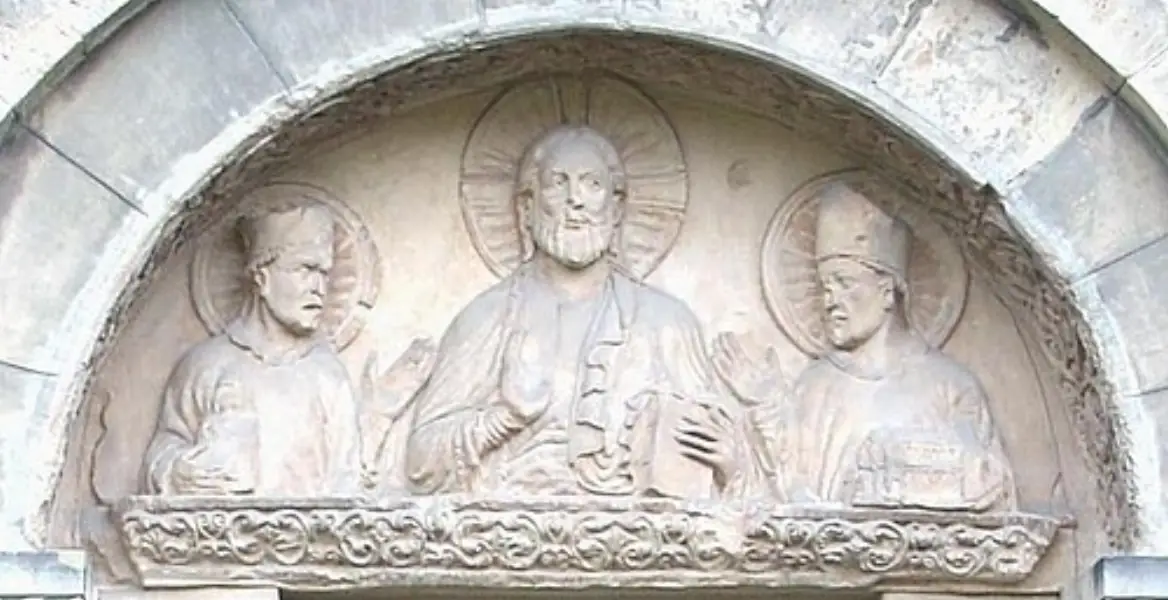
Epiphanius's legacy rests on two foundations: the Life Ennodius wrote and the institutions of mercy his career exemplified. The Vita Epifanii is among the most detailed biographies of any fifth-century western bishop, and modern historians have mined it for what it shows of an age that left few witnesses — the mechanics of ransom diplomacy, the restoration of churches that occupied much of the Odoacer years, the reach of a well-placed prelate across the patchwork of kingdoms succeeding Roman rule. Scholars such as Andrew Gillett place his embassies among the significant acts of political communication in the late antique West, and Patrick Amory and Herwig Wolfram cite him as a witness to the settlement between Italians and Goths. Devotionally, his memory survived the middle ages on both sides of the Alps: honored at Hildesheim as diocesan patron, where a Romanesque basilica of Saint Godehard displays him in tympanum relief beside Christ, and at Pavia, which kept his feast on 21 January, the day of his death. He stands for a type the church would always need — the man of no army whose word still opens gates — and for the conviction, peculiar to his century, that a bishop might succeed where legions failed.
§ Veneration
Timeline
- 438
Epiphanius was born at Pavia, son of Maurus and Focaria, a kinswoman of Bishop Mirocles of Milan.
§ Biography
- 446
At the age of eight he joined the household of Bishop Crispinus and became a lector, learning letters and stenography.
§ Biography
- 456
He was consecrated subdeacon in his eighteenth year.
§ Biography
- 458
He was ordained deacon at the age of twenty.
§ Biography
- 466
Named successor by the dying Bishop Crispinus before the ex-consul Flavius Rusticus, he was consecrated bishop of Pavia in Milan despite his own resistance.
§ Biography
- 475
Emperor Julius Nepos dispatched him to Euric, ruler of the Visigoths, to treat of the barbarian incursions; a peace was concluded.
§ Biography
- 489
During the war between Theodoric and Odoacer his sister Honorata was abducted from St. Vincent's monastery at Pavia; he negotiated her ransom.
§ Biography
- 494
He set out for the court of Gundobad, king of the Burgundians, to ransom Ligurian captives, accompanied by Ennodius.
§ Biography
- 21 Jan 496
Worn down by the hardships of that winter trek through Burgundy, he passed away at Pavia aged fifty-eight, three decades after he had entered the church's service.
§ Biography
- 501
His successor Ennodius composed the Vita Epifanii, the chief source for his life.
§ Veneration
- 963
His relics were translated to Hildesheim, where a grand reliquary chasse in the cathedral preserves them.
§ Veneration
- 1834
Tosi, bishop of Pavia, gave formal recognition to the authenticity of the remains that city had long venerated as the bishop's.
§ Veneration
In Their Own Words
Ennodius devotes but eight sections of the vita (101 - 107), five of which are taken up with the account of the restoration of churches
The Record
- Patron of
- Patron saint of the Diocese of Hildesheim
- Canonization
- Pre-congregation; venerated as a saint from soon after his death
Prayer
Bibliography
Show 5 sources
- Gillett, Andrew (2003). Envoys and Political Communication in the Late Antique West, 411-533. Cambridge: Cambridge University Press. p. 285. ISBN 0-521-81349-2.
- Ferreiro, Alberto (1999). The Visigoths: Studies in Culture and Society. Leiden: Brill. p. 29. ISBN 90-04-11206-5.
- Amory, Patrick (1997). People and Identity in Ostrogothic Italy, 489-554. Cambridge: Cambridge University Press. pp. 201-202. ISBN 0-521-52635-3.
- Wolfram, Herwig (1988). History of the Goths. Berkeley. p. 281. ISBN 0-520-05259-5.
- Cook, Genevieve Marie (1942). The Life of Saint Epiphanius by Ennodius: A translation with an introduction and commentary. Washington: Catholic University of America.
Profile text adapted from the Wikipedia article, licensed CC BY-SA 4.0.
Pray with this saint every day
Save St. Epiphanius of Pavia to your favorites, read the full profile, and get feast-day reminders in the Saints app.
Get the Saints AppFree on the App Store for iPhone and iPad