
c. 310 – 403·Feast May 12
St. Epiphanius of Salamis
Bishop, heresiologist and scourge of the Panarion
Overview
Epiphanius of Salamis (c. 310–320 – 403) was the combative fourth-century bishop of Salamis in Cyprus, revered as a saint and Church Father across the Eastern Orthodox, Catholic and Oriental Orthodox churches. Born into a Romaniote Jewish family of Judea — or converted in his youth — he embraced monastic life in Egypt before returning to Palestine around 333 and founding a monastery near Eleutheropolis, which he led as superior for thirty years. There he acquired the languages that made his reputation: Hebrew, Syriac, Egyptian, Greek and Latin, earning from Jerome the name Pentaglossos, 'five-tongued'. His fame for learning brought consecration as Bishop of Salamis around 365 or 367, an office he held for nearly forty years while traveling widely against false teaching, defending the Nicene cause at Antioch in 376 and at the Council of Rome in 382. He is best remembered for the Panarion, his handbook of eighty heresies written between 374 and 377, and for his zeal against images, recorded in his famous letter about tearing down an embroidered curtain in a Palestinian church. Summoned to Constantinople in 402 against John Chrysostom, he realized he was being used as a tool and turned homeward, dying at sea in 403.
The Complete Life
A Jewish Christian of Judea
Epiphanius came from the small settlement of Besanduk near Eleutheropolis in Judea — the place is identified with modern Beit Guvrin in Israel — and Christianity was his either by birth into a Romaniote family or by a conversion in his youth; either way he belonged to that Jewish-Christian world of Roman Palestine out of which so much of the church's early diversity came. As a young man he sought the monastic formation then flowering in Egypt, living as a monk there, receiving his education, and coming into contact with Valentinian groups whose teachings he would later dismantle in writing. Around 333 he returned to Palestine and founded a monastery at Ad, near his home town, a house that would surface repeatedly in the polemics Jerome waged against Rufinus and John of Jerusalem. There, as its superior for thirty years, he was ordained a priest and acquired the extraordinary linguistic range that made him famous: Hebrew, Syriac, Egyptian, Greek and Latin, a mastery for which Jerome called him Pentaglossos, the five-tongued. He belonged to the same generation of Palestinian pioneers as Hilarion near Gaza and Chariton in the Judaean desert, the men who planted monasticism in the Holy Land.
§ Life
Bishop of Salamis
Epiphanius's reputation for learning carried him from the cloister to the episcopate. Around 365 or 367 he was nominated and consecrated Bishop of Salamis in Cyprus — the city also known as Constantia — and he became Metropolitan of the Church of Cyprus, holding the see until his death nearly forty years later. The appointment transformed a desert-trained abbot into one of the international figures of fourth-century Christianity, for Epiphanius used his episcopate to travel widely in the war against beliefs he judged false. At a synod in Antioch in 376, where Trinitarian questions were debated against Apollinarianism, he took the side of Bishop Paulinus, who had the support of Rome, against Meletius of Antioch, supported by the Eastern churches; in 382 he appeared at the Council of Rome and again upheld Paulinus's cause. His convictions were those of a monk-bishop: the faith was fixed, heresy was poison, and the bishop's office existed to warn the flock. Contemporaries found the combination formidable — a man who could read the heretics in their own five languages and had spent three decades in the desert before ever holding a see.
§ Life
Guardian Against Heresy
The great instrument of Epiphanius's vigilance was the Panarion, composed between 374 and 377 and framed as a book of antidotes for souls envenomed by the serpent of false teaching. It catalogues eighty heresies, beginning with the four 'mothers' of pre-Christian error — barbarism, Scythism, Hellenism and Judaism — then passing through philosophical schools and Jewish sects before marching through sixty Christian heresies, from assorted gnostics to the trinitarian disputes of his own century, closing with the Collyridians and Messalians. Some of the movements he describes are not recorded in any other surviving source, which makes the book precious to historians even where its judgments are harsh. Its most distinctive feature is its pharmacy of animals: Epiphanius likens heretics to poisonous beasts, some fifty in all, detailing how each produces its venom and how the Christian may be protected from its bite — Origen becomes a croaking toad, the Gnostics a fangless snake, the Ebionites a many-headed monstrosity like the Hydra. The work also preserves lost writings, including Justin Martyr's heresiology, the Greek of Irenaeus and Hippolytus's Syntagma, and it is a key source for the early Jewish gospels circulating among the Ebionites and Nazarenes.
§ Panarion
The Curtain at Anablatha
Epiphanius's instinct against sacred images found its most famous expression on a journey through Palestine. Passing a villa called Anablatha, he entered a church to pray and saw a dyed and embroidered curtain on its doors bearing an image of Christ or one of the saints. In a letter of about 394 to John, Bishop of Jerusalem — preserved because Jerome translated it at his request — he recounts that he tore the curtain apart and told the custodians to use it as a shroud for the poor, then sent them a plain curtain of the best quality from Cyprus in replacement, and asked that curtains of the image-bearing sort be kept out of the churches of Christ altogether. The letter is accepted by modern scholars as authentic, unlike many passages the Byzantine Iconoclasts later attributed to him, and it shows both his severity and his scruple: he robbed a village church and paid for it personally. The incident seeded the long conflict between Rufinus and John on one side and Jerome and Epiphanius on the other, and it earned him a place in the later history of the iconoclasm controversy, where both parties raided his memory for authorities.
§ The curtain incident
The Origenist Storm and Death at Sea
Epiphanius's last years were consumed by the Origenist controversy. Preaching in Jerusalem during a visit of 394 or 395, he attacked Origen's followers and pressed John II of Jerusalem to condemn the master's writings, then inflamed the quarrel by consecrating a priest for Jerome's Bethlehem monastery — an intrusion on John's jurisdictional rights — while Rufinus and Jerome traded literary attacks through the 390s. In 399 the dispute widened when Theophilus of Alexandria, reversing his earlier position, began persecuting Origenist monks in Egypt; four of them, the so-called Tall Brothers, fled to Constantinople, where John Chrysostom sheltered them. Theophilus seized the chance to destroy his enemy: in 402 he assembled a handpicked council at Constantinople, stocked with men of anti-Origenist sympathies, and Epiphanius, by then nearly eighty, was among those called. He set out, but somewhere on the journey he understood that he was being used as a tool against Chrysostom. Refusing the part, he started home to Salamis and died on the way in 403 — the old fighter, as an engraving by Jan Luyken later pictured it, borne back toward the sea that carried his body home.
§ Origenist controversy and death
The Five-Tongued Doctor's Afterlife
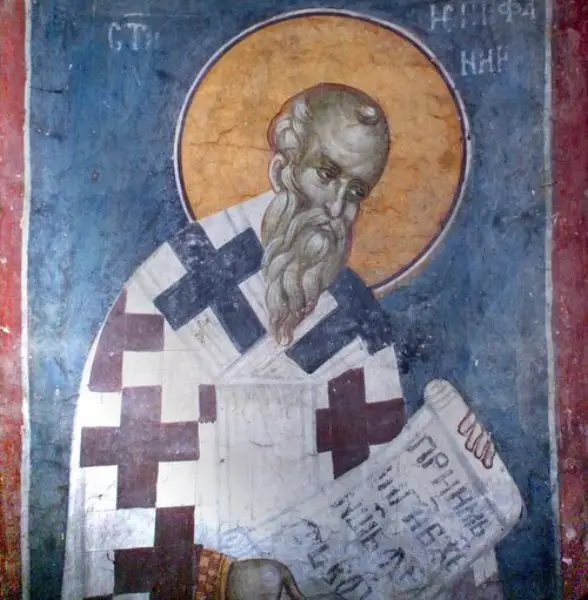
Epiphanius remained a reference point for the church long after his death. He was counted among the Church Fathers in both East and West, honored with a feast on 12 May in the Byzantine tradition and on 17 Pashons among the Copts, and depicted in fresco from the Gračanica monastery to Saint Sophia in Kyiv as a bishop in the omophorion holding a scroll. His writings stayed in circulation: the Ancoratus, his earliest known work, argues against Arianism and Origen; On Weights and Measures — drafted at Constantinople in 392 for a Persian priest — comes down in Syriac, Armenian and Georgian versions and matters in the history of measurement; On the Twelve Gems survives in fragments, the most complete Georgian. The Panarion was first translated into English only in 1987-1990, and modern scholars value it as a window on the fourth-century church and on texts otherwise lost. Such was his reputation for learning that the Physiologus, the fountain of medieval bestiaries, was widely and falsely attributed to him, and the homilies of a 'Saint Epiphanius, bishop' are now dated to a later century — tributes, in their way, to a name that stood for doctrinal vigilance itself.
§ Other works
Timeline
- 315
Born at Besanduk near Eleutheropolis in Judea, into a Romaniote Christian family or converted in youth.
§ Life
- 333
As a young man he returned to Roman Palestine after monastic formation in Egypt, establishing a monastery at Ad, close to Eleutheropolis.
§ Life
- 366
His reputation for learning brought consecration as Bishop of Salamis, Cyprus, in 365 or 367, and he also served as Metropolitan of the Church of Cyprus.
§ Life
- 374
He wrote the Panarion between 374 and 377, a handbook cataloguing and refuting eighty heresies, pagan religions, and philosophical systems.
§ Panarion
- 376
He took part in a synod at Antioch debating Trinitarian questions against Apollinarianism, upholding Bishop Paulinus over Meletius.
§ Life
- 382
He attended the Council of Rome, again supporting the cause of Paulinus of Antioch.
§ Life
- 392
He composed On Weights and Measures at Constantinople for a Persian priest.
§ Other works
- 394
Preaching in Jerusalem he attacked Origen's followers, tore down an image-bearing curtain at Anablatha, and wrote to Bishop John II of Jerusalem.
§ The curtain incident
- 402
Summoned by Theophilus of Alexandria to the council against John Chrysostom at Constantinople, he set out despite his great age.
§ Origenist controversy and death
- 403
Realizing he was being used against Chrysostom, he turned back toward Salamis and died at sea on the way home.
§ Origenist controversy and death
In Their Own Words
Seeing this, and being loth that an image of a man should be hung up in Christ's church contrary to the teaching of the Scriptures, I tore it asunder and advised the custodians of the place to use it as a winding sheet for some poor person.
a toad noisy from too much moisture which keeps croaking louder and louder
opposed ... to our religion
Since I took the habit, I have not allowed anyone to go to sleep with a complaint against me and I have not gone to rest with a complaint against anyone.
It is necessary, if one can, to possess Christian books. In fact, just seeing the Bible makes us more hesitant in the face of sin and gives us greater vigor to carry out justice.
Ignorance of the Scriptures is a great precipice and a deep abyss.
It is a great betrayal of salvation not to know any of the divine laws
The commandments are as many as the plagues of Egypt, the beatitudes are triple three, the image of the Trinity.
The Record
- Major works
- Panarion (Adversus Haereses), a compendium of eighty heresies (374-377)·Ancoratus, an argument against Arianism and Origen·On Weights and Measures, a work of biblical antiquarianism (392)·On the Twelve Gems (De Gemmis)·Letter to John II, Bishop of Jerusalem (394), preserved in Jerome's Latin translation
- Symbols
- Vested as a bishop in the omophorion·Sometimes holding a scroll
- Canonization
- Pre-congregation; honored as a saint and Church Father East and West
Prayer
Bibliography
Show 4 sources
- Kitzinger, Ernst, "The Cult of Images in the Age before Iconoclasm", Dumbarton Oaks Papers, Vol. 8, (1954), pp. 83-150.
- Kim, Young Richard. Epiphanius of Cyprus: Imagining an Orthodox World. Ann Arbor: University of Michigan Press, 2015.
- Jacobs, Andrew S. Epiphanius of Cyprus: A Cultural Biography of Late Antiquity. Christianity in Late Antiquity. Oakland: University of California Press, 2016.
- Herbermann, Charles, ed. (1913). "Epiphanius of Salamis". Catholic Encyclopedia. New York: Robert Appleton Company.
Profile text adapted from the Wikipedia article, licensed CC BY-SA 4.0.
Pray with this saint every day
Save St. Epiphanius of Salamis to your favorites, read the full profile, and get feast-day reminders in the Saints app.
Get the Saints AppFree on the App Store for iPhone and iPad