
died c. 1420
St. Epiphanius the Wise
Russian monk and hagiographer of Sergius
Overview
Epiphanius the Wise was a Russian Orthodox monk and hagiographer of the late fourteenth and early fifteenth centuries, remembered above all as a disciple of Sergius of Radonezh and as the author of some of the most celebrated lives of Russian saints. Born in Rostov in the first half of the fourteenth century, he received his formation at the monastery of Gregory the Theologian in his native city, where he mastered the copying of manuscripts and the painting of icons and absorbed the Greek hagiographic tradition. He later joined the Trinity Monastery, the house Sergius had founded, and travelled widely, visiting Moscow, Constantinople, and Mount Athos. His literary achievement rests on three principal works: the Life of Stephen of Perm, the Life of Sergius of Radonezh, and the Encomium of Sergius, to which some scholars add the Trinity Chronicle. The historian Serge Zenkovsky ranked him alongside Stephen of Perm, Sergius, and the painter Andrei Rublev as standard-bearers of the movement by which Russia, in the closing years of the fourteenth century and the first decades of the fifteenth, renewed its spiritual and cultural life.
The Complete Life
A Rostov Childhood and a Scribe's Formation
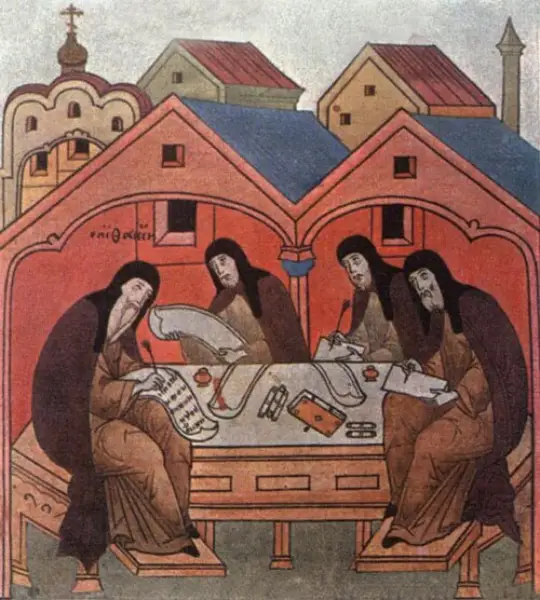
Rostov gave Epiphanius his birth, at some point in the opening decades of the fourteenth century, and it was there that the whole cast of his mind took shape. As a young man he entered the monastery of Gregory the Theologian in Rostov, a house where the intellectual demands on a novice were unusually broad. There he learned to copy manuscripts, the patient discipline on which the whole literary culture of medieval Rus depended, and there he also studied the painting of icons. The two crafts were closely related: both asked the monk to hand on, with exactness and reverence, the inherited forms of the faith. Alongside these practical skills he acquired Greek, the language in which much of the great hagiographic literature of the Church had been written, and he absorbed the Greek traditions of writing the lives of saints. That double formation, in the manual arts of the scriptorium and the literary artistry of Byzantine hagiography, gave the future writer both his technique and his ambition. Everything he later produced, from formal lives to encomia, presupposed the years in which a Rostov novice learned to handle brush, pen, and the two languages of his vocation.
§ Life
Disciple of Sergius and Traveller
From the monastery of Gregory the Theologian Epiphanius moved to the Trinity Monastery, the house that Sergius of Radonezh had founded in 1337 and that was becoming the spiritual heart of Muscovite monasticism. There he bound himself to Sergius as a disciple, and the relationship determined the shape of his whole literary career: it was the memory of his abbot that he would one day set down in writing. His vocation, however, was never confined to one cloister. Epiphanius travelled extensively, and the places he is known to have visited mark out a striking arc across the Christian world of his time. He went to Moscow, the princely capital whose church life was then gathering new energy; he made his way to Constantinople, where the traditions of Greek letters that he had begun to study in Rostov lived on in their original setting; and he reached Mount Athos, the monastic peninsula from which so much spiritual and literary influence had flowed into the Slavic lands. Few Russian monks of his generation could claim so wide a horizon, and the journeys help to explain the confidence with which he later wrote about sanctity in its ideal form.
§ Life
The Hagiographer at Work
Epiphanius wrote at least three works that bear his name: the Life of Stephen of Perm, the Life of Sergius of Radonezh, and the Encomium of Sergius, while Boris Kloss has argued that the Trinity Chronicle should be added to the list. The Life of Sergius shows his method at its most personal. He began it a year after the death of his abbot, working from what he himself remembered and from the testimony of contemporaries whose recollections he could still summon. Yet he let the book mature for decades, finishing it twenty-six years after Sergius died, that is, around 1417 to 1418. The delay was not neglect but care: he wanted a portrait built from tested recollection rather than immediate impression. The work followed the well-established conventions of hagiography and set a number of deliberate parallels to passages of Scripture, but its attention fell on the saint's spiritual qualities rather than on his close ties to Prince Dmitry Donskoy. A later rewriting by Pachomius the Serb circulated more widely than Epiphanius's own text, which means that the version most readers meet today is already one step removed from the disciple's original hand.
§ Works
The Weaving of Words
The spirituality of Epiphanius is inseparable from his style. He was convinced that an idealized account of sanctity demanded an elevated form of speech, and he pursued that conviction through lengthy panegyrics that pile praise upon praise. His manner of writing received a name of its own among literary historians: pletenie sloves, the weaving or braiding of words. It is marked by an abundance of neologisms, for Epiphanius delighted in forming large numbers of compound nouns and adjective-noun combinations that stretched the resources of the Russian language. Behind the wordplay stood a serious conviction. The plain speech of ordinary people, he believed, can never do justice to the marvels that God's holy ones have accomplished for the glory of Christ, and so the subject matter of hagiography required a language as extraordinary as the lives it described. His admiration for Theophanes the Greek, the great painter whose work he knew, points in the same direction: recent scholarship has often thought that his new literary style was shaped by the contemporary surge in Russian painting, and his own 1413 letter to Cyril of Beloozero about Theophanes remains the principal source of information about the artist.
§ Works
A New Page in Russian Literature
The judgment of later centuries has been remarkably consistent: Epiphanius changed what Russian religious writing could be. Serge Zenkovsky credited his writings with opening a fresh chapter in the story of Russian letters, and set Epiphanius, with Stephen of Perm, Sergius of Radonezh, and Andrei Rublev, at the head of the generation in which Russia, between the close of the fourteenth century and the early decades of the fifteenth, underwent its great spiritual and cultural awakening. That verdict assigns the monk of Rostov a place normally reserved for painters and princes of the Church. His immediate literary afterlife was complicated by the rewriting of the Life of Sergius by Pachomius the Serb, which became the more readily available version and long mediated his portrait of the saint to later readers. Modern scholarship has continued to enlarge his corpus and his significance. Boris Kloss's argument that Epiphanius also compiled the Trinity Chronicle, if accepted, makes him a chronicler as well as a hagiographer. And a single letter of 1413, written to Cyril of Beloozero about Theophanes the Greek, has secured him a permanent place in the history of Russian art, since it preserves the principal contemporary account of the great icon painter and his manner of working.
§ Works
Timeline
- 1337
Sergius of Radonezh establishes Trinity Monastery, the community Epiphanius later enters as a disciple.
§ Life
- 1413
Writes to Cyril of Beloozero about Theophanes the Greek, giving the main account of the icon painter.
§ Works
- 1417
Finishes the Life of Sergius of Radonezh around 1417-1418, twenty-six years after Sergius died.
§ Works
- 1420
Dies around 1420, remembered as the leading hagiographer of his Russian generation.
§ Introduction
In Their Own Words
the Russian spiritual and cultural revival of the late fourteenth and early fifteenth century
...are incapable of expressing the greatness of the deeds done by holy men to the glory of Christ.
a new page in Russian literary history
The Record
- Major works
- Life of Stephen of Perm·Life of Sergius of Radonezh·Encomium of Sergius·Trinity Chronicle (authorship argued by Boris Kloss)·Letter of 1413 to Cyril of Beloozero concerning Theophanes the Greek
- Canonization
- Pre-congregation; venerated as a saint in the Russian Orthodox Church.
Prayer
Bibliography
Show 7 sources
- Biographical Index of the Middle Ages. Walter de Gruyter, 2011, p. 345. ISBN 978-3-11-091416-0.
- Owen, Weldon (9 October 2012). The Book of Saints: A Day-By-Day Illustrated Encyclopedia. Weldon Owen International, p. 112. ISBN 978-1-68188-719-7.
- Martin, Janet. Medieval Russia, 980-1584. Cambridge, 1995, pp. 230, 232.
- Zenkovsky, Serge A. Medieval Russia's Epics, Chronicles, and Tales. Revised Edition, New York, 1974, pp. 259-289.
- "Epiphanius the Wise", Encyclopedia of Medieval Literature. Archived from the original on 2018-08-09.
- Prokurat, Michael; Peterson, Michael D.; Golitzin, Alexander (6 April 2010). The A to Z of the Orthodox Church. Scarecrow Press, p. 150. ISBN 978-1-4616-6403-1.
- Kloss, Boris. "Determining the Authorship of the Trinity Chronicle", in Michael S. Flier and Daniel Rowland (eds.), Medieval Russian Culture, Vol. 2. University of California Press, 1994, pp. 57-72.
Profile text adapted from the Wikipedia article, licensed CC BY-SA 4.0.
Pray with this saint every day
Save St. Epiphanius the Wise to your favorites, read the full profile, and get feast-day reminders in the Saints app.
Get the Saints AppFree on the App Store for iPhone and iPad