
died c. 303·Feast June 2
St. Erasmus of Formia
Bishop and martyr, patron of sailors
Overview
Erasmus of Formia, known throughout Christendom as Saint Elmo, was a bishop and martyr who died around the year 303, probably in the Diocletianic Persecution. Tradition makes him Bishop of Formia in Campania, and the Golden Legend of Jacobus de Voragine credits him with a wider charge over all Italian Campania, with a hermit's sojourn on Mount Lebanon, and with a martyr's crown under Diocletian. The acts of his passion, put together in part from legends that mistake him for a Syrian bishop of the same era, Erasmus of Antioch, leave little that a historian can verify, but the devotion they inspired is beyond dispute. His cult was firm enough by the sixth century that Pope Gregory the Great could record his relics in the cathedral of Formia, and when that city was razed by the Saracens in 842 his veneration passed to Gaeta. Sailors claimed him as their patron, interpreting the strange glow that gathers at a ship's mastheads in stormy weather as proof of his protection and naming it Saint Elmo's Fire. He is also one of the Fourteen Holy Helpers, invoked against colic, intestinal ailments, cramps, the pains of childbirth, and cattle pests, and he is the patron of Gaeta, Formia, Santeramo in Colle, and Roccagorga.
The Complete Life
A Saint Shrouded in Legend
Almost everything commonly told of Saint Erasmus reaches us through pious tradition rather than through records a historian can trust. The acts of his passion were partly compiled from legends, and those legends confuse him with another figure of the same name, Erasmus of Antioch, a Syrian bishop whose story became entangled with his own. The Golden Legend of Jacobus de Voragine, the great medieval collection of the saints, is the source of the fullest account: it presents him as a bishop seated at Formia with authority over all Italian Campania, as a hermit who withdrew to Mount Lebanon, and as a martyr who died in the Diocletianic Persecution at the opening of the fourth century. The era is fixed with some confidence, for his death is placed around 303, but the details that surround it are another matter. Careful students of the saints have concluded that the narrative of his sufferings, as it stands, rests on no secure historical foundation. What the sources cannot give, however, devotion has more than supplied: whatever the exact course of his life, the Church from an early date reckoned Erasmus among its heroic confessors, and his cult spread from Formia across the whole Mediterranean world.
§ Documentation of his life
Bishop of Formia and Hermit of Lebanon
Tradition assigns to Erasmus the episcopal chair of Formia, the ancient city on the Campanian coast, and paints his office in the broadest terms: the Golden Legend speaks of him as a bishop set over all the Italian Campania, not merely over one coastal town. His vocation, in the telling of the acts, joined two contrasting ideals of the early Church, the burden of the bishop and the solitude of the monk. When the persecution against Christians was unleashed under the emperors Diocletian, who reigned from 284 to 305, and Maximian Hercules, who ruled in the West from 286 to 305, Erasmus abandoned his diocese and fled to Mount Lebanon, where he concealed himself for seven years. The withdrawal was not flight from the faith but retreat into it: in the desert above the Phoenician coast he lived as a hermit, waiting out the storm that was destroying his brethren. The legend relates that around that time an angel appeared to him and counselled him to return to his city. The heavenly command ended the hermit's peace and set him once more on the road that would lead through interrogation, torture, and at last to martyrdom.
§ Account of life and martyrdom
Confession Before Emperors
On the journey back from Lebanon the acts place the first of Erasmus's trials. Soldiers met him on the road and questioned him, and he answered without disguise that he was a Christian. They brought him to Antioch, to trial before the emperor Diocletian himself, and there, after terrible tortures, he was bound in chains and thrown into prison. An angel appeared to him in his cell and helped him to escape, and the freed bishop pressed on through the provinces, preaching as he went. In Lycia he restored to life the son of one of its leading men, and the miracle moved many to conversion and baptism, and baptism brought notice. Word of the itinerant confessor reached Maximian, the Western emperor, whom Voragine judged much worse than Diocletian, and Maximian ordered his arrest. Brought before this second and harsher master, Erasmus continued to confess his faith without wavering. The pattern of the legend is plain and deliberate: wherever the bishop is thrown down, he rises to preach; wherever he preaches, the Church grows; and every act of imperial cruelty only multiplies the conversions it was meant to prevent. His mission, in the memory of the Church, was made effective precisely by his sufferings.
§ Account of life and martyrdom
Tortures and the Martyr's Crown
The cycle of torments recounted of Erasmus is among the most lurid in all hagiography, and the tradition itself warns that a number of unreliable legends have gathered around his story. Maximian, enraged by the bishop's constancy, is said to have shut him inside a barrel studded with projecting nails and sent it tumbling down a hillside; angels, the tradition says, kept him alive through it. Thrown into prison with the intention that he should die of starvation, he escaped once more, was recaptured, and was carried into the Roman province of Illyricum, where he continued to preach and to convert numerous pagans to Christianity before his final arrest. There, according to the traditional account, he suffered the torture with which his memory is forever linked: his abdomen was slit open and his intestines were wound around a windlass, and so the bishop of Formia died around the year 303. Students of iconography have suggested that this gruesome detail may have developed from a misreading of an early image that showed the saint simply holding a windlass, the sign of his patronage of sailors. However the detail arose, art took it up again and again, from Dieric Bouts to Poussin, fixing the martyrdom of Erasmus in the visual memory of Europe.
§ Account of life and martyrdom
Saint Elmo's Fire and the Ports of Italy
The afterlife of Erasmus has been lived out most of all at sea. The story runs that a bolt of lightning fell beside him and he simply went on preaching; from that tale sailors, who stand in particular danger from sudden storms and lightning, claimed his prayers as their own. The luminous electrical discharges that gather at the mastheads of ships in certain weather were read as a visible sign of his protection, and they took from him the name that every mariner knows: Saint Elmo's Fire. His relics had a storm of their own. Pope Gregory the Great recorded in the sixth century that they were preserved in the cathedral of Formia, and when the Saracens razed the old Formiae in 842 the cult of the saint was moved to Gaeta, whose cathedral of Saint Erasmus still bears his name and whose city he patronizes, together with Santeramo in Colle, Roccagorga, Formia, and Bassiano. In Rome an altar stands to him in the north transept of St. Peter's Basilica, its altarpiece a copy of Poussin's Martyrdom of St Erasmus, and his skull is venerated in the church of St. Peter in Munich. As one of the Fourteen Holy Helpers he is invoked against colic in children, intestinal ailments, cramps, the pains of labour, and cattle pests.
§ Veneration and patronage
Timeline
- 303
During the persecution under Diocletian and Maximian Hercules, the bishop of Formia is tried, tortured, and finally martyred in Illyricum around this year.
§ Account of life and martyrdom
- 500
In the sixth century, Pope Gregory the Great records that the relics of Erasmus are preserved in the cathedral of Formia.
§ Veneration and patronage
- 842
Saracens raze the old Formiae, and the cult of Erasmus is moved to nearby Gaeta.
§ Veneration and patronage
In Their Own Words
much worse than was Diocletian
The Record
- Patron of
- sailors·colic in children·intestinal ailments and diseases·cramps and the pain of women in labor·cattle pest·Bassiano·Gaeta·Santeramo in Colle·Formia·Roccagorga·Fort St. Elmo (Malta)
- Symbols
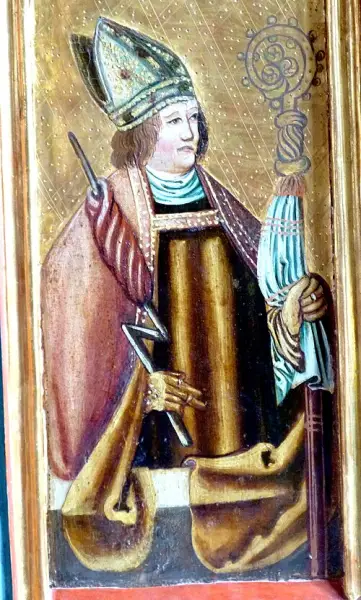
- entrails wound on a windlass·vested bishop holding a winch or windlass
- Canonization
- Pre-congregation martyr; numbered among the Fourteen Holy Helpers of Catholic devotion.
Prayer
Bibliography
Show 7 sources
- Martyrologium Romanum. Libreria Editrice Vaticana, 2001. ISBN 88-209-7210-7.
- "Saint of the Day, June 2: Erasmus of Formia". SaintPatrickDC.org. Retrieved 2012-03-07.
- "Saint Erasmus". Saints.SQPN.com. Retrieved 2012-03-07.
- Lanzi, Fernando and Lanzi, Gioia. "Erasmus of Gaeta", Saints and Their Symbols. Liturgical Press, 2004. ISBN 9780814629703.
- "Hieromartyr Erasmus the Bishop of Formia in Campania". Orthodox Church in America. Archived from the original on 2018-02-15. Retrieved 2019-11-12.
- Eyers, Jonathan (2011). Don't Shoot the Albatross!: Nautical Myths and Superstitions. A&C Black, London. ISBN 978-1-4081-3131-2.
- "Altar of St. Erasmus - St. Peter's Basilica". Archived from the original on 2023-10-02. Retrieved 2019-11-12.
Profile text adapted from the Wikipedia article, licensed CC BY-SA 4.0.
Pray with this saint every day
Save St. Erasmus of Formia to your favorites, read the full profile, and get feast-day reminders in the Saints app.
Get the Saints AppFree on the App Store for iPhone and iPad