
1st century·Feast January 4
St. Erastus of Corinth
Treasurer of Corinth and apostle of the Seventy
Overview
Erastus of Corinth, also known as Erastus of Paneas, stands at the meeting point of the New Testament, archaeology, and Orthodox tradition. The Epistle to the Romans names him as the steward, the oikonomos, of the city of Corinth, an office understood as the manager of household affairs and, in a civic setting, the treasurer or chamberlain of the city. The same name appears in the Acts of the Apostles, where Paul sends Timothy and Erastus into Macedonia, and in the second letter to Timothy, where Erastus remains at Corinth; tradition has often taken all three to be one man. The Eastern Orthodox Church numbers him among the Seventy Disciples of the Lord and remembers him as a deacon and steward, first of the Church at Jerusalem and later of Paneas in Palestine, keeping his feast on January 4, July 26, and November 10. In 1928 and 1947 excavators near the theater of Corinth uncovered an inscription in which an Erastus records that he paved a public area at his own expense as aedile, a discovery that fueled a long and still unresolved debate about the social standing of the first Christians.
The Complete Life
A Helper of Paul in Three Books
The New Testament introduces Erastus three times, and each passage shows a different facet of the same service. In the Acts of the Apostles he appears as one of Paul's travelling helpers: the apostle, detained in Asia, sends two of his men ahead of him into Macedonia, Timothy and Erastus, entrusting the preparation of the Macedonian churches to his lieutenants. In the Epistle to the Romans he stands again in the company of the apostle's correspondents, sending greetings to the church at Rome alongside Gaius, the host of Paul and of the whole church, and Quartus, called simply our brother; here Erastus carries a title as well as a name, for he is identified as the treasurer of the city of Corinth. The third mention comes in the farewell pages of the second letter to Timothy, where Paul, writing near the end of his life, notes that Erastus remained at Corinth while Trophimus was left behind at Miletus, sick. Taken together, the three verses sketch a man of standing and stability: trusted with missions, named with honour in a letter of introduction, and settled at last in the city whose public finances he had managed. Ancient translation and modern commentary alike have weighed the meaning of his civic office, whether steward, chamberlain, or director of public works.
§ Relevant verses
Among the Seventy
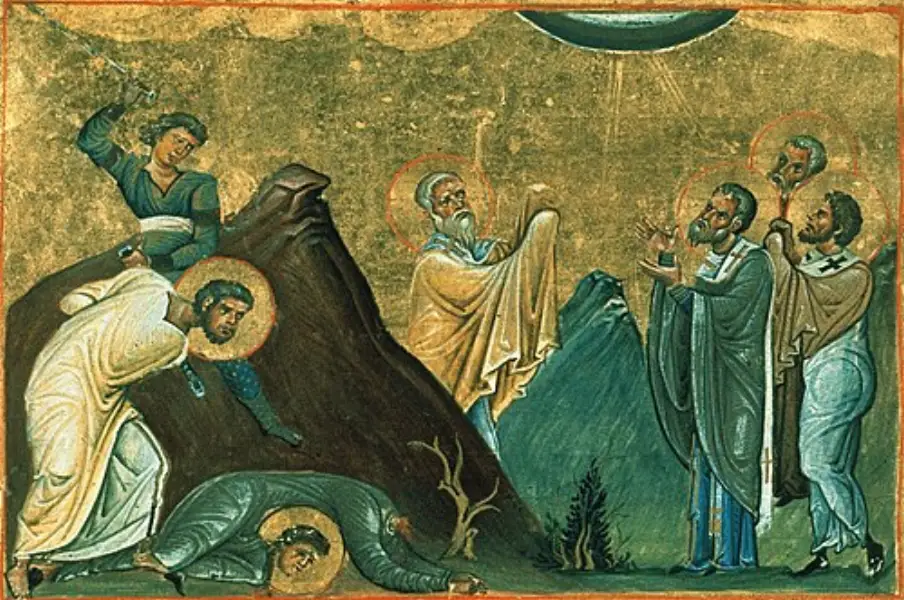
The Eastern Orthodox Church received Erastus not merely as a name in the Pauline letters but as one of the Seventy Disciples whom the Lord sent out before his face. In that tradition he served as a deacon and steward, first of the Church at Jerusalem, the mother church of the apostolic age, and afterward of Paneas in Palestine, the town near the sources of the Jordan known in the Gospels as Caesarea Philippi. His memory is kept three times in the course of the year: on January 4, when the Church commemorates the Seventy together, and again on July 26 and on November 10. The liturgical poetry of the Orthodox Church gathers him with his fellow apostles of the Seventy, Olympas, Herodion, Sosipater, Quartus, and Tertius, in a troparion of the third tone that begs their intercession for the forgiveness of transgressions. The kontakion assigned to the same choir of saints sings of apostles illumined by divine light who wisely overthrew the works of idolatry, drew the nations in for their Lord, and schooled them in the worship of the Trinity. These hymns, preserved in the Prologue of Ohrid of St. Nikolai Velimirovic, show how the modest officer of Corinth was received into the apostolic college of the undivided Church.
§ Hymns
The Erastus Inscription and the Modern Debate
During the campaigns of 1928-1929 and again in 1947, archaeologists digging beyond the theater of ancient Corinth brought to light portions of a Latin inscription that has kept Erastus's name in scholarly controversy for a century. Its words give, in full, ERASTVS PRO AEDILITATE SUA PECUNIA STRAVIT: Erastus, in discharge of his term as aedile, laid this paving at his own cost. When the stone was cut remains disputed, though a date in the middle of the first century is possible. Its excavator, T. Leslie Shear, and some New Testament scholars after him identified this aedile with the Erastus whom the Epistle to the Romans calls the city treasurer, proposing that the future Christian steward had financed the paving as a public benefaction before or during his time in office. Other scholars have rejected the identification, and the argument matters far beyond one name, for the dispute touches the wider question of what rank the earliest members of Paul's churches held in society: whether they included men of civic elite standing, as a Roman official turned believer would suggest, or drew mainly from humbler ranks. Steven Friesen has argued that the stone was mishandled in its publication and the identification is therefore unsound; David Gill has mounted the case for the aedile, and the stone remains a linchpin of the debate.
§ Erastus inscription
Timeline
- 1929
Excavations near the theater of Corinth in 1928 and 1929 brought to light parts of an inscription naming an Erastus.
§ Erastus inscription
- 1947
Further portions of the Erastus inscription were recovered, recording how he paved an area at his own expense as aedile.
§ Erastus inscription
In Their Own Words
Holy Apostles, Erastus … entreat the merciful God, to grant our souls forgiveness of transgressions.
The Record
- Canonization
- Pre-congregation; numbered among the Seventy Disciples in the tradition of the Eastern Orthodox Church.
Prayer
Bibliography
Show 7 sources
- "οἰκονόμος [Steward]". Blue Letter Bible - Lexicon. Retrieved 18 May 2012.
- Weiß, Alexander. Soziale Elite und Christentum. Studien zu ordo-Angehörigen unter den frühen Christen. Berlin/Boston: De Gruyter, 2015, pp. 108-110, 145-147.
- Lord, Louis E. (1947). A History of the American School of Classical Studies at Athens 1882-1942. Cambridge: Harvard University Press, p. 212.
- "PH209961". Searchable Greek Inscriptions. The Packard Humanities Institute. Retrieved 18 May 2012.
- Friesen, Steven (January 2007). "The Wrong Erastus: Status, Wealth, and Paul's Churches", Corinth in Context. Institute for the Study of Antiquity and Christian Origins. Retrieved 18 May 2012.
- Gill, David W. J. (1989). "Erastus The Aedile". Tyndale Bulletin 40 (2): 298. doi:10.53751/001c.30545.
- Erastus of Corinth. OrthodoxWiki (source article, dually licensed under CC-By-SA and GFDL).
Profile text adapted from the Wikipedia article, licensed CC BY-SA 4.0.
Pray with this saint every day
Save St. Erastus of Corinth to your favorites, read the full profile, and get feast-day reminders in the Saints app.
Get the Saints AppFree on the App Store for iPhone and iPad