
c. 421 – 514·Feast November 2
St. Erc of Slane
Bishop of Slane and tutor of Brendan
Overview
Erc mac Dega, called in Latin Ercus and in Cornish Erth, was an Irish bishop of the fifth and early sixth centuries whose life joined the age of Saint Patrick to the age of Saint Brendan. Tradition remembers him as a pagan druid, the son of Dago and a member of King Laoghaire's retinue, and the only man of that court who rose to pay homage to Patrick during the saint's confrontation with the druids at the Hill of Slane in 433. Converted by Patrick, he was appointed the first Bishop of Slane, and the monastery founded on that hill remained active for at least six hundred years. Patrick sent him south to complete the conversion of Kerry, over which he held spiritual charge together with a wide stretch of southwest Limerick. Around 484 Brigit of Kildare travelled with him to his native province, and in 512 he trained the young Brendan the Navigator at his church in Ardfert. He established a school at Slane where King Dagobert II of the Franks is said to have been educated. In old age he returned to Slane and lived in prayer and solitude at a hermitage beside the Boyne, dying there on November 2, 514, at the age of ninety-three. The Cornish Saint Erth of St Erth in Cornwall is generally held to be the same man.
The Complete Life
The Druid Who Knelt at Slane
Erc's story begins on the wrong side of the conversion of Ireland: he is believed to have been a druid of the old religion, a son of Dago attached to the retinue of King Laoghaire, the high king whose druids stood in opposition to the Christian mission. In 433 the confrontation between Patrick and the pagan establishment came to its famous climax at the Hill of Slane, where the bishop lit his paschal fire in defiance of the king's ordinance. When the court looked on, Erc mac Dega alone broke ranks and paid homage to Saint Patrick, a public act of reverence that set him apart from every other man of the king's company. Another druid, Dubhthach maccu Lugar, also paid tribute to Patrick and was converted, but Erc's defection became the founding legend of a church. Patrick received the convert, instructed him in the Christian faith, and appointed him the first Bishop of Slane, making a former servant of the old religion the shepherd of its first great Irish defeat. The foundation born of that moment proved astonishingly durable, for the house on the Hill of Slane kept its community for six hundred years and more, a span that carried Ireland from the age of Patrick into the age of the Norman arrival.
§ Early life
Apostle of Kerry and Tutor of Brendan
Patrick did not leave his convert idle. Erc's coming to Kerry probably followed hard upon the preaching of Saint Benignus, whom Patrick had dispatched in 450 to evangelize the tribes of West Munster; Benignus, however, was summoned away before long to North Clare and Connaught. To Erc fell the unfinished work: Patrick sent him to complete the conversion of Kerry, and Kerry itself he governed spiritually, and with it a broad stretch of southwest Limerick whose very centre held the convent of Saint Ita at Killeedy. Before Patrick's death in 461 the apostle had already sent Bishop Erc south to Munster, binding the southern province to the mission of Slane. The years that followed made the bishop a figure of national stature. Around 484 Brigit of Kildare, the most famous abbess in Ireland, travelled with him as his companion on the journey to his native province, a detail that places Erc in the first rank of the Irish church. He was the friend and tutor of Saint Brendan the Navigator, the patron of Kerry, and is credited with schooling the boy Brendan at his church in Ardfert in the year 512. He also founded the school at Slane in which King Dagobert II of the Franks is said to have passed his earliest years of study, a claim that would make his classroom a stopping place between Ireland and the Merovingian court.
§ Hill of Slane
The Hermitage Beside the Boyne
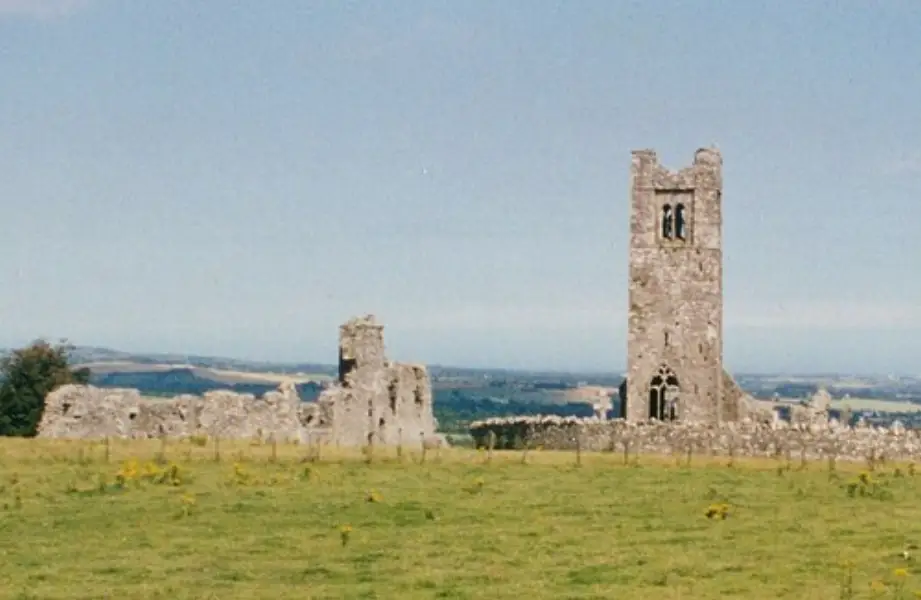
Having given the prime of a long life to the conversion of the south and the training of the next generation, Erc turned at last toward quiet. He returned to Slane, the hill of his conversion and his episcopal city, and lived out the rest of his days in prayer and solitude at a hermitage beside the River Boyne. The active bishop of Munster became, in the pattern so beloved of Irish monasticism, an old man of contemplation, and the landscape of Slane still keeps the memory of that retreat: in the grounds of Slane Castle stand the ruins known as St. Erc's Hermitage, where a chapel of the closing fifteenth or opening sixteenth century stands beside an older dwelling, buildings that may look back to his retreat. He died on November 2, 514, at the age of ninety-three, having lived long enough to see the church he served pass fully from the age of Patrick to that of Brendan and the great monastic schools. Dean Cogan, the nineteenth-century historian of the diocese and a native of Slane, summed up the tradition of the place when he described Erc as a man whose sanctity and usefulness were alike remarkable, a verdict that joins the two halves of his life, the bishop at work and the hermit at prayer.
§ Hill of Slane
Slane, Cornwall, and the Memory of the Saint
Erc's memory took root in two countries. At Slane his monastery endured for at least six centuries, and in the sixteenth century the hilltop site became a Franciscan friary supported by the Fleming family. The twelfth-century martyrology of Gorman recorded him with his churches: naming him bishop of Lilcach and of Ferta Fer Feic by Sid Truim, a man out of the West; Ferta Fear Fiac, the gloss explains, means the Graves of the Men of Fiac. Patrick's reputed praise of him, that everything he judged was just and that everyone who passes a just judgment shall receive the blessing of Bishop Erc, kept his name attached to the ideal of the just judge. In Cornwall he was honoured as Saint Erth or Herygh, the brother, in that tradition, of the saints Uny and Ia; he made his way across the sea from Ireland into Cornwall, and there a church and the village that grew into St Erth took him for their dedication. William of Worcester wrote in 1478 that Saint Herygh the bishop lies in a certain church under the cross of Saint Paul's in London, though the claim may reflect confusion with Saint Erconwald instead. Trevessa, in the parish of St Erth, received a chapel of St Ercus in the year 1403. His feast is kept in Ireland on November 2 and in Cornwall on October 31.
§ Hill of Slane
Timeline
- 433
As a druid in King Laoghaire's retinue, he alone honours Saint Patrick during the confrontation at the Hill of Slane.
§ Early life
- 450
Soon after Benignus preaches to the tribes of West Munster, Patrick sends Erc to complete the conversion of Kerry.
§ Hill of Slane
- 461
Before Saint Patrick's death, he sends Bishop Erc south to Munster, where Erc holds spiritual charge over Kerry.
§ Hill of Slane
- 484
Around this year Brigit of Kildare accompanies him as travelling companion on a journey to his native province.
§ Hill of Slane
- 512
Trains the young Brendan the Navigator at his church in Ardfert, acting as the boy's friend and tutor.
§ Hill of Slane
- 2 Nov 514
Dies on 2 November at the age of ninety-three, back at Slane in the hermitage beside the Boyne where he had withdrawn.
§ Hill of Slane
- 1403
A chapel of St Ercus is built at Trevessa in the Cornish parish of St Erth.
§ Hill of Slane
In Their Own Words
Bishop Erc – Everything he judged was just; Everyone that passes a just judgement – Shall receive the blessing of Bishop Erc
Erc of Slane, bishop of Lilcach and from Ferta Fer Feic beside Sid Truim from the West
The Record
- Major works
- Foundation of the original monastery on the Hill of Slane·School at Slane, where King Dagobert II received his early education
- Canonization
- Pre-congregation; revered from earliest times as one of the missionary bishops of Patrick's age.
Prayer
Bibliography
Show 6 sources
- Monks of Ramsgate. "Erc". Book of Saints, 1921. CatholicSaints.Info, 29 December 2012 (public domain).
- O'Connor, Denis. "Diocese of Kerry and Aghadoe." The Catholic Encyclopedia, Vol. 8. New York: Robert Appleton Company, 1910.
- "The Missionary Saints of Ireland". St. Gregory the Great Orthodox Church, 30 January 2012. Retrieved 18 February 2018.
- Trench, C. E. F. (1995). Slane. An Taisce – the National Trust for Ireland. ISBN 0-903693-09-7.
- Doble, G. H. (1960). The Saints of Cornwall: part 1. Truro: Dean and Chapter, pp. 95-96.
- Rice, V. Rev G., "Christianity in Slane", Slane History and Archaeology Society. Archived from the original on 24 August 2012.
Profile text adapted from the Wikipedia article, licensed CC BY-SA 4.0.
Pray with this saint every day
Save St. Erc of Slane to your favorites, read the full profile, and get feast-day reminders in the Saints app.
Get the Saints AppFree on the App Store for iPhone and iPad