
610 – 670
St. Erembert
Merovingian nobleman who governed the see of Toulouse
Overview
Érembert was born in 610 in the valley of Feuillancourt, close to the town now called Saint-Germain-en-Laye, into the family of a Merovingian nobleman. In that valley stood a priory dedicated to Saint Saturnin, the first occupant of the see of Toulouse — a dedication that would prove prophetic for the boy's own future. As a young man he withdrew from the world to the Abbey of Fontenelle, where Saint Wandrille personally clothed him with the habit of Saint Benedict. He then became a disciple of Saint Lambertus, at the time abbot and afterwards raised to the bishopric of Lyon. In 656 the king Chlothar III appointed him to the episcopal throne of Toulouse. He carried that burden for ten years, then relinquished it and went back to the monastery of his first profession, where he died around 670. His hagiography preserves one striking wonder: with his staff alone he put out a raging fire that had trapped a crowd inside a basilica.
The Complete Life
A Noble Birth in the Feuillancourt Valley
The valley of Feuillancourt, where Érembert first saw the light in 610, lies near the town known today as Saint-Germain-en-Laye. There his father, a nobleman of the Merovingian court, kept his household, and there the child grew up within earshot of the church's life rather than far from it. A priory dedicated to Saint Saturnin stood in that valley — Saint Saturnin being the first bishop ever to occupy the see of Toulouse. The proximity was more than geographical coincidence, as events would show: the boy born beside a priory of Saturnin would one day be appointed to the very see that Saturnin had founded. For a family of Merovingian nobility, a son's path might ordinarily have led toward the king's service or the administration of great estates. Érembert's path bent instead toward the cloister. What drew him from the valley of his birth to the monastic cloister the sources do not say; they record only that he went, and that he never came back except as a bishop and then as a monk again. The outline of his life suggests a seriousness of purpose formed early and never abandoned — a man who, having once given himself, gave everything else as well.
§ Introduction
The Habit of Saint Benedict at Fontenelle
Érembert's formal entrance into religious life took place at the Abbey of Fontenelle, the great Norman monastery whose influence spread across the Merovingian church. There he received the habit of Saint Benedict from the hands of Saint Wandrille himself, the abbey's founder — a detail that places the young nobleman within the closest circle of one of the age's most respected monastic reformers. To be clothed by the founder was no small distinction; it marked Érembert as a monk formed at the source of Fontenelle's tradition rather than at its margins. From Fontenelle his formation passed under a second master: Saint Lambertus, then abbot and later elevated to the bishopric of Lyon. Érembert became his disciple, learning from a man who combined the government of a monastery with the burdens of a diocese. The sequence of his formation — first the Benedictine habit from the founder's own hands, then service beside a monk who would wear a mitre — fitted him for both the worlds in which his life would unfold: the silence of the cloister and the administration of a great episcopal see. Few Merovingian churchmen were trained so deliberately for both.
§ Introduction
Ten Years on the See of Saint Saturnin
In 656 King Chlothar III appointed Érembert Bishop of Toulouse, the ancient southern see whose first bishop, Saint Saturnin, had been honored by a priory in the saint's native valley. For ten years he governed that church, carrying out the episcopal office in an age when kings routinely placed monks of proven character on episcopal thrones. Then, having held the position for a decade, he did what few bishops of any age have done: he resigned its cares and returned to the monastery where his religious life had begun, choosing the common life over the honors of his rank. His hagiography records the wonder for which he was remembered — a fire that broke out with such violence that a crowd was trapped inside a basilica, and that died out when Érembert confronted it with nothing but his staff. The image is fitting for a man whose authority was exercised quietly: flame mastered not by command but by the presence of a bishop who asked for mercy. He died around 670, remembered in the region of his birth and of his episcopate alike.
§ Introduction
Timeline
- 610
Born into a Merovingian noble family in the valley of Feuillancourt, near present-day Saint-Germain-en-Laye.
§ Introduction
- 656
Appointed Bishop of Toulouse by King Chlothar III.
§ Introduction
- 666
After holding the see of Toulouse for ten years, laid down the office and returned to his original monastery.
§ Introduction
- 670
Died, remembered for the wonder in which his staff quenched a fire threatening a crowd trapped in a basilica.
§ Introduction
The Record
- Symbols
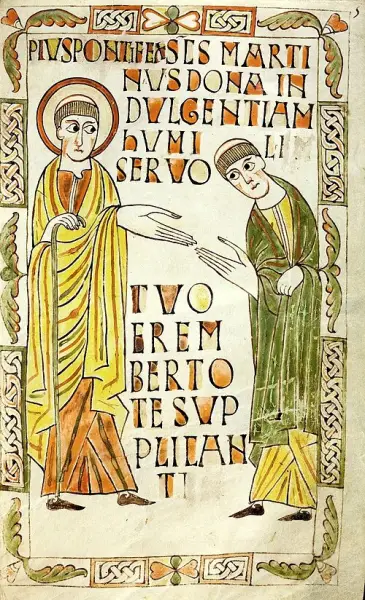
- Shown asking for mercy while turning toward Saint Martin
- Canonization
- Pre-congregation; honored as a saint since the Merovingian era
Prayer
Bibliography
Show 1 sources
- Hagiography of Saint Érembert
Profile text adapted from the Wikipedia article, licensed CC BY-SA 4.0.
Pray with this saint every day
Save St. Erembert to your favorites, read the full profile, and get feast-day reminders in the Saints app.
Get the Saints AppFree on the App Store for iPhone and iPad