
died 30 June 718·Feast June 30
St. Erentrude
First abbess of Nonnberg Abbey at Salzburg
Overview
Erentrude, whose name survives in many forms — Ehrentraud, Erentrudis, Arentruda — came of the royal house of the Franconian Merovingians and was Rupert of Salzburg's niece on the father's side, though some early writers made her his sister. Educated for the religious life at the convent of St. Radegund in Poitiers, she was serving as an abbess at Worms when Rupert, home from his missionary labors in Bavaria, asked her to help found religious communities in his new field. Around the year 700 he built Nonnberg Abbey near Salzburg and installed her as its first abbess. Under her guidance the nuns of Nonnberg served the poor, the needy, and the sick, holding together the contemplative enclosure and active charity in a pattern typical of Merovingian women's monasticism. When Rupert sensed his death approaching in early 718, she asked to go before him; she saw a vision of him after his passing and died three months later, on 30 June 718. Her tomb at Nonnberg became a center of healing and intercession, honored by emperors and preserved in a silver reliquary since 1624.
The Complete Life
A Princess of the Franconian Royal House
Almost everything about Erentrude's origins comes to us through legend and later biography rather than contemporary record. She was born at the close of the seventh century, most likely somewhere in the lands that are now Germany or Austria, into the Franconian-Merovingian royal house. One early tradition holds that her childhood was spent in Franconia; the hagiographer Agnes Dunbar records that she lived at Worms and was given to God from her earliest years. The duchess Regintrudis, a Franconian princess who later lived as a nun at Nonnberg, may have been a kinswoman. Her bond with Rupert of Salzburg defined her life: she was his fraternal niece, though Alban Butler suggests she may in truth have been his sister, so inconsistently do the early sources speak. Her education was entrusted to the convent of St. Radegund at Poitiers, one of the great women's houses of the Frankish world, where she entered to take up the nun's vocation. The first biographical account of her would not be written until the beginning of the fourteenth century, when Caesarius, a chaplain of Nonnberg, gathered his material from the oldest nuns of the abbey and the people of the neighborhood at their bishop's direction.
§ Life and ministry
From Worms to the Mountains of Salzburg
By the time Rupert came looking for helpers, Erentrude had already been entrusted with the government of souls as an abbess at Worms. Rupert had spent years preaching and planting churches across Bavaria; now he returned to his home city to recruit committed men and women for the work ahead. The writer Linda Kulzer observes that Erentrude passed through real conflict during her Worms years, and that the struggle tempered her character and deepened her hunger for mystical contemplation. When her uncle's call came, she answered it at enormous personal cost, leaving her own country behind for the mission field of Salzburg. Several of the Worms nuns are thought to have followed her. Near Salzburg, Rupert raised a convent — Nonnberg Abbey, built around the year 700 — and set her over it as its first abbess. That house would prove astonishingly durable: it stands today as the oldest community of Benedictine women in the former German lands, known to millions of filmgoers from its appearance in The Sound of Music, and still rooted in the foundation Erentrude governed thirteen centuries ago.
§ Life and ministry
The Works of Mercy at Nonnberg
Caesarius' sketch of Erentrude's government at Nonnberg shows a community whose purpose reached well beyond the choir. Erentrude and her nuns worked among the poor and the sick, and Kulzer stresses that this outreach was the deliberate center of their monastic existence — not a diversion from it. Their pattern matched that of other Merovingian women's houses, where enclosure and charity were held together rather than opposed: the wealth of convents of that era flowed out daily to poor people who came to their gates, and cloister rules were never interpreted so strictly as to bar the nuns from ministering to need. Within the community, Erentrude instructed her nuns and the young girls in their care by example as much as by precept, training them in deep piety and steering them with gentleness and wisdom. Caesarius singled out her affection for children, which she passed on to the women she formed. The portrait is of an abbess who understood authority as nurture rather than command — a royal-born woman who spent her nobility not on estates and privileges but on the sick, the poor, and the young entrusted to her care.
§ Life and ministry
Cloister and Charity Held Together
The spirituality that Erentrude embodied was distinctively Merovingian. Later monastic epochs would emphasize self-denial and humility as the marrow of religious life; hers instead balanced contemplative prayer with organized works of mercy, and the sources record no tension between the two. The nuns of Nonnberg kept the discipline of enclosure while refusing to let it paralyze their service: cloistered they remained, and ministers of the poor they also were. Erentrude's own interior life had been forged in the conflicts of Worms, which Kulzer links to her growing desire for mystical contemplation — suffering did not diminish her prayer but concentrated it. Her teaching of the community was characterized by the same gentleness the sources attribute to her governance: wisdom without harshness, formation without force. Her great love for children became part of the house's tradition. And her friendship with Rupert carried a spiritual weight of its own: the two saints prayed for each other across the border of death, as the story of their final months shows. In her, the active and contemplative currents of early medieval holiness met without collision.
§ Life and ministry
The Vision at Rupert's Death
Caesarius preserves a moving account of Erentrude's last year. Around the beginning of 718, Rupert, conscious that his death was imminent, summoned his niece to his side. He made her promise not to reveal what he told her, and asked her prayers for the journey ahead. Her reply reversed his petition: she begged to be the first to go to the grave. At his rebuke she reminded him how much she had given up, leaving her native land to follow him to Salzburg, and he yielded so far as to promise he would intercede that she should join him soon after he had gone. Rupert died in March of that year. While Erentrude was praying for his soul, she saw him in a vision, telling her that her own hour had come. Three months to the day after his passing, on 30 June 718, she died. She was laid to rest in a grave set among the rocks at Nonnberg, and from that tomb her reputation for healing and intercession began to grow, drawing the faithful in the centuries that followed.
§ Death and legacy
Emperors, Relics, and a Coin
Erentrude's cult flourished for a millennium after her death. In the eleventh century Emperor Henry II, crediting his cure from leprosy to her intercession, rebuilt the burned and plundered church and convent of Nonberg as a thank offering; he wore her relic in a gold ring, and when the rebuilt church was rededicated in 1024 her remains were moved with great reverence into the new crypt, where they have rested ever since. Caesarius tells that Abbot Mazzelin of St. Peter's secretly took a chest bone as his relic, was struck blind on the spot, and regained his sight only after vowing to resign his abbacy for a hermit's life — a vow he kept, and by a final wonder his body was carried not to his abbey but to Nonnberg, where a grave near the saint's crypt may be his. On 4 September 1624 her remains were enshrined in silver beneath the church's altar, an event commemorated annually as the Translatio Erentrudis until the Second Vatican Council. The 1924 examination of the relics revealed a short, slight woman of at most fifty-five, with a lock of blonde hair. In 2006 Austria struck a commemorative coin bearing her image and crypt; in 2018, a postage stamp. Through Nonnberg's daughter house at Eichstätt, forty American Benedictine convents trace their lineage to hers.
§ Death and legacy
Timeline
- 700
Rupert of Salzburg built Nonnberg Abbey near Salzburg and installed Erentrude as its first abbess.
§ Life and ministry
- 718
Early in the year, Rupert, aware his death was near, asked Erentrude to visit him; she asked to die before him.
§ Death and legacy
- Mar 718
Rupert of Salzburg died; while praying for his soul, Erentrude saw a vision of him announcing her own hour had come.
§ Death and legacy
- 30 Jun 718
Erentrude died three months after Rupert and was laid to rest in a rocky grave at Nonnberg.
§ Death and legacy
- 1024
When Emperor Henry II's rebuilt church was rededicated, her remains were transferred with great honor into the new crypt.
§ Death and legacy
- 4 Sep 1624
Her remains received a silver reliquary in a solemn rite and were set beneath the church's altar at Nonnberg.
§ Death and legacy
- 1924
An examination of her relics found her short and slight, at most fifty-five at death, with a lock of blonde hair.
§ Death and legacy
- 2006
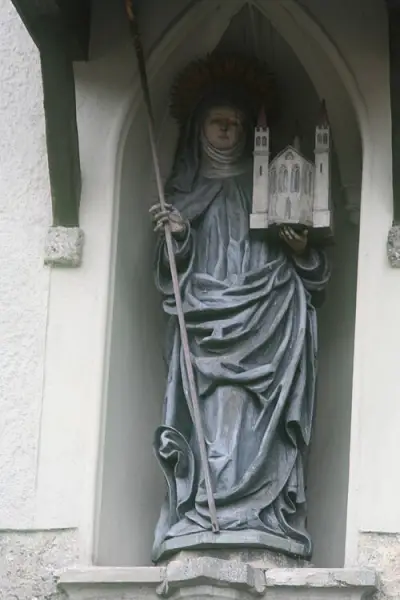
Her image appeared on an Austrian commemorative coin showing the crypt of Nonnberg Abbey with her statue.
§ Death and legacy
In Their Own Words
was consecrated to God from her childhood
guided [them] with all gentleness and wisdom
praised [Erentrude's] great love for children
The Record
- Major works
- Nonnberg Abbey, co-founded with Rupert of Salzburg
- Canonization
- Pre-congregation; venerated continuously since shortly after her death
Prayer
Bibliography
Show 4 sources
- Butler, Alban (1981). Butler's Lives of the Saints (vol. 2). Westminster, Maryland: Liturgical Press. ISBN 0814623778
- Dunbar, Agnes B.C. (1901). A Dictionary of Saintly Women (vol. 1). London: Burn & Oates
- Kulzer, Linda (1996). "Erentrude: Nonnberg, Eichstätt, America". In Medieval Women Monastics: Wisdom's Wellsprings. Miriam Schmitt, Linda Kulzer, eds. Collegeville, Minnesota: Liturgical Press, pp. 49–62. ISBN 0814622925
- Sonnen, J.P. (9 April 2018). "Sound of Music convent attracts movie tourists". The B.C. Catholic. Vancouver, British Columbia: Archdiocese of Vancouver
Profile text adapted from the Wikipedia article, licensed CC BY-SA 4.0.
Pray with this saint every day
Save St. Erentrude to your favorites, read the full profile, and get feast-day reminders in the Saints app.
Get the Saints AppFree on the App Store for iPhone and iPad