
died 7th century·Feast January 8
St. Erhard of Regensburg
Wandering mission bishop and healer of Saint Odilia's blindness
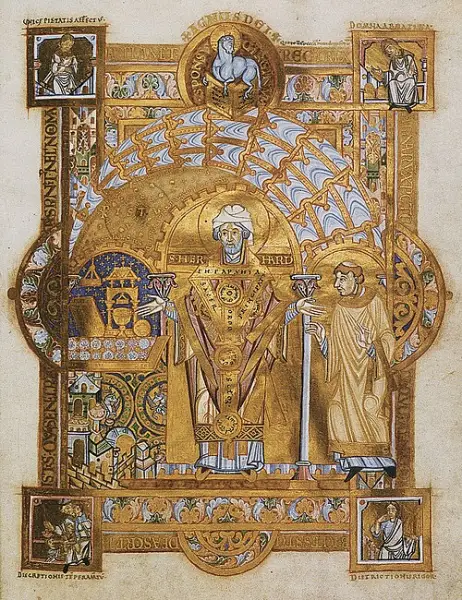
Overview
Erhard of Regensburg stands among the shadowy great figures of the seventh-century mission field. Ancient documents also call him Erard and Herhard, and even his homeland is disputed: his eleventh-century life calls him 'Scoticus' — a man of Ireland or Scotland — while modern scholarship favors a Frankish origin, perhaps at Narbonne in southern Gaul. He is identified with the abbot Erhard of Ebersheimmunster named in a Merovingian diploma of 684. Some traditions make him bishop of Ardagh before he crossed to the continent in the company of Albert of Cashel, said to be his friend or brother; the pair reached Rome, and while Albert went on to Jerusalem, Erhard turned toward Bavaria. There he lived for a time as a hermit beside Saint Hildulf in the Vosges, and then worked as a chorepiscopus — a traveling bishop without a fixed see — serving missionaries at the Agilolfing ducal court in Regensburg. After the martyrdom of Emmeram he became bishop of Regensburg, founded monasteries in great number, and baptized the blind-born Odilia of Alsace, who regained her sight at the font. He died at Ratisbon, was buried at Niedermünster, and was canonized by Pope Leo IX in 1052.
The Complete Life
A Saint Whose Origins Are Disputed
Few saints of such standing have left so uncertain a biographical trail. Erhard was born at some point in the sixth century, but where — and even under what name — has been argued for a thousand years. Ancient documents style him variously Erard and Herhard, and his eleventh-century biography describes him as 'Scoticus', meaning a native of Ireland or Scotland. Modern scholars, weighing the evidence differently, judge him a Frank, perhaps from Narbonne in the far south of Gaul. The Catholic Encyclopedia's Peter Nugent acknowledged plainly that the legendary accounts of his life yield little that history can confirm. Even the identity of the man is a matter of identification rather than record: scholars equate the bishop of Regensburg with an abbot named Erhard of Ebersheimmunster who appears in a Merovingian diploma issued in 684 — a slim documentary thread, but a real one. What no source disputes is the sphere of his holiness: the Danube lands around Regensburg, where his memory took deepest root, and the mountain country of the Vosges, where his first certain trace is found.
§ Life
From Ireland or Gaul to the Hermit's Rock
The traditional narrative, whatever its chronological difficulties, gives Erhard a vocation formed by journey. Some hold that he served as bishop of Ardagh in Ireland before crossing to the continent with Albert of Cashel — described as his friend, or his brother — whose feast falls on the same day. Together the two reached Rome; from there Albert sailed for Jerusalem while Erhard made his way to Bavaria. The story stumbles on chronology, since more than a century separates the historical Erhard from Albert, and the medieval lives often braided separate men into one. In the region of the Vosges mountains Erhard fell in with Saint Hildulf, said to have been Archbishop of Trier, who lived as a hermit there from 666 to 671; for five years Erhard shared his solitude and learned from it. Whatever the truth of his origins Whatever the truth of his origins, the outline is coherent: a bishop who abandoned a fixed charge — Ardagh, or whatever see was his — for the unsettled life of a missionary, training himself first in the harshest school available, the hermit's silence among the Vosges rocks.
§ Life
The Walking Bishop of Bavaria
Erhard belonged to the earliest generation of chorepiscopi — country bishops, 'walking bishops' who held no permanent diocese but moved from place to place supporting the missionaries at their work. Tradition says Boniface himself appointed him; more probably he served as missionary bishop at the ducal court of the Agilolfings in Regensburg. When Emmeram won the martyr's crown, Erhard took up the city's bishopric in his place. His energies were prodigious: monastic foundations across the region trace back to him, above all the celebrated Niedermünster near Regensburg, which he personally governed as abbot for a time. Fourteen monasteries in Bavaria alone are credited to him, and some seven more in the Vosges, in the diocese of Strasbourg; he may also have been abbot of Ebersheim. The most beloved story attached to him belongs to Alsace: Odilia, daughter of Duke Adalrich, blind from birth, recovered her sight when Bishop Erhard baptized her — or, in another telling, was baptized by Hildulf while Erhard stood as her godfather. Erhard also sent word to the duke, who had disowned his daughter, and made peace between father and child.
§ Life
The Grave at Niedermünster and the Rite of 1052
Ratisbon — Regensburg — was the chief theater of Erhard's apostolic work, and there he died, though the date cannot be fixed. He was laid to rest in the Erhard-crypt at Niedermünster, which still stands, and wonders were reported at his grave. Through the Middle Ages the tomb was tended by the Erhardinonnen, a community of women who maintained an unbroken round of prayer at the site. Imperial favor followed: in 974 Otto II bestowed properties in the Danube valley on the convent 'where the holy confessor Erhard rests'. The formal act of elevation came on 7 October 1052, when Pope Leo IX raised the remains of Erhard and Saint Wolfgang in the presence of Emperor Henry III and a gathering of bishops — a ceremony that in that age carried the force of canonization. Regensburg's own records mention only the raising of Wolfgang, yet the church has always reckoned Erhard among the canonized of 1052. His relics now rest within a silver shrine of the nineteenth century, placed on the north flank of the Niedermünster church where pilgrims may still venerate them.
§ Veneration
Lives, Shrines, and a Saint of the Common Things
Erhard's memory generated literature as well as pilgrimage. Toward the turn of the twelfth century the Fulda monk Paul von Bernried wrote out the saint's life at the suggestion of Abbess Heilika of Niedermünster, adding to it a second book of miracles; the learned Regensburg canon Conrad of Megenberg, who died in 1374, later produced a new edition. Three ancient Latin lives are printed in the Acta Sanctorum for 8 January. His cult spread widely and touched ordinary life: Niedermünster preserves a crosier said to be his, carved of black buffalo horn; in 1720 Archbishop Johann Franz Eckher of Freising gave an arm relic to the village church of Attaching; a Prague martyrology records the transfer of relics there under Emperor Charles IV. Since the fourteenth century the foremost pilgrimage place in his honor has been St. Erhard in Styria, while Salzburg keeps its own parish church of St. Erhard on the slope below Nonnberg. Because he was counted a patron of livestock, folk medicine carried his image on slips given to sick animals into the early twentieth century — and a Bamberg beer still bears his name.
§ Veneration
Timeline
- 666
Joined Saint Hildulf, said to be Archbishop of Trier, in the solitude of his hermitage in the Vosges mountains.
§ Life
- 671
His five years of shared solitude with Hildulf in the Vosges came to an end.
§ Life
- 684
Identified with the abbot Erhard of Ebersheimmunster named in a Merovingian diploma of that year.
§ Life
- 974
Emperor Otto II endowed the convent sheltering the holy confessor Erhard with lands along the Danube.
§ Veneration
- 7 Oct 1052
Pope Leo IX elevates the remains of Erhard and Wolfgang before Emperor Henry III, a rite then equivalent to canonization.
§ Veneration
- 1720
Archbishop Johann Franz Eckher presented a reliquary holding an arm relic of Erhard to the parish church of Attaching near Freising.
§ Veneration
- 1866
A bone of the saint's skull was enclosed in a precious receptacle at Niedermünster.
§ Veneration
In Their Own Words
the legendary account of his life offers little that is historically certain
The Record
- Major works
- Niedermünster monastery near Regensburg·Monastic foundations across Bavaria and the Vosges
- Patron of
- Co-patron of the Diocese of Regensburg·Cattle·Shoemakers, blacksmiths and bakers·Against eye diseases and plague
- Symbols
- A bishop's book bearing two eyes, recalling the healing of Saint Odilia·An axe·Baptizing Saint Odilia
- Canonization
- Canonized by Pope Leo IX on 8 October 1052
Prayer
Bibliography
Show 6 sources
- Nugent, Peter. "St. Erhard of Ratisbon." The Catholic Encyclopedia Vol. 5. New York: Robert Appleton Company, 1909
- Odden, Per Einar. "Den hellige Erhard av Regensburg (d. ~686?)", Den katolske kirke, May 3, 1998
- van den Akker s.j., A., "Erhard van Regensburg", Heiligen
- Monks of Ramsgate. "Erard". Book of Saints 1921. CatholicSaints.Info, 29 December 2012
- "St. Erhard", Stadt Regensburg
- "Erhard von Regensburg (8. Jänner)", Diözese Eisenstadt
Profile text adapted from the Wikipedia article, licensed CC BY-SA 4.0.
Pray with this saint every day
Save St. Erhard of Regensburg to your favorites, read the full profile, and get feast-day reminders in the Saints app.
Get the Saints AppFree on the App Store for iPhone and iPad