
c. 1125-1160·Feast May 18
St. Erik (Eric IX of Sweden)
King of Sweden and martyr
Overview
Erik Jedvardsson, called Eric IX and in Swedish tradition Erik den helige, governed Sweden from about 1156 until his violent death at Uppsala on 18 May 1160, and he is the one Swedish king whom the church has honored as a saint. No contemporary writing about him survives; everything known of his life comes from a papal letter of his son's reign, a Cistercian chronicle near 1200, and above all a hagiographic legend committed to writing in the late thirteenth century, so that the historian's Erik and the church's Erik can never be fully separated. The legend presents a just lawgiver, the codifier of what was remembered as King Erik's Law, a benefactor of monasteries, and a man of severe personal asceticism; it also credits him with the expedition that carried the Christian faith to Finland and left behind Bishop Henry of Uppsala as its missionary and martyr. His end was political rather than judicial: Magnus Henriksen, a Danish claimant, surprised the king near Uppsala as he left Mass on the feast of the Ascension, cut him down with a band of rebels, and beheaded him. Buried in the church of Old Uppsala, the dead king was soon venerated as a martyr; his son Knut built the dynasty of the Folkung era on that memory, the relics were translated to the new cathedral of Uppsala in 1273, and every medieval Swedish sovereign swore office with a hand on the saint's reliquary. A forensic examination of the relics in 2014-2016 found wounds on the bones that correspond strikingly with the legend's account of his death.
The Complete Life
Origins and Background
The family roots of Erik lie in shadow. Later kings of his line were buried at Varnhem Abbey in Västergötland, which suggests Geatish origins like those of other medieval Swedish ruling houses, and study of the king's own remains indicates that he may have passed his final decade and a half in Västergötland, not in the Uppland province where his life ended. The one manor securely attested to him, however, lay in Västmanland, and Eriksberg in central Västergötland has been proposed as the original family seat. He had a brother whose name began with J, identified with a Joar Jedvardsson, and the Saga of King Sverre speaks of Eirik the Saint as son of Jatvard. The father's name, Jedvard, the Norse form of Edward, is not Scandinavian and may reflect English missionary influence. Fourteenth-century tradition gives the king a mother, Cecilia, daughter of Blot-Sweyn, but scholars doubt it.
§ Background
Reign and Christian Kingship
No writing contemporary with Erik mentions him; the earliest notice is a letter from the reign of his son Knut calling him King of the Swedes, and the only full narrative is the legend of the late thirteenth century, whose historicity Swedish historians have debated without end. The legend makes him royal by blood and unanimously elected, ruling ten years from about 1150 as a rival to Sverker the Elder; what can be said with confidence is that most provinces acknowledged him after 1156. He strengthened his position by marrying Christina Björnsdotter, a Danish princess and granddaughter of Inge the Elder. The one near-contemporary source on his rule, a Cistercian chronicle near 1200, is unexpectedly unflattering: it tells of the king and queen harassing the monks of Varnhem until the house was reconstituted under Abbot Gerhard of Alvastra, while a thirteenth-century source records gifts to Nydala Abbey in Småland. The legend itself emphasizes his consolidation of the faith, his support of the oppressed against the powerful, his code known as King Erik's Law, a possible monastic chapter at Old Uppsala with the tithes to sustain it, and a personal asceticism of prayers, fasts, almsgiving, and a horsehair shirt, details that may be hagiographic convention but that align, in the matter of fasting, with fish-heavy diet shown by analysis of his bones.
§ Achievements
The Finnish Crusade
Legend assigns to Erik the first carrying of Christianity into Finland, then a pagan land said to have harmed Sweden. It tells how he led an armed expedition east of the Baltic to subdue and convert the Finns, and how, when they would not accept the faith, he fought and defeated them; after the victory he knelt in tears, grieving to his companions that so many souls had perished who might have won eternal life. Erik is said to have prevailed on the English-born Bishop Henry of Uppsala to stay in Finland as missionary, a bishop who would himself die a martyr there. No independent source confirms the crusade, but a papal bull of the early 1170s complains that the Finns promised Christianity when armies threatened and renounced it when the armies left, implying Swedish expeditions, and a letter of 1216 reserved to Erik's grandson conquests made by his ancestors. If the expedition happened, it was probably little more than a raid by sea.
§ Crusade to Finland
Assassination
Whatever the legend says about unanimity, Erik's kingship had rivals: Karl Sverkersson held Östergötland, and the Danish prince Magnus Henriksen, great-grandson of Inge I, claimed the throne as well. The legend ascribes Magnus's plotting to the Devil, telling how he drew Swedish nobles to him with gifts and promises, possibly in league with the House of Sverker, as a late medieval chronicle suggests. On the feast of the Ascension in May 1160 the conspirators brought a considerable army against the king near Uppsala at Östra Aros. Told that the enemy was advancing, Erik finished hearing Mass, then armed himself together with the small company about him and advanced to face them. The rebels dragged him from his horse, taunted and stabbed him, and cut off his head. The bones examined in our own time show decapitation, back wounds, and neck injuries of a kind battle armor would have prevented, matching the legend's scene. A papal bull to Knut confirms that the king died at the hands of enemies, and the short chronicle in the Västgötalagen, about 1250, praises him as one rewarded by God, whose bones rest in Uppsala and work wonders there. Pope Alexander III's complaint of 1172 about Swedes venerating a man killed in feasting and debauchery has been read by some as alluding to Erik, since the Ascension celebrations may have opened the way to the surprise attack, but the identification is uncertain.
§ Assassination
Succession and Family
The assassinator's triumph was brief: Magnus Henriksen took power but could not hold it and died at rivals' hands within a year, and Karl Sverkersson, possibly his accomplice, was himself murdered in 1167 after Erik's son Knut came home from exile. By 1173 Knut had beaten his Sverker rivals and went on to unify the kingdom, ruling until 1195 or 1196, and though his father had been a short-reigned and in the end unsuccessful king, Knut made the House of Erik the ruling dynasty of Sweden and anchored it in the memory of its martyred forebear. Knut was followed by his son Erik Knutsson and grandson Erik Eriksson. Erik's own children by Christina of Denmark were Knut, who ruled from 1167 to 1196; Filip, named by some historians as grandfather of King Knut Långe; Katarina, who married Nils Blake; and Margaret, who wed Sverre I of Norway in 1185 and died in 1202.
§ Succession
Veneration and Relics
The murdered king was buried in the church of Old Uppsala, which he himself had rebuilt around the burial mounds of the pagan kings before him. His son Knut promoted the martyr's cult, attested in the Vallentuna Calendar of 1198, and the body was enshrined about 1167, though the earliest direct evidence comes from around 1220. In 1273 the relics and regalia were translated to the new cathedral at Uppsala, built over the martyrdom site, and archaeology with ground-penetrating radar has confirmed an older Romanesque church beneath the cathedral, probably the Trinity church where the legend places the killing. Throughout the Middle Ages, the coronation oath of every incoming Swedish sovereign was sworn with hands laid upon the reliquary. Johan III melted down the medieval casket, and the Renaissance casket made in the 1570s at the order of Queen Catherine Jagiellon now holds the relics in Uppsala Cathedral. The 2014-2016 forensic study found twenty-three of its twenty-four bones from one man of thirty-five to forty, decapitated, stabbed in the back, and bearing neck wounds impossible in armored battle. Erik is commemorated on 18 May by the Roman Catholic Church and by the Evangelical Lutheran Church in America as Erik, King of Sweden, martyr; processions once went from the cathedral to Old Uppsala on his feast to pray for a good harvest, and the Catholic cathedral of Stockholm bears his name.
§ Veneration
Patronage
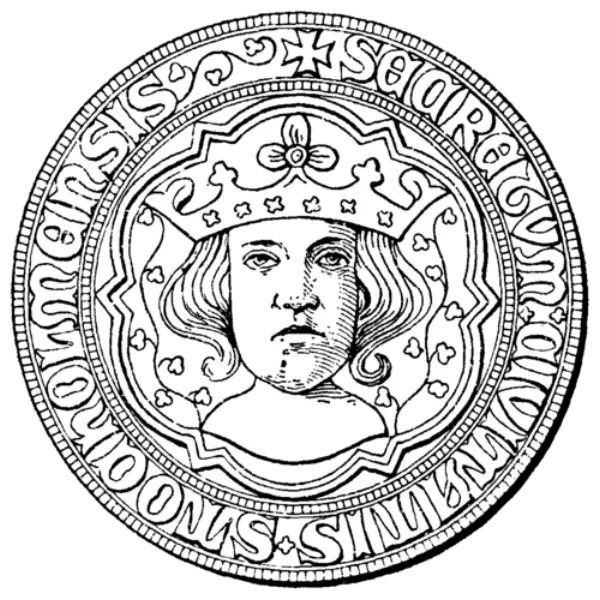
Erik is the patron saint of Sweden and of its capital: his crowned head appears on the arms of Stockholm and of the city's Royal Guards and Commandant General. In art he is shown as a young king murdered at the altar, with Bishop Henry of Uppsala beside him, and late medieval paintings of the two stand in Uppsala Cathedral.
§ Patronage
Timeline
- 1125
Born, probably between about 1120 and 1125; his father Jedvard bore a non-Scandinavian, possibly English name, and a fourteenth-century tradition names his mother as Cecilia, a daughter of King Blot-Sweyn, though this is disputed. His family is thought to have Geatish roots.
§ Background
- 1156
Recognized as king in most provinces after the murder of Sverker the Elder; the legend says he was chosen unanimously on a vacancy of the throne and reigned ten years, which would place the start about 1150 as a rival to Sverker. His realm excluded Östergötland, where Karl Sverkersson ruled.
§ Legend
- 1158
He and Queen Christina Björnsdotter of Denmark quarreled with the monks of Varnhem Abbey in Västergötland, driving some of them to Denmark, where they founded Vitskøl Abbey in 1158; the royal couple later relented and let Varnhem be reorganized under Abbot Gerhard of Alvastra, and donations to Nydala Abbey are also recorded.
§ Legend
- 1160
On the feast of the Ascension in May, Magnus Henriksen and his allies surprised Erik near Uppsala at Östra Aros as he attended Mass; hearing that the enemy was near, he heard Mass to the end, armed himself and his few companions, was pulled from his horse, stabbed, and beheaded.
§ Assassination
- 1167
In about this year, as his son Knut Eriksson rose to power after the fall of the last Sverker king, Erik's body was enshrined at the church of Old Uppsala, which the king himself had rebuilt beside the mounds of his pagan predecessors; direct evidence for the enshrinement appears only from about 1220.
§ Veneration
- 1198
The so-called Vallentuna Calendar shows Knut encouraging his father's veneration as a martyr; around the same year a papal bull confirmed that Erik had been killed by enemies, and legends told of a fountain springing where the royal head had fallen.
§ Veneration
- 1273
A century after Knut unified the kingdom, Erik's relics and regalia were moved to the new cathedral of Uppsala, raised on the place of his martyrdom; the translation both displayed and deepened the devotion of the Swedish church to its royal martyr.
§ Veneration
- 1570
King Johan III had the medieval reliquary melted down, in part to help pay the Älvsborg ransom demanded by the Treaty of Stettin and to fund war against Russia; his Catholic queen Catherine Jagiellon commissioned the present Renaissance casket in the 1570s.
§ Reliquary
- 2016
After the reliquary was opened in 2014, researchers reported that the bones belonged mostly to one strongly built man of thirty-five to forty, about 171 centimeters tall, decapitated and stabbed in the back, with neck injuries possible only outside battle, findings consistent with the legendary account.
§ Reliquary
In Their Own Words
Then Eric the Saint asked the people of Finland to accept Christianity and make peace with him. But when they refused to accept it, he fought against them and conquered them by the sword, avenging the blood of the Christian men which they had spilled often and for a long time. And when he had scored such an honourable victory he prayed to God, falling on his knees with tears in his eyes. Then one of his good men asked why he cried, since he should rejoice over the honourable victory which he had won over the enemies of Jesus Christ and the holy faith. He then replied: I am happy and praise God since he gave us victory. But I greatly regret that so many souls were lost today, who could have gained eternal life if they had accepted Christianity.
The Record
- Major works
- Remembered as the codifier of King Erik's Law·Credited with a monastic chapter at Old Uppsala and the introduction of tithes·The Eric Legend, the late thirteenth-century hagiography that preserves his story
- Patron of
- Sweden·Stockholm
- Symbols
- Crowned head on the coat of arms of Stockholm·Shown as a young king murdered at Mass, beside Bishop Henry of Uppsala
- Canonization
- Pre-congregation royal martyr; commemorated in the Roman Martyrology on 18 May
Prayer
Bibliography
Show 12 sources
- Nyheter, S. V. T. (2016-03-16). "Medieuppbåd bevakar analys av Erik den helige". SVT Nyheter (in Swedish). Retrieved 2025-05-19.
- Guy-Ryan, Jessie. "The Gruesome Legend of Swedish King Might Actually Be True", Atlas Obscura, March 19, 2016
- Sabine Sten et al., "Erik den heliges skelett", Fornvännen 111, 2016, p. 28, 33.
- "King Sverre's Saga, Chapter 100". Archived from the original on 2016-05-25.
- Sven Tunberg. Sveriges historia till våra dagar. Andra Delen. Äldre medeltiden. Stockholm: P.A. Norstedt & Söners Förlag, 1926.
- Göte Paulsson, Annales suecici medii aevi. Svensk medeltidsannalistik kommenterad och utgiven, Lund: Gleerup, 1974, p. 265.
- Peter Sawyer. När Sverige blev Sverige. Alingsås: Viktoria Bokförlag, 1991, pp. 42-3.
- Philip Line, Kingship and State Formation in Sweden 1130-1290. Leiden: Brill, 2007, pp. 89-90, 425.
- Hans Gillingstam (1973-1975). "Karl Sverkersson". Svenskt biografiskt lexikon, Band 20.
- Sture Bolin with contribution (about the cult and liturgy of St. Erik) by Bengt Hildebrand (1953). "Erik den helige". Svenskt biografiskt lexikon, Band 14.
- Lindkvist, Thomas (2021). The Västgöta Laws. London: Routledge. ISBN 978-1-003-17437-0.
- Oertel, Christian (2014). The Cult of St Erik in Medieval Sweden: Veneration of a Royal Saint, Twelfth-Sixteenth Centuries. Brepols. ISBN 978-2-503-56474-6.
Profile text adapted from the Wikipedia article, licensed CC BY-SA 4.0.
Pray with this saint every day
Save St. Erik (Eric IX of Sweden) to your favorites, read the full profile, and get feast-day reminders in the Saints app.
Get the Saints AppFree on the App Store for iPhone and iPad