
died c. 742·Feast April 12
St. Erkembode
Bishop of Thérouanne whose tomb draws children's shoes
Overview
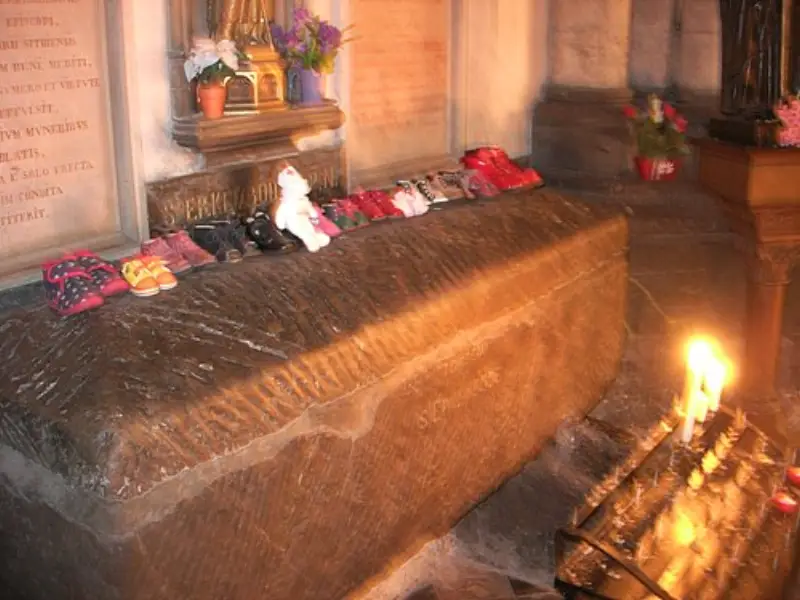
Of Erkembode's beginnings nothing survives: he belongs to the late seventh and the first half of the eighth centuries, and the first page of his life is blank. It has been guessed that he was an Irish monk who crossed to the continent with companions and settled at Sithiu, the monastery in what is now Saint-Omer in northern French Flanders. There he placed himself under the abbot Saint Bertin, himself formed in the school of Saint Columbanus at Luxeuil. The clergy and people eventually chose Erkembode as bishop of the immense diocese of Thérouanne, a charge he carried while remaining abbot of his monastery — an episcopate of twenty-six years spent traveling a see that stretched from Ypres in present-day Belgium down to the valley of the Somme. He died on 12 April, in a year no source fixes with certainty, and was buried in the cathedral of Saint-Omer, where his tomb still lies. On it, pilgrims once left their shoes as tokens of their journeys; today parents of children with disabilities leave tiny pairs there, asking the saint's intercession for their sons and daughters.
The Complete Life
An Unknown Monk from Ireland
The sources are blunt about Erkembode's origins: of his early life, nothing is known. He emerges into history only as a grown man, already a monk, at Sithiu — the great monastery of what is now Saint-Omer, in the flat country of northern France. Scholarly guesswork has supplied the outline that the records omit: most likely he was Irish, one of the wandering monks of that nation who crossed the North Sea and the Frankish lands in astonishing numbers, and he probably came in the company of several fellow countrymen. At Sithiu he submitted to the direction of Saint Bertin, the monastery's abbot, who died around 709 and who had himself been formed by Saint Columbanus of Luxeuil, the austere Celtic founder whose abbey stood in the Vosges mountains. Erkembode thus stood three links down a chain of Celtic monastic tradition: Columbanus, Bertin, and himself. In later centuries, after the Carolingian reforms of Benedict of Aniane, the abbey of Sithiu passed into the Order of Saint Benedict — a house that began in the Irish vein and ended in the Benedictine one, with Erkembode among the figures who bridged the two.
§ Veneration
Twenty-Six Years over an Immense See
Erkembode's elevation came from below rather than above: the clergy and the people together elected him bishop of Thérouanne, and he accepted the office without surrendering the abbacy he already held, governing monastery and diocese at once. The see he inherited was enormous by any measure. Its capital, Thérouanne, had been recorded by Julius Caesar in his Gallic Wars as the chief town of the Morini; in Erkembode's day the diocese reached from Ypres, in present-day Belgium, south to the valley of the Somme — the whole breadth of what is now called French Flanders. Such a territory could be governed only from the saddle and the road, and Erkembode traveled it widely for twenty-six years. His very name, which means 'recognised envoy', seems to have destined him for the itinerant episcopate he exercised. He died on 12 April, worn out, one supposes, by the distances he had covered; the year of his death is uncertain, with scholarly estimates proposing 734, 740, or, in the judgment of the Bollandists, 742 — no source fixing it beyond dispute. The diocese that wore him out became the measure of his sanctity.
§ Veneration
Shoes at the Tomb
Erkembode was buried in the cathedral of Saint-Omer, and there his tomb remains, an object of unbroken devotion across more than twelve centuries. The custom that grew up around it is one of the most touching in medieval piety. Because the pilgrims who came to his grave had usually traveled far — the saint himself had been a man of the roads — they took off their shoes and left them at the tomb as ex-votos, silent testimony to the journeys they had made in body and in spirit. The practice evolved with the centuries. Today the visitors who cluster around the shrine are above all parents of children with disabilities, who lay pairs of small shoes on the saint's tomb and beg Erkembode's intercession for the healing of their sons and daughters; the cathedral staff periodically clear away the older pairs to make room for new ones. His feast is kept on 12 April, the day of his death. His life was written early — a vita by Jean Lelong, called Joannes Iperius, fourteenth-century abbot of St-Bertin, preserved in the Acta Sanctorum — but his truest biography is the pile of little shoes that gathers at his grave.
§ Veneration
Timeline
- 12 Apr 742
Dies on 12 April after twenty-six years as bishop of Thérouanne; proposed years for his death run from 734 to 742, the Bollandists favoring 742.
§ Introduction
- 742
Is buried in the cathedral of Saint-Omer, where his tomb remains an object of pilgrimage.
§ Introduction
- 1863
The early vita by Joannes Iperius, fourteenth-century abbot of St-Bertin, is published in the Acta Sanctorum.
§ Notes
The Record
- Patron of
- Children with disabilities, invoked by their parents
- Symbols
- Pairs of children's shoes left on his tomb
- Canonization
- Pre-congregation; venerated at his tomb since the early Middle Ages
Prayer
Bibliography
Show 4 sources
- Paul Guérin, ed., "Saint Erkembode, Evėque de Thérouanne (742)" in Les petits bollandistes: vies des saints, d'après le père Giry, volume 4, s.v. 12 April
- "Tout d'abord, qui est Saint Erkembode?", La cathédrale de Saint Omer (archived 2016-03-12)
- James Duffy, Lives of the Irish Saints, vol. 4 (1875)
- [Iperius] "The life of St Erkembode, fourth abbot of Saint-Bertin", Acta Sanctorum (1863), 12 April, 93–5
Profile text adapted from the Wikipedia article, licensed CC BY-SA 4.0.
Pray with this saint every day
Save St. Erkembode to your favorites, read the full profile, and get feast-day reminders in the Saints app.
Get the Saints AppFree on the App Store for iPhone and iPad