
c. 546 – 594·Feast October 29
St. Ermelinde
Brabant maiden who fled an unwanted marriage for hermit life
Overview
Ermelinde, a saint of sixth-century Brabant, was born around 546 at Lovenjoel into wealth and influence: her parents, Ermeonoldo and Armensinda, were chatelains related to the Pippinids, the family that would one day supply the Carolingian dynasty. They planned a marriage for their daughter; she refused it, cutting off her hair to end their campaign on her behalf. Conceding at last to her vocation, they gave her a small parcel of land, on which she lived as a hermit in a wooded district probably near Beauvechain, giving what she had to the poor. Her troubles did not end with her vows. Two brothers, the local lords, tried to seduce her; rebuffed, they conspired to abduct her during her night prayers. Warned, the tradition says, by an angel, she slipped away and made her way to Meldert, where she built a second hermitage and passed the remainder of her life in prayer until her death in 594. Her cult took deep root in Brabant: her relics rest at Meldert, a spring at Lovenjoel is credited with curing eye ailments, and her memory is kept on 29 October.
The Complete Life
Cutting Off the Hair They Had Adorned
Ermelinde was born around 546 at Lovenjoel, in the heart of Brabant, to parents of real standing: Ermeonoldo and Armensinda were rich chatelains, and through their blood ran kinship with the Pippinids, the ascendant dynasty of the Frankish world. A daughter of such a house was an asset to be married well, and her parents arranged to do exactly that. Ermelinde refused. When persuasion failed, she reached for the oldest gesture of a woman's consecration available to her age and cut off her hair, destroying the very marker of the bride they meant to present. The gesture worked where words had not: her parents yielded, permitted her to follow the vocation she had chosen, and settled a little land on her for its support. The episode, preserved in the tradition and retold by the historian Jane Tibbetts Schulenburg, belongs to a broader pattern of early medieval women who broke engagements their families had made on their behalf. For Ermelinde, the severed hair was the first of many renunciations — of security, of family approval, and finally of the place where her consecration had begun.
§ Life
The Hermit of the Forest and the Flight by Night
On the land her parents granted, Ermelinde gave herself to two disciplines: charity toward the poor and solitude before God. She made her hermitage in a forested stretch of the country, probably in the region of Beauvechain, dividing what she had between prayer and almsgiving. But solitude did not purchase safety. Two brothers, the local lords of the district, set their sights on her; when she rejected their advances, their admiration curdled into a plot to carry her off by force, choosing for their attempt the hour of her night prayers, when they knew she would be at church and unguarded. The tradition records that an angel warned her of the ambush in time. She escaped, and did not merely flee — she left the region altogether, making her way to Meldert, in the land of Hoegaarden, where she established a new hermitage. There, beyond the reach of the lords who had hunted her, she spent the rest of her days in prayer, dying in 594. The pattern of her life was set: threatened in one sanctuary, she built another, deeper in the quiet.
§ Life
A Spring, a Reliquary, and a Procession
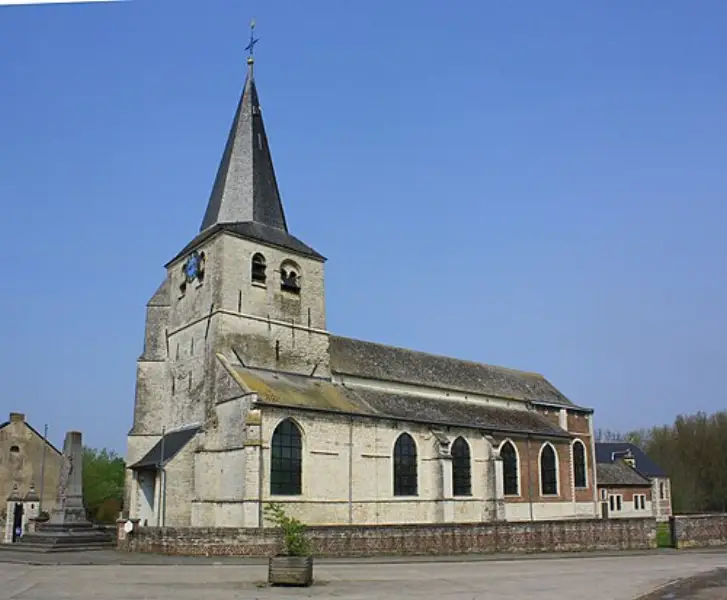
Ermelinde's memory settled into the soil of Brabant and would not be displaced. She was venerated at Tirlemont, and with special devotion at Lovenjoul and Meldert — the two villages that framed her life. At Lovenjoul a spring rises on land that belonged to her kindred, and the water acquired a reputation for curing ailments of the eyes, taking her name: the Spring of St. Hermelinda. At Meldert her cult was strongest of all. The parish church there stands under her patronage and keeps a reliquary containing her remains, which are shown to the parishioners once every fifty years in an act of solemn devotion. On the Tuesday of Pentecost each year a procession winds through Meldert in her honor, and the confraternity that bears her name still meets in the town. The diocese of Malines keeps her feast on 29 October, the day tradition assigns to her death. Her fame crossed the border: at Moergestel, in the Dutch province of North Brabant, she is honored, and in 2008 the town inaugurated a park in her name. In Kansas, she numbers among the 'Saints for Thanksgiving' at a rural chapel, where her novena is prayed from 22 November to 1 December.
§ Veneration
Timeline
- 546
Born at Lovenjoel to the wealthy chatelains Ermeonoldo and Armensinda, kindred of the Pippinids.
§ Life
- 29 Oct 594
Dies at Meldert, traditionally on 29 October, after passing her final years in a hermitage of prayer there.
§ Life
- 2008
A Saint Ermelinde park is inaugurated at Moergestel in North Brabant, where she is also venerated.
§ Veneration
In Their Own Words
cut off her hair in order to dissuade her parents from pushing her into an unwanted marriage contract
The Record
- Patron of
- Against eye ailments, through the spring at Lovenjoel
- Symbols
- The miraculous spring of St. Hermelinda at Lovenjoul
- Canonization
- Pre-congregation; venerated in Brabant since the early Middle Ages
Prayer
Bibliography
Show 5 sources
- Monks of Ramsgate. "Ermelinda". Book of Saints, 1921. CatholicSaints.Info, 1 January 2013
- Schulenburg, Jane Tibbetts. Forgetful of Their Sex: Female Sanctity and Society, ca. 500-1100. University of Chicago Press, 2018, p. 157. ISBN 9780226518992
- Walsh, Michael. A New Dictionary of Saints. Liturgical Press, 2007, p. 182. ISBN 9780814631867
- "Sant' Ermelinda Vergine nel Brabante", Santi e Beati, June 13, 2001
- "Sant' Ermelinda", Santo del Giorno
Profile text adapted from the Wikipedia article, licensed CC BY-SA 4.0.
Pray with this saint every day
Save St. Ermelinde to your favorites, read the full profile, and get feast-day reminders in the Saints app.
Get the Saints AppFree on the App Store for iPhone and iPad