
died 1035·Feast November 3
St. Ermengol
Bishop of Urgell
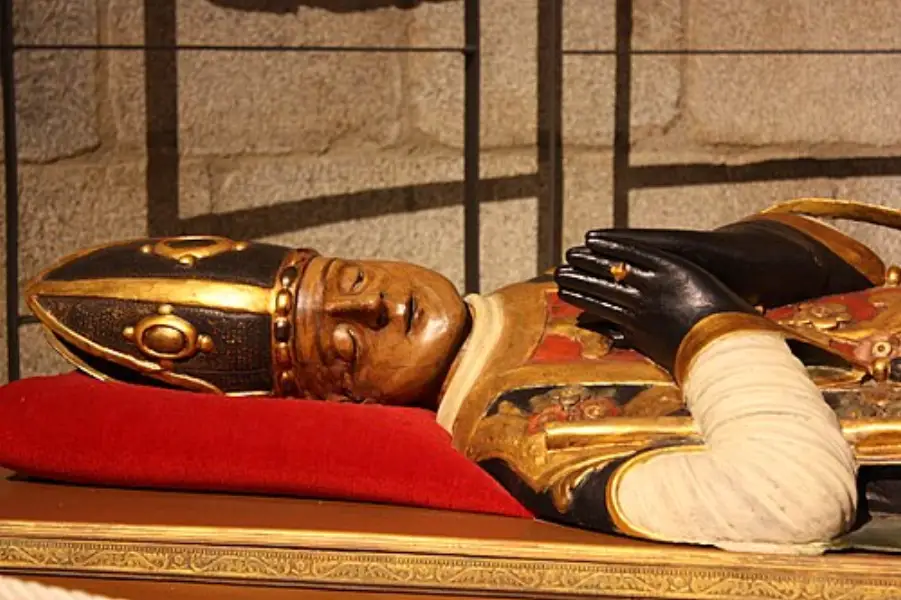
Overview
Ermengol, whose name appears also as Armengol, Armengod, or Hermengaudius, governed the diocese of Urgell in the Pyrenees from 1010 until his death in 1035, and he belongs to that generation of eleventh-century Catalan bishops who were at once churchmen, builders, landlords, and men of war. He was born, probably in the village of Ayguatébia, into the ruling house of the county of Conflent: his father was Bernat I, viscount of Conflent, his mother Guisla de Lluçià, and his predecessor in the see of Urgell, Bishop Sal·la, was his own uncle, who arranged for the nephew to succeed him. Reaching the rank of archdeacon by 1002, Ermengol took up the episcopate by reforming his cathedral clergy on the Augustinian pattern, endowing them with lands across three shires, and securing from Pope Benedict VIII in Rome a confirmation of his bishopric's possessions and jurisdiction. He involved himself in the founding of the bishopric of Roda de Isábena, led the Christian expedition that took the Guissona plain from the Taifa of Zaragoza around 1020, quarreled persistently with the nobles of Urgell, and built the cathedral whose consecration in 1040 he did not live to see. The labor that killed him was characteristic: in 1035 he died helping to raise a bridge near the village of El Pont de Bar. Veneration began the following year, and within a few years he had been canonized; the town of Seu d'Urgell still keeps his memory each year with the Saint Ermengol Fair.
The Complete Life
Origins and Rise
Ermengol came from the aristocracy that ruled the Pyrenean counties in the generation after the fall of the Caliphate's power in the march of Spain. His father, Bernat I, was viscount of Conflent; his mother, Guisla de Lluçià, belonged to another noble house of the region; and the family's grip on ecclesiastical office appears plainly in the fact that the bishop of Urgell, Sal·la, was the boy's uncle. The village of Ayguatébia is given, with some uncertainty, as his birthplace. By 1002 the young man had risen to archdeacon, and in 1003 Sal·la set in motion the arrangement by which the see would pass to his nephew, a succession typical of the period, in which the great families treated the dioceses of the church as part of their patrimony even while endowing them devoutly.
§ Introduction
Episcopate
Ermengol held the bishopric of Urgell from 1010 to 1035 and used those twenty-five years to reshape the church of his diocese. His first act was to reform the cathedral canons, organizing their common life on the pattern taught by Saint Augustine, and to secure their upkeep with estates given over in Vallespir, Cerdanya, and Alt Urgell. His Roman journey fell in 1012, though some accounts prefer 1011 and Pope Sergius IV; from Benedict VIII he obtained a privilege confirming the property of his bishopric and its jurisdiction, notably its claim over the county of Ribagorza. In 1017 he involved himself in the creation of the neighboring bishopric of Roda de Isábena, consecrating Borrell as its bishop and receiving in return the latter's formal recognition of Urgell's seniority in the church hierarchy. Around 1020 the bishop appears in a very different role, as leader of the Christian armed expedition that seized the Guissona plain from the Taifa of Zaragoza, an enterprise that belongs to the long frontier warfare of the Catalan counties with al-Andalus.
§ Introduction
Public Works and Death
Conflict with the lay nobility of the county of Urgell marked the whole of Ermengol's episcopate, a struggle in which the fortified church of the early eleventh century defended its lands and rights against the counts and viscounts around it. Against that background the bishop poured his resources into construction, above all the cathedral of Urgell, the Romanesque church that his successor Eribau consecrated in 1040. The work that ended his life was humbler but in its way as consequential: in 1035, while helping in the building of a bridge beside the village of El Pont de Bar, the bishop was killed. The date of death is the last certain fact of his career, and the image it fixed, of a bishop dying at the site of a public work, has kept his memory attached to engineering and building as much as to liturgy.
§ Introduction
Cult and Memory
Veneration of Ermengol began in the year following his death, and within a few years the church had numbered him among the saints, an almost immediate acclamation of the kind common in eleventh-century Catalonia before the formal processes of Rome. His feast is kept on November 3. The townspeople of Seu d'Urgell honor him annually with the Saint Ermengol Fair, a market and festival that carries the bishop's name in the civic calendar of the diocese to this day. Historians of the period, notably Jeffrey Bowman in his study of bishops and bridges in the medieval Pyrenees, have taken Ermengol as a type of the warrior-builder prelate, in whom sanctity, seigneurial power, and public construction were a single enterprise.
§ Introduction
Timeline
- 1002
Attained the post of archdeacon; the following year Bishop Sal·la of Urgell, his uncle, made the arrangements by which Ermengol would succeed him in the see.
§ Introduction
- 1010
Began his episcopate as bishop of Urgell, opening it with a reform of the cathedral canons on the model of the life of Saint Augustine and grants of land in Vallespir, Cerdanya, and Alt Urgell.
§ Introduction
- 1012
Traveled to Rome for an audience with Pope Benedict VIII, who confirmed the possessions of the bishopric of Urgell and its jurisdiction, including that over the county of Ribagorza; one account dates the journey to 1011 and to Sergius IV.
§ Introduction
- 1017
Had a hand in setting up the new see of Roda de Isábena, conferring episcopal consecration on Borrell, and received from him acknowledgment of Ermengol's superiority in the ecclesiastical hierarchy.
§ Introduction
- 1020
Credited with leading the Christian military undertaking that wrested the Guissona plain from the Islamic Taifa of Zaragoza around this time.
§ Introduction
- 1035
Lost his life at a bridge works he had gone to help with, beside the hamlet of El Pont de Bar, closing a tenure marked by recurring strife with the magnates of Urgell and by construction crowned by the cathedral of Urgell itself.
§ Introduction
- 1040
The cathedral he had built was consecrated by his successor, Bishop Eribau; veneration of Ermengol had begun the year after his death, and his canonization followed within a few years.
§ Introduction
The Record
- Major works
- Built the cathedral of Urgell, consecrated in 1040·Died helping to construct a bridge at El Pont de Bar·Reformed the cathedral canons of Urgell on the Augustinian rule
- Patron of
- Diocese of Urgell·The town of Seu d'Urgell
- Symbols
- Bridge, in memory of the work that cost his life
- Canonization
- Veneration began the year after his death; canonized within a few years
Prayer
Bibliography
Show 3 sources
- The Bishop Builds a Bridge: Sanctity and Power in the Medieval Pyrenees, Jeffrey A. Bowman, The Catholic Historical Review, Vol. 88, No. 1 (Jan., 2002), 1-3.
- Catalunya Romànica, vol. VII, "La Cerdanya, El Conflent", Enciclopedia Catalana, Barcelona, 1995, p. 265.
- Historia y cultura militar durante la expansión feudal en el valle del Ebro, siglos XI y XII. Presupuestos metodológicos para una didáctica de la guerra en la Edad Media, Prensas de la Universidad de Zaragoza, Zaragoza, 2021, p. 170.
Profile text adapted from the Wikipedia article, licensed CC BY-SA 4.0.
Pray with this saint every day
Save St. Ermengol to your favorites, read the full profile, and get feast-day reminders in the Saints app.
Get the Saints AppFree on the App Store for iPhone and iPad