
fl. 615·Feast Unknown
St. Erminulfus
Seventh-century Bishop of Évreux at the Council of Paris
Overview
Erminulfus was bishop of Évreux in the first half of the seventh century, when the Frankish church of Neustria was taking shape around its ancient episcopal sees. His name survives in a single dated witness: on 10 October 615 he stood among the bishops who subscribed the decrees of the Council of Paris, assembled in the Merovingian kingdom. In the old catalogue of the bishops of Évreux he follows Laudulfus, attested in 585, and precedes Waldus, attested about 648, so that his episcopate belongs to the generation bridging the sixth and seventh centuries. Beyond his subscription at the council almost nothing is recorded of his life, his origins, or his government of the diocese; like most of his colleagues in the Merovingian church he is known to history only through the official acts in which his signature appears. Yet the see he governed was one of the oldest in Normandy, tracing its foundation back to the legendary Taurinus, and for a decade or more around 615 Erminulfus was its chief shepherd.
The Complete Life
A Shepherd in Merovingian Normandy
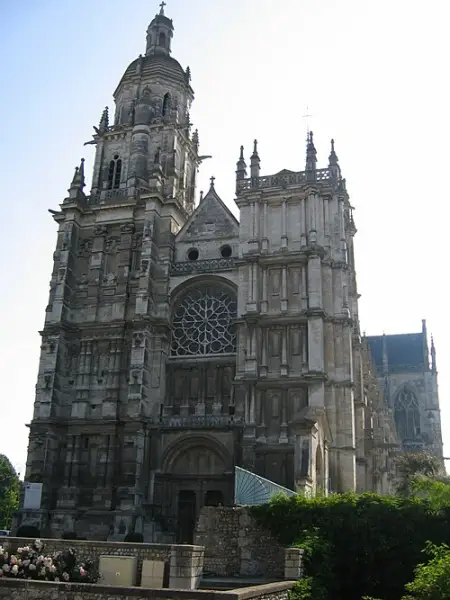
The diocese Erminulfus governed was among the ancient churches of Neustria. Its cathedral stood at Évreux, in the land of the Aulerci Eburovices, and its foundation was ascribed in legend to Taurinus, a missionary bishop whose true dates the medieval sources could not fix. By the seventh century the succession of its bishops had become steady enough to be recorded: Maximus, Etherius, Gaud, Maurusius at the Council of Orléans in 511, Licinius, Ferrocinctus at Paris in 557, Viator, and Laudulfus in 585. Somewhere in this line, probably as its seventh or eighth occupant, Erminulfus took up the crozier. Nothing is told of his family or his early years; Merovingian episcopal lists are silent about nearly everything but names and dates of attendance at councils. Yet the office itself carried weight. A bishop of Évreux in 615 presided over clergy and people across the Eure, kept the Latin learning of the past alive in a rural world, owed service to the Merovingian court, and answered for the orthodoxy of his church before the assembled episcopate of the realm.
§ History
The Council of Paris, 615
Erminulfus's one dated act is his presence at the Council of Paris, which gathered on 10 October 615 and whose decrees the bishops present signed. This assembly belongs to the long series of Frankish councils by which the Merovingian church ordered its own life: it took up the discipline of the clergy, the protection of ecclesiastical property, the care of the poor, and the proper relation between bishops and the royal power. Attendance mattered. A bishop who subscribed the decrees of a council bound himself and his church to their observance, and his name entered the acta as a perpetual witness. For Évreux, a see on the western edge of the Frankish world, the presence of its bishop at Paris affirmed that the diocese stood in full communion with the church of the kingdom. The subscription list is nearly all we have of Erminulfus, but it is enough to place him among the shepherds who carried the faith of Gaul from the Roman world into the early Middle Ages, and enough to fix the one certain date of a life otherwise given in silence.
§ History
Timeline
- 585
Laudulfus, Erminulfus's predecessor on the see of Évreux, is attested in the episcopal catalogue this year.
§ To 1000
- 10 Oct 615
Signs the decrees of the Council of Paris as bishop of Évreux on 10 October.
§ To 1000
- 648
His successor Waldus is attested about this year, marking the close of Erminulfus's episcopate.
§ To 1000
The Record
- Canonization
- Pre-congregation; remembered among the holy bishops of the ancient see of Évreux
Prayer
Bibliography
Show 5 sources
- Johann Friedrich (1867). Drei unedirte Concilien aus der Merovingerzeit: mit einem Anhange über das Decretum Gelasii. Bamberg: Reindl. pp. 15, 47.
- Odette Pontal (1986). Die Synoden im Merowingerreich. Schöningh, p. 312.
- Louis Duchesne (1910). Fastes épiscopaux de l'ancienne Gaule: II. L'Aquitaine et les Lyonnaises. Paris: Fontemoing. pp. 225–230.
- Alphonse Chassant; G. Ern Sauvage (1846). Histoire des évêques d'Évreux: avec des notes et des armoiries. Évreux: Tavernier.
- Gallia Christiana: In Provincias Ecclesiasticas Distributa. Vol. Tomus XI. Paris: Typographia Regia, 1759. pp. 564–673.
Profile text adapted from the Wikipedia article, licensed CC BY-SA 4.0.
Pray with this saint every day
Save St. Erminulfus to your favorites, read the full profile, and get feast-day reminders in the Saints app.
Get the Saints AppFree on the App Store for iPhone and iPad