
11th century, died c. 1080·Feast June 12 (June 11 in the Diocese of Strängnäs)
St. Eskil
Anglo-Saxon missionary bishop and martyr
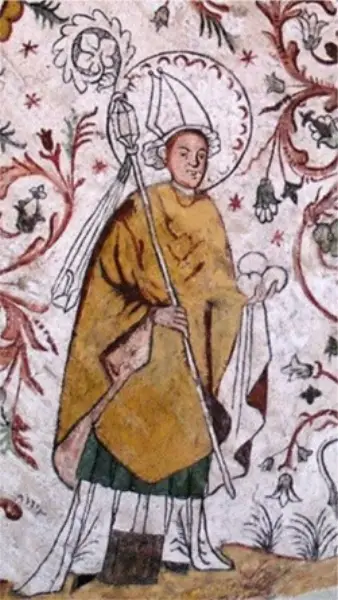
Overview
Eskil was an English monk of the eleventh century who carried the Christian faith to the lake country of middle Sweden and died there a martyr's death. Sent out as a missionary bishop by Saint Sigfrid of Växjö, in company with the saints Botvid and David, he made the village of Tuna, the modern Eskilstuna, his missionary diocese, the first episcopal foundation in the lands around Lake Mälaren. He probably labored under King Inge the Elder at the close of the century. Around 1080 he traveled some thirty kilometers east to Strängnäs, an ancient holy place of the old religion, and there, according to the tradition, he interrupted a pagan sacrifice and was killed by stoning and by the axe. The earliest echo of his death comes not from Sweden but from Denmark, where Ælnoth of Canterbury, writing about 1122, records an English bishop of noble birth, Eskillinus, slain by the Swedes and Geats among whom he preached. The developed legend of the thirteenth century sets the martyrdom under King Blot-Sweyn, who is said to have ordered the bishop executed as a sorcerer after Eskil's prayers raised a storm that broke up the rite. His followers carried the body back toward Tuna, and where they laid it down a spring broke from the hillside, a fountain still shown to pilgrims today. He was buried at Tuna, which took his name as Eskilstuna; the see he founded was eventually reestablished at Strängnäs, where the cathedral rose on the very hill of the sacrifice he defied, and he is honored as the principal patron of Södermanland and of the Diocese of Strängnäs.
The Complete Life
Life and Mission
Eskil was one of the English missionaries whom the church of the eleventh century sent to the Scandinavian north. He came to the Lake Mälaren country as a bishop in the train of Saint Sigfrid of Växjö, together with Saint Botvid and Saint David, and Alban Butler records that he was Sigfrid's kinsman. All three of these saints are said to have died in the attempt to bring Christianity to the peoples around the lake, and two of them, Eskil and Botvid, became joint patrons of Södermanland County, while David was taken as patron of Västerås and Västmanland. Eskil probably worked during the reign of King Inge the Elder at the end of the eleventh century. As an itinerant missionary bishop he planted his seat at the village of Tuna, today's Eskilstuna, the earliest episcopal foundation anywhere in the Mälaren country; the more archaic traditions place his actual dwelling at Fors, on the opposite bank of the river. Around 1080 he walked the thirty kilometers east to Strängnäs, a place sacred in the old Norse religion, and there his mission met its end.
§ Life
Legend and Martyrdom
The sources for Eskil's death are stratified. Closest in time is the legend of Saint Canute of Denmark, composed around 1122 by Ælnoth, a priest from Canterbury who had made his home as an exile in that country; it tells of an Eskillinus, a bishop of England and noble birth, killed by the wild barbarians, named as Swedes and Geats, in the midst of whom he was preaching. In its fuller thirteenth-century form the legend recounts that Eskil preached successfully under King Inge but was put to death under Blot-Sweyn when he tried to halt a pagan sacrifice on the hill where Strängnäs Cathedral now stands. When the people refused his remonstrance, he called down by prayer a terrible storm that scattered the ritual, and the king condemned him to die as a sorcerer. He was stoned and cut apart with axes, and the stones of his execution became his attribute in art. The legend adds that Christians carrying his body toward Fors were stopped at Tuna by a dense fog, took the obstacle for a sign, and buried him there; in the earlier telling, a spring burst from the ground where the body was laid down outside Strängnäs, and it still flows. Those who shaped the legend drew, stylistically, on several models, among them the story of Saint Olaf of Norway.
§ Legend
Veneration and Legacy
The cult of Eskil took root on both sides of his story. At Strängnäs, the hill of the interrupted sacrifice received first a wooden church dedicated to him and later the cathedral itself; a chapel of the saint stood in the cathedral by 1400 at the latest, and pilgrims kept coming to the martyrdom site even though his relics rested at Tuna. That burial church in time grew into one of the earliest monasteries of the region, and when Tuna gained its town charter the saint's name was fused with it, giving Eskilstuna. His relics were honored in the church of Eskilstuna and in churches across the diocese, elsewhere in Sweden, and in the Danish cities of Roskilde and Copenhagen; a fifteenth-century silver hand-reliquary that held a piece of his arm bone is now in the History Museum of Stockholm. The veneration spread to Odense in Denmark and Trondheim in Norway. His feast, kept on the presumed day of his death, 11 June, was shifted to 12 June everywhere but in the Diocese of Strängnäs so as not to collide with the feast of Saint Barnabas. Gustav Vasa razed the monastery of Saint Eskil in the Reformation and raised the royal castle of Eskilstuna House on its ground, but the saint remains the patron of Södermanland and of the Diocese of Strängnäs.
§ Veneration
Timeline
- 1080
Sent as a missionary bishop to the region of Lake Mälaren by Saint Sigfrid of Växjö, together with Saint Botvid and Saint David, all three of whom would perish in the effort to Christianize the Mälaren country.
§ Life
- 1080
Established his missionary see at the village of Tuna, present-day Eskilstuna, the earliest diocese anywhere in the country around Lake Mälaren; the older traditions set his dwelling at Fors, on the opposite bank of the river. Butler records that he was a kinsman of Sigfrid.
§ Life
- 1080
Made a journey of some thirty kilometers east of Tuna to Strängnäs, an Old Norse sacred site, and there, by disrupting a holy ritual of the old religion, provoked his death by stoning and by the axe; the developed legend places the martyrdom under King Blot-Sweyn, who condemned the bishop for sorcery after a storm raised by his prayers scattered the sacrifice.
§ Legend
- 1080
His followers set out to return the corpse to Tuna; where the body rested on the ground a miraculous spring gushed from the mountainside outside Strängnäs, and the body was buried at Tuna after fog impeded the bearers on their way.
§ Legend
- 1122
About this year Ælnoth of Canterbury, an Anglo-Saxon priest settled in Denmark, wrote in his legend of King Canute of Denmark of an Eskillinus, a noble-born English bishop killed by the wild barbarians, Swedes and Geats, among whom he preached the gospel, the earliest source touching the saint.
§ Legend
- 1200
The diocese Eskil had founded at Tuna was moved or reestablished at Strängnäs once that town had accepted Christianity, and the first wooden church on the hill of the pagan rite was dedicated to the martyr; Strängnäs Cathedral later rose on the same ground.
§ Veneration
- 1200
When Tuna received its municipal charter, the martyr's name was joined to it, creating Eskilstuna; relics of Eskil were venerated in the church there, in other churches of Sweden, and in Roskilde and Copenhagen in Denmark.
§ Veneration
- 1400
A chapel of Saint Eskil stood in Strängnäs Cathedral by at least this date, and pilgrimage to the hill of his martyrdom continued even though his relics lay elsewhere.
§ Veneration
- 1527
The monastery of Saint Eskil at Eskilstuna, one of the first in the region and built around his burial church, was destroyed in the Swedish Reformation under Gustav Vasa and replaced by the royal castle of Eskilstuna House; a fifteenth-century silver reliquary in the shape of a hand survives in Stockholm.
§ Veneration
The Record
- Major works
- Founded the first diocese of the Lake Mälaren region, at Tuna·Remembered through the medieval legend that recounts his martyrdom at Strängnäs
- Patron of
- Södermanland·Diocese of Strängnäs
- Symbols
- Episcopal attire·Three stones
- Canonization
- Pre-congregation martyr, venerated from the late 11th century
Prayer
Bibliography
Show 10 sources
- Forster, Thomas Ignatius M.. Circle of the seasons, and perpetual key to the calendar and almanack, United Kingdom, p. 164, 1828.
- Butler, Alban. "Saint Eskill, Bishop and Martyr in Sweden". Lives of the Fathers, Martyrs, and Principal Saints, 1866. CatholicSaints.Info. 15 June 2013.
- Travel, Pilgrimage and Social Interaction from Antiquity to the Middle Ages (Jenni Kuuliala, Jussi Rantala eds.), United Kingdom, Taylor & Francis, 2019, ISBN 9780429647703.
- Fryxell, Anders. The History of Sweden, United Kingdom, R. Bentley, 1844, p. 172 et seq.
- "St. Eskil", FaithND, faith.nd.edu.
- Saints and Sainthood Around the Baltic Sea: Identity, Literacy, and Communication in the Middle Ages (2015), Germany, Medieval Institute Publications, p. 241, ISBN 9781580443241.
- Fallow, T.M., The Reliquary, United Kingdom, John Russell Smith, 1894, p. 227.
- Sanctity in the North: Saints, Lives, and Cults in Medieval Scandinavia (Thomas A. DuBois, ed.), United Kingdom, University of Toronto Press, 2008, p. 83, ISBN 9780802091307.
- Methods and the Medievalist: Current Approaches in Medieval Studies (Jesse Keskiaho, Marko Lamberg, eds.), United Kingdom, Cambridge Scholars Publishing, 2020, p. 251, ISBN 9781527561809.
- Toni Schmid, "Eskil", Svenskt biografiskt lexikon, vol. 14, p. 518-522.
Profile text adapted from the Wikipedia article, licensed CC BY-SA 4.0.
Pray with this saint every day
Save St. Eskil to your favorites, read the full profile, and get feast-day reminders in the Saints app.
Get the Saints AppFree on the App Store for iPhone and iPad