
died 308·Feast March 7
St. Eubulus
Martyr of Caesarea in Palestine
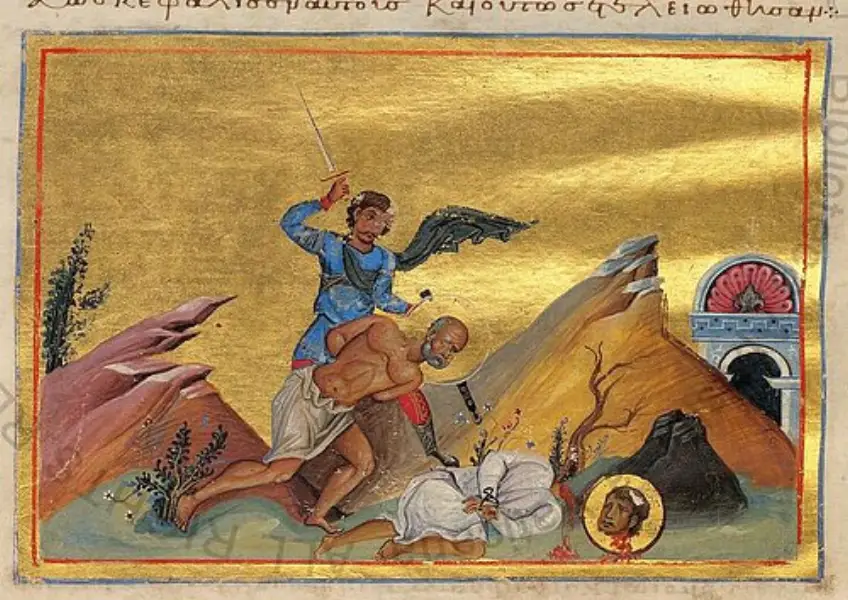
Overview
Eubulus was a Christian of the early fourth century who died in the final wave of the great persecution at Caesarea in Palestine, the last of the long line of martyrs of that city. He had traveled there in the company of Adrian of Batanea, a fellow Christian from the region east of the Jordan, to visit and serve the local congregation. Questioned at the city gates about the purpose of their journey, the two told the truth, and for that honesty they were seized and imprisoned on the orders of Governor Firmilian, who put them to torture. Adrian was condemned first and, on 5 March 308, was exposed to a lion in the arena; surviving the beast's attack, he was dispatched by the sword. Two days later the judge who had condemned Eubulus offered him release on the single condition that he sacrifice to the idols. Eubulus refused, was condemned to the same death, and was martyred on 7 March 308. With him the twelve-year bloodshed at Caesarea, which had claimed martyr after martyr since the persecutions began, came to its close. The Roman calendar honors him on 7 March, two days after his companion, and the hagiographic tradition preserves the pair together, remembered chiefly through the lives of the Saints collected by Butler and Shea.
The Complete Life
The Journey to Caesarea
In the last years of the persecutions that had troubled the church of Palestine for a dozen years, Eubulus set out with Adrian of Batanea for Caesarea Maritima, the administrative capital of the province and the scene of some of the era's most famous martyrdoms. Their purpose was pastoral: the care of the faithful of that city, a dangerous errand in a place where confessors were being condemned in the amphitheatre. At the city gates the two travelers were stopped and asked the reason for their journey. They answered honestly, saying what they had come to do, and the guards arrested them on the spot, acting under the authority of the governor Firmilian. The candor that cost them their freedom is the first mark the tradition records of these two men, who might have passed unmolested had they lied.
§ Legend
Trial and Martyrdom
Firmilian had the two prisoners tortured, and Adrian was condemned first. On 5 March he was exposed to a lion in the amphitheatre of Caesarea; the beast mauled him but did not finish him, and a soldier completed the execution with the sword. Two days later, on 7 March, the judge turned to Eubulus. The record preserves a small but telling detail: the judge who had condemned Adrian now held out to Eubulus his life on one condition, sacrifice before the idols, the standard bargain by which the Roman authorities hoped to break the confessors without more bloodshed. His refusal brought down the identical sentence, and he underwent the identical kind of death. The Martyrology assigns his feast to 7 March, two days after Adrian's, so that the church keeps the two companions on their separate days of witness.
§ Legend
The Last of the Caesarean Martyrs
Eubulus holds a particular place in the martyrology of Palestine: with him, the tradition closes the long catalogue of those killed at Caesarea during the twelve years of persecution that preceded his death. The city had seen some of the most storied confessors of the era pass through its courts and its arena, and the death of the traveler from Batanea marked the end of that bloodshed. His companion Adrian of Batanea is commemorated on 5 March and Eubulus on 7 March, and the older lives of the saints, from Butler's collection to Shea's Pictorial Lives, have kept their common story alive. A distinct figure must not be confused with him: another Greek Christian named Eubulus receives a passing greeting in the Second Letter to Timothy, one of the pastoral epistles attributed to Paul, and other men of the same name are recorded in classical history.
§ Legend
Timeline
- 308
Traveled with Adrian of Batanea to Caesarea in order to visit and serve the community of believers there; on arrival at the gates the two were questioned about their purpose and answered truthfully, and were at once imprisoned by the guards on Governor Firmilian's orders.
§ Legend
- 308
Endured torture at the hands of the authorities of Caesarea, under the governor Firmilian.
§ Legend
- 308
On 5 March his companion Adrian was exposed to a lion in the arena; mangled yet still alive, he was then put to death by the sword, the day of his own feast.
§ Legend
- 308
On 7 March the judge who had condemned Adrian put release within Eubulus's reach on a single condition, that he sacrifice before the idols; his no brought the identical sentence and a martyr's death of the very same kind.
§ Legend
- 308
His death brought to a close the twelve years of persecution at Caesarea, of which Eubulus and Adrian were the last of the many martyrs.
§ Legend
The Record
- Major works
- Remembered as the closing witness of the Caesarean persecutions under Governor Firmilian
- Patron of
- Persecuted Christians·Those tempted to compromise their faith
- Symbols
- Lion, from the manner of the martyrs' death
- Canonization
- Pre-congregation martyr
Prayer
Bibliography
Show 4 sources
- Husenbeth, Frederick Charles. Emblems of Saints: By which They are Distinguished in Works of Art, Longman, Green, Longman, and Roberts, 1860, p. 3.
- Butler, Alban. Lives of the Saints, Benziger Brothers, 1894.
- Shea, John Dawson Gilmary. "Saints Adrian and Eubulus, Martyrs". Pictorial Lives of the Saints, 1889. CatholicSaints.Info. 1 February 2014.
- Monks of Ramsgate. "Hadrian and Eubulus". Book of Saints, 1921. CatholicSaints.Info. 1 September 2013.
Profile text adapted from the Wikipedia article, licensed CC BY-SA 4.0.
Pray with this saint every day
Save St. Eubulus to your favorites, read the full profile, and get feast-day reminders in the Saints app.
Get the Saints AppFree on the App Store for iPhone and iPad