
died c. 250·Feast December 8
St. Eucharius
First Bishop of Trier and Missionary of Gaul
Overview
The church of Trier honors Eucharius as the first of its bishops, in the ancient imperial city on the Moselle, and the traditions around him reach for the apostolic age itself. The legend preserved in the Gesta Treverorum counts him among the seventy-two disciples of the Lord, despatched by St. Peter himself to preach the gospel in Gaul as its bishop, with Valerius serving him as deacon and Maternus as subdeacon. On their journey Maternus died at Ellelum in Alsace, and the story relates how the two messengers hurried back to Peter, whose pastoral staff, laid upon the dead man, raised him after forty days in the grave — the reason the staff became the emblem of every missionary envoy. Preaching together along the Rhine, the three won Gentiles to the faith in great numbers and founded churches, until at Trier the harvest was so rich that Eucharius fixed his episcopal residence there. An angel, the tale continues, foretold his death and named Valerius his successor. His own death came on 8 December, at the close of a quarter-century on the episcopal throne, and his body was laid to rest in the church of St. John beyond the gates. Modern historians, weighing the contradictions of the legend, place these first missionaries of Trier after about 250.
The Complete Life
Sent by the Apostle
The story of Eucharius begins, as the Gesta Treverorum tells it, in the company of the Lord himself: he is numbered among the seventy-two disciples whom Christ sent out before his face. After the resurrection, St. Peter chose him for a still greater commission — to carry the gospel into Gaul — and sent him forth as a bishop, attended by the deacon Valerius and the subdeacon Maternus. The three formed the pattern of every mission band that would follow: a bishop at the head, clergy at his side, the sacraments and the preaching committed to all. The road west tested them almost at once. At Ellelum in Alsace, Maternus fell dead, and his companions faced the collapse of their undertaking with the practical faith that marks the whole legend: they retraced their steps all the way to Rome and begged Peter to give their brother back. Peter handed Eucharius his own pastoral staff, and when the staff was laid upon the body Maternus rose from a grave he had kept for forty days. From that hour, the tradition says, the staff became the distinctive mark of the envoy — above all, of the missionary sent with Christ's authority.
§ Narrative
The Harvest on the Rhine
Restored to their journey and strengthened by the miracle, the three companions preached their way toward the Rhine, and the account records that the Gentiles were converted in large numbers. Churches multiplied under their hands as they moved through the provinces, and the work bore its richest fruit at Trier, the old imperial residence on the Moselle, where the response to the preaching was so swift and so abundant that Eucharius resolved to make the city his episcopal seat — the decision from which the church of Trier counts its beginnings. The legend attaches other wonders to these years, among them the raising of a dead man to life by Eucharius himself. The same narrative extends the threefold mission across the whole region: Valerius governed Trier for fifteen years after him, and Maternus, raised from his Alsatian grave, went on to found the dioceses of Cologne and Tongeren and to rule as bishop for forty years in all. However the chronology is weighed, the picture the tradition preserves is of one missionary enterprise flowering into a family of churches along the middle Rhine, with Trier as their mother see.
§ Narrative
Death Foretold and Succession Promised
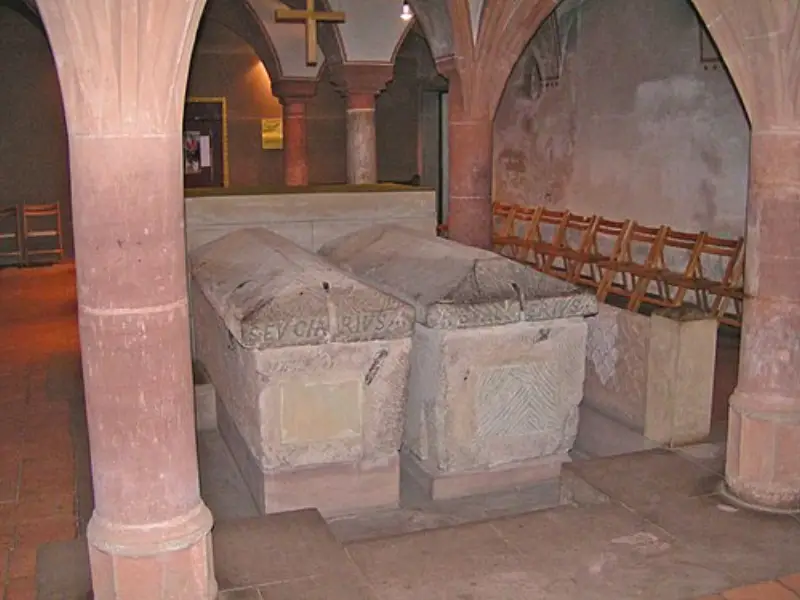
Eucharius's story closes with the quiet dignity of a bishop who has finished his course. An angel, the account relates, announced to him his approaching death and at the same time pointed out Valerius as his successor — a double message that joined the assurance of heaven to the continuity of the church. Death found him on 8 December, after a quarter-century on the throne; his body was laid to rest in the church of St. John beyond the city gates. His feast is still kept on that date. His relics now rest in the crypt of what was originally called the abbey of St. Eucharius, the house at Trier renamed St. Matthias' Abbey when it acquired relics of the apostle; there the tombs of Eucharius and Valerius lie together, the visible heart of his cult. The devotion spread beyond Trier: at Echternach, the abbey bound in friendship to St. Matthias, the cult and liturgy of Eucharius were firmly established. Whatever the historians make of the legend's chronology, the church of Trier has never ceased to honor the man it counts as its first bishop.
§ Narrative
Chronicle, Legend, and Criticism
The story of Eucharius reached its fixed form in the famous chronicle of Trier, the Gesta Treverorum, compiled in the monastery of St. Matthias — a work the sources describe as a curious mixture of truth and error. Medieval writers loved to push the foundations of their dioceses as early as possible, both to magnify their churches and to defend their rights, and the ravages of the Normans had swallowed the more reliable early records; when the lives of the primitive founders came to be written anew, imagination filled the gaps. An amplification of the narrative, telling the lives of all three saints, is attributed to the monk Goldscher, who lived at St. Matthias around 1130, and from the Gesta the story passed unchallenged into numerous medieval works. Modern scholarship has been cooler: contradictions abound, since the three saints are set at the head of dioceses founded more than a century after Peter's day, and the Bollandists, with Marx, Lütolf, and other historians following Hontheim and Calmet, assign these first bishops of Trier to the period after about 250. The legend survives as the Church's memory of her own beginnings — pious, inconsistent, and enduring.
§ Veneration and traditions
Timeline
- 250
After preaching along the Rhine and in Alsace, he fixes his episcopal residence at Trier.
§ Narrative
- 8 Dec 250
Dies on 8 December after twenty-five years as bishop; his body is laid to rest in St. John's church outside the walls.
§ Narrative
- 990
At the close of the tenth century, the upper half of St. Peter's staff, kept at Cologne, is presented to Trier.
§ Narrative
- 1130
The monk Goldscher of St. Matthias' Abbey near Trier is said to write an amplification of the three saints' lives.
§ Veneration and traditions
The Record
- Major works
- Founding of the church of Trier, as told in the Gesta Treverorum tradition
- Patron of
- missionaries and envoys, whose staff recalls the pastoral staff of St. Peter
- Symbols
- the pastoral staff of St. Peter
- Canonization
- Pre-congregation; ancient cultus as the founding bishop of Trier
Prayer
Bibliography
Show 5 sources
- Meier, Gabriel. "St. Eucharius." The Catholic Encyclopedia. Vol. 5. New York: Robert Appleton Company, 1909.
- "Saint Eucharius." New Catholic Dictionary. CatholicSaints.Info. 8 December 2012.
- Bonato, Mauro. "Sant' The Eukaryo of Trier", Santi e Beati, December 13, 2016.
- Raaij, Lenneke van. "The Long Arms of Saint Eucharius of Trier?", After Empire Project, August 22, 2017.
- Bistum Trier - Bistum - Geschichte/Bischöfe.
Profile text adapted from the Wikipedia article, licensed CC BY-SA 4.0.
Pray with this saint every day
Save St. Eucharius to your favorites, read the full profile, and get feast-day reminders in the Saints app.
Get the Saints AppFree on the App Store for iPhone and iPad