
c. 380 – c. 449·Feast November 16
St. Eucherius of Lyon
Ascetic Archbishop of Lyon and Master of Scripture
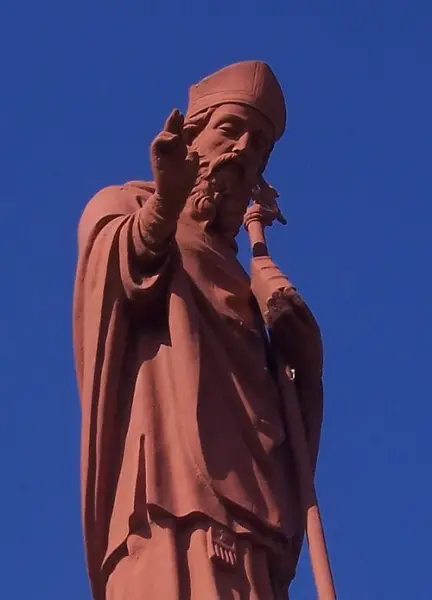
Overview
Eucherius belonged to the topmost ranks of Gallo-Roman society and of the church of his native Gaul, and he is remembered above all for letters that urged an extreme self-abnegation. Around the year 400, after two sons had been born to his marriage with the Gallo-Roman lady Galla, he proposed that husband and wife embrace a stricter life together; their household practiced what its contemporaries called unwealth, narrowing its comforts to the minimum that prayer and devotion required. When his wife died, the father took his two boys with him into the monastery of Lérins, keeping there a hard and simple round of study while he saw to their schooling, before settling as a hermit on the neighboring island of Lerona and in a cave at what is now Beaumont-de-Pertuis, whose fame spread through southeastern Gaul. Counsel came from John Cassian, who dedicated a set of his Collationes to Eucherius and Honoratus. Around 428 he wrote his praise of the desert; by about 434 the clamor for his leadership had made him bishop of Lyon, a chair which Henry Wace judged none of its occupants, Irenaeus excepted, had filled with more distinction. He presided as metropolitan at the first council of Orange in 441 and died around 449, leaving two sons as bishops and a body of writings that Erasmus would later print with admiration.
The Complete Life
A Marriage Turned to Friendship
Eucherius came of the high-born Gallo-Roman aristocracy of the late fourth century, a class whose wealth and learning furnished the young Gallic church with many of its bishops and monks. He married a Christian woman named Galla, and around the year 400 the couple had two sons, Veranus and Salonius; some sources add two daughters, Consortia and Tullia. The turning of the household came after the boys were born, when Eucherius proposed to his wife that together they adopt a more ascetic manner of living. What followed was not separation but a transformed partnership: their marriage settled into what the age called a marriage of friendship, the same freely chosen continence that Paulinus and Therasia had embraced at Nola. The family took up the practice its contemporaries named unwealth, restricting life to the minimum required to support prayer and devotion — a wealthy house deliberately stripped of its luxury. In an aristocratic world where rank, estates, and display were the currency of standing, the choice was radical, and it announced everything the rest of Eucherius's life would pursue: the conviction that the gospel's counsels were not ornament but command, to be kept first at home.
§ Life
Lérins, the Islands, and the Desert Fathers
When Galla died, Eucherius did what was common enough among fifth-century Christian parents of his standing: he withdrew with his sons to the monastery of Lérins, the celebrated community founded by Honoratus on an island off the Provençal coast. On that island the father kept a hard and simple round of study, with the schooling of Veranus and Salonius his chief labor, until the two were sent to visit Paulinus of Nola, the great aristocrat-turned-ascetic whose example shadowed the whole movement. Eucherius then pressed farther along the same road, withdrawing to the neighboring island of Lerona, now called Île Sainte-Marguerite, where he gave his days to study and to mortification of the flesh. He weighed joining the anchorites of the eastern deserts and consulted John Cassian, the famed hermit newly arrived from the East at Marseille; Cassian answered not with discouragement but with dedication, entrusting the second set of his Collationes, on the daily lives of the Egyptian Thebaid and the themes of grace, free will, and Scripture, to Eucherius and Honoratus. He never reached Egypt. Instead he became what the East could not supply — a desert father of Gaul — settling as a hermit in a cave at present-day Beaumont-de-Pertuis, where his renown spread through the whole southeast.
§ Life
Archbishop of Lyon
The recluse could not long be kept from office. Eucherius's fame as a hermit had spread so widely through southeastern Gaul that the church of Lyon chose him for its bishop, probably in the year 434, in succession to Sicarius. The elevation joined two of the strongest currents of fifth-century Gallic Christianity: the monastic movement born at Lérins, which supplied the episcopate with its most trusted men, and the old metropolitan dignity of Lyon, the see of Irenaeus, chief church of the Rhône valley. Eucherius discharged the office surrounded by the learned friendship his desert years had never cost him — Cassian still, and Honoratus; Hilary now at Arles; Claudianus Mamertus; Agroecius, who addressed a book to him; and Sidonius Apollinaris — so that Lyon became a hinge between the monks of the islands and the scholars of the cities. The certain datum of his episcopate is the first council of Orange in 441, which he attended as metropolitan of Lyon, presiding over the bishops of his province; he retained that dignity until his death. Under his government the see stood at the height of its early medieval standing.
§ Life
The Contempt of the World and the Sense of Scripture
Eucherius's asceticism was inseparable from his pen. Around 428 he composed De laude eremi, an epistolary essay in praise of the desert, offered to Hilary of Arles — a manifesto for the withdrawal that had shaped his own life. His Liber formularum spiritalis intelligentiae, addressed to his son Veranus, defended the lawfulness of allegorical reading of the Bible, gathering the metaphors of the Psalms and phrases such as the hand of God to show that the letter of Scripture opens onto mystery; in its pages the Greek word anagoge is taken up to name the reading that lifts the letter of Scripture toward the heavenly Jerusalem awaited at the world's end — an early working of what would become the classic hermeneutics of the Middle Ages. To his other son he addressed the Institutiones ad Salonium, and a letter to Faustus of Lérins described his pilgrimage to Jerusalem. His longest flight of eloquence was the Epistola paraenetica ad Valerianum cognatum, on the contempt of the world, giving voice to the despair for the present age — and the hope for the world to come — shared by so many educated men of Late Antiquity. So admirable did Erasmus find the Latin of it that he saw the letter through the press himself at Basel in 1520.
§ Works
A Dynasty of Bishops
Eucherius governed Lyon until about the year 449, when he died after some fifteen years in the see. The most remarkable feature of his last years was the continuation of his line: the church of Lyon called his son Veranus to the throne he was leaving, while Salonius received the bishop's office at Geneva, so that the monk of Lérins left behind him not writings merely but a living episcopal family. Such successions were not unknown among the Christian aristocracy of Gaul, where the faith of a household could become the pastoral patrimony of a province, but few families could claim two sees at once. In the church's memory he remained the model of the scholar-bishop: Henry Wace would rank him the most distinguished occupant of Lyon after its martyr-teacher Irenaeus. His body of work, and the example of a life that moved from aristocratic marriage through shared renunciation, island hermitage, and episcopal service, passed into the bloodstream of Gallic monasticism. He died, as he had lived, at the point where learning and asceticism met — a Roman noble who had counted the world's losses as gain, and left the church of Gaul richer in both books and bishops.
§ Life
The Long Afterlife of a Desert Voice
Eucherius's afterlife has been unusually long for a fifth-century provincial bishop. His Formulas for spiritual understanding became a seedbed of medieval exegesis, cited whenever readers asked how the hand of God might be found in the letter of Scripture, and his anagoge — Scripture read toward the Jerusalem to come — passed into the standard repertoire of interpretation. De laude eremi never ceased to be copied as the classic defense of desert life in Latin; a full English rendering appears as an appendix in the modern edition of the lives of the Jura Fathers, and modern scholarship has edited the Latin text afresh. The contempt of the world outlived even its author's name in the literary tradition: the same despairing eloquence echoes through later writing on the world's vanity, and it was precisely the quality of that Latin which moved Erasmus, at the height of the Renaissance, to print the letter at Basel in 1520. Historians of monasticism return to him for the testimony of a marriage transformed into ascetic friendship, and exegetes for the earliest Gallic voice of the allegorical method. The church honors him on 16 November in East and West alike.
§ Works
Timeline
- 380
Born around this year into a high-ranking family of Roman Gaul.
§ Introduction
- 400
His sons Veranus and Salonius are born, around this year, to Eucherius and his wife Galla
§ Life
- 428
Composes for Hilary of Arles his epistolary essay De laude eremi, extolling the life of the desert
§ Works
- 434
Probably this year, he is chosen bishop of Lyon after his fame as a hermit spreads through southeastern Gaul
§ Life
- 441
Presides at the first council of Orange in the metropolitan's chair for Lyon, an office he holds for the rest of his life
§ Life
- 449
Dies about this year; his son Veranus succeeds him at Lyon and Salonius becomes bishop of Geneva
§ Life
In Their Own Words
You show how strong in you is the love of solitary places, since the strongest human love must yield to it. What shall I call that love of the desert if not the love of God in you?
I would say that the desert deserves to be called a temple of our God without walls. Since it is clear that God dwells in silence, we must believe that he loves the solitary expanses of the desert. ... Although God is present everywhere, and regards the whole world as his domain, we may believe that his preferred place is the solitudes of heaven and of the desert.
The story is told that someone once asked a wise man where he could be sure to find God. The wise man told his questioner to come along where he would lead him, and together they went into the solitude of the open desert. ‘Behold’, he said, ‘where God is’. God is more promptly believed to be there, since he is more easily found there.
The cell in the desert truly deserves to be called the ark of strength, the seat of faith, the tabernacle of charity, the treasury of piety, the storehouse of justice.
How pleasant is the solitude of a remote place to those who thirst for God! How attractive for those who seek Christ are those solitary lands stretching in every direction under protecting nature. All things are silent there, and the joyful mind is spurred on by silence in its search for God, finding nourishment in ineffable ecstasies. No sound is heard in the desert save the voice of God.
The Record
- Major works
- De laude eremi (In Praise of the Desert)·Liber formularum spiritalis intelligentiae·Institutiones ad Salonium·Epistola paraenetica ad Valerianum cognatum, de contemptu mundi·Letter to Faustus of Lérins describing his pilgrimage to Jerusalem
- Canonization
- Pre-congregation; venerated in the Roman Catholic and Eastern Orthodox Churches
Prayer
Bibliography
Show 5 sources
- Salvator Pricoco (1965). Eucherii De Laude eremi. University of Catania.
- Gregory of Tours, Historia Francorum (The History of the Franks). London: Penguin Books, 1974.
- Sidonius Apollinaris, The Letters of Sidonius. Oxford: Clarendon, 1915.
- K. Pollmann (2007). "Poetry and Suffering: Metrical Paraphrases of Eucherius of Lyons' Passio Acaunensium Martyrum", in Otten & Pollmann (eds), Poetry and Exegesis in Premodern Latin Christianity. Leiden and Boston: Brill (Supplements to Vigiliae Christianae, 87).
- Vivian, Tim; Vivian, Kim; Russell, Jeffrey Burton (1999). "Appendix III: In Praise of the Desert by Eucherius of Lyon". The life of the Jura Fathers. Kalamazoo, Michigan: Cistercian Publications. pp. 197–215.
Profile text adapted from the Wikipedia article, licensed CC BY-SA 4.0.
Pray with this saint every day
Save St. Eucherius of Lyon to your favorites, read the full profile, and get feast-day reminders in the Saints app.
Get the Saints AppFree on the App Store for iPhone and iPad