
died 107·Feast March 1
St. Eudokia of Heliopolis
Samaritan martyr and penitent convert of Phoenicia
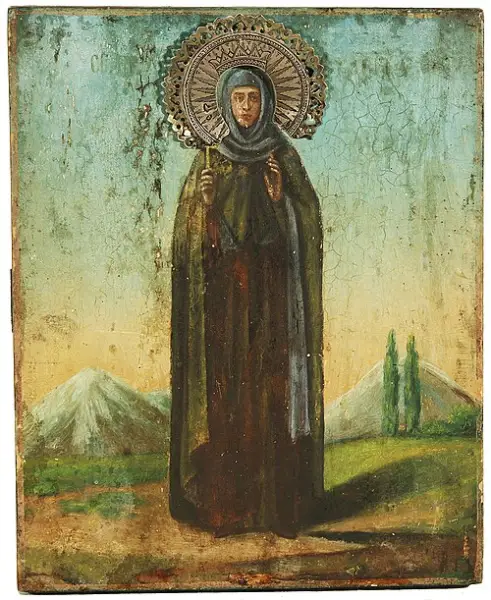
Overview
Eudokia of Heliopolis was a Samaritan woman remembered as a martyr of the early second century. She lived in Heliopolis of Phoenicia, the city known today as Baalbek in Lebanon, where her striking beauty and independent means drew a circle of wealthy admirers. Her direction changed when she encountered a monk named Germanus, who instructed her in the Christian faith and set her a week of solitary fasting and prayer. At its close she resolved to leave her former life behind, gave away her possessions, and received baptism from Theodotus, bishop of Heliopolis. Around the age of thirty she entered a monastery near the city and devoted her remaining wealth to charitable undertakings. Her refusal of former suitors provoked one persistent admirer, Philostratos, whose sudden collapse and recovery through her intercession brought about his own conversion to Christianity. Roman officials, angered by her activity, ordered her execution, and she was beheaded on 1 March 107. She is venerated in the Eastern Orthodox, Oriental Orthodox, and Roman Catholic traditions under several titular formulas as a venerable martyr.
The Complete Life
A Samaritan in Heliopolis
The sources identify Eudokia as a Samaritan woman who made her home in Heliopolis of Phoenicia, the ancient city that stands today as Baalbek in Lebanon. Beyond this, the record preserves almost nothing of her childhood, her family, or the circumstances that carried her from Samaria into the rich temple country of the Beqaa valley. What the tradition does remember is the shape of her adult life before conversion. She was remarkably beautiful, and she converted that beauty into security, accumulating considerable wealth through the devoted attention of prosperous lovers. Hers was a life sustained by charm and patronage rather than by family or trade, and it made her a familiar figure in a city famed for its grandeur. The account gives no hint of dissatisfaction with this existence; her change of heart came not from hardship but from an unexpected meeting with a Christian teacher. In this way her story belongs to a recognisable class of early martyrs: men and women of ambiguous reputation whose encounter with the gospel uprooted an established way of life and set them on a course that ended at the executioner's block.
§ Life
The Teaching of Germanus
Eudokia's turn toward Christianity began with a monk named Germanus, from whom she first learned the faith. According to the legend preserved in her acts, she put to him a direct and anxious question: whether someone like herself could still be saved from judgment. Germanus did not turn her away. What he prescribed was a discipline: a whole week spent shut up alone in her room, given wholly to fasting and prayer. Eudokia carried the rule out to the letter, and when the seven days were over Germanus came back with a further command. Her riches were to be given away, and the life she had led was to be abandoned for good. Only after this renunciation did she seek the sacrament that sealed her change: she was baptized by Theodotus, the bishop of Heliopolis. The sequence of the story is instructive, for it presents conversion as a process rather than a moment, moving through instruction, disciplined prayer, material renunciation, and finally incorporation into the Church through its bishop. Whatever the historical kernel, the narrative shaped how later generations understood her: a woman whose transformation was complete, ordered, and irreversible.
§ Life
The Monastery and the Conversion of Philostratos
At about the age of thirty, Eudokia entered a monastery near Heliopolis and began dispensing the fortune she had gathered in her former life across a range of charitable projects. Her wealth, once the currency of her old existence, became the instrument of her new one. Alongside this generosity she maintained a firm boundary against her past, rejecting all of her former suitors. One of them, a man named Philostratos, refused to accept her refusal and persisted in his pursuit. According to the account, he was struck down on account of his insistence, and Eudokia responded not with vindication but with prayer, interceding for him until he recovered. The effect on Philostratos was decisive: healed through the petition of the woman he had pursued, he converted to Christianity himself. The episode became one of the most retold parts of her story, for it displayed the character of her new life in miniature. Her refusal was absolute, yet her care for the man who harassed her was genuine, and the miracle her prayer obtained accomplished what argument could not, turning a suitor into a brother.
§ Life
Martyrdom on the First of March
The surviving account records the end of Eudokia's life with brevity. Her activity in Heliopolis, her renunciation, her charity, and her power of attracting converts aroused the anger of the Roman officials of the city, who resolved to silence her. They had her beheaded, and the tradition fixes the date precisely: 1 March in the year 107. She died, then, in the reign of Trajan, at the hands of the civil authority of a city whose temples and imperial patronage left little room for a Samaritan convert who turned prominent citizens toward Christ. No trial is described, no dialogue with a governor is preserved, and no account of her burial survives; the Passion narratives that later centuries composed for other martyrs never grew up around her name in the detail they did for some. What the record insists upon is the fact and the date of her death, and it is on that fixed point, the first day of March, that her commemoration has turned ever since. She thus belongs to the earliest stratum of attested Christian martyrs of the Phoenician interior.
§ Life
Veneration Across the Traditions
Eudokia's cult belongs to the era before formal canonization procedures: she was recognized as a martyr by the sustained devotion of the Church rather than by decree. Her feast is kept on 1 March, the anniversary of her execution, and she is venerated in three communions: Eastern Orthodoxy, the Roman Catholic Church, and Oriental Orthodoxy. The Orthodox tradition honors her under a family of titles that reveal how her story was received, calling her the Holy Monastic Martyress Eudocia, the Venerable Martyr Eudocia, Martyr Eudokia of Heliopolis, the Righteous Martyr Eudocia the Samaritan, and Our Holy Mother the Martyr Eudocia, or combinations of these. Roman Catholics commonly speak of her simply as Saint Eudokia of Heliopolis. The Coptic Church preserves a distinct commemoration, remembering the martyrdom of Saint Eudexia, a variant of her name, on 5 Baramhat in its synaxarium. This multiplication of forms across Greek, Latin, Coptic, and Slavic usage testifies to how widely her memory traveled, even though the bare narrative of her life remained short and fixed from an early period. Her cult, older than any record that describes it, has outlived the empire that condemned her and the temples among which she died.
§ Names
Name, Memory, and Folklore
Eudokia's name has traveled far and altered much along the way. It appears in modern Greek as Evdokia, in Latin as Eudocia, in Russian and other East Slavic forms as Yevdokiya, and in a Coptic variant as Eudexia or Eutychia, each tradition keeping the martyr within its own liturgical tongue. Writers of her tradition have taken care to distinguish her from another early saint, the martyr Eudokia, with whom she is easily confused and with whom her cult is sometimes blended. Her reach extended beyond the Church's calendars altogether. In Romanian folklore, the figure of Baba Dochia, a storied old woman associated with the turning of winter into spring, is thought to have taken her very name from the martyr, a survival that carried a second-century saint of Phoenicia into the peasant calendar of the Carpathians. Few saints of the early second century can claim so dispersed an afterlife. A woman about whom so little is recorded, remembered chiefly for a week of prayer, a gift of her goods, and a beheading on the first of March, gave her name to legends, languages, and seasons across a continent.
§ Romanian folklore
The Record
- Canonization
- Pre-congregation martyr, honored as a saint since the early centuries of the Church.
Prayer
Bibliography
Show 7 sources
- "Martyr Eudokia of Heliopolis", Orthodox Church in America
- "Venerable Martyr Eudocia", St. Nicholas Russian Orthodox Church
- A Reader's Guide to Orthodox Icons
- Greek Orthodox Metropolis of Toronto (Canada)
- Catholic.net, "St. Eudokia of Heliopolis"
- "Commemoration of the Martyrdom of St. Eudexia (Eutychia) - 5 Baramhat - Coptic Synaxarium", St-Takla.org, retrieved 25 April 2023
- Andreas Johns, Baba Yaga: the ambiguous mother and witch of the Russian folktale (Peter Lang, 2004), p. 76
Profile text adapted from the Wikipedia article, licensed CC BY-SA 4.0.
Pray with this saint every day
Save St. Eudokia of Heliopolis to your favorites, read the full profile, and get feast-day reminders in the Saints app.
Get the Saints AppFree on the App Store for iPhone and iPad