
1353 – 1407·Feast July 7
St. Eudoxia of Moscow
Grand princess, foundress, and monastic saint of Moscow
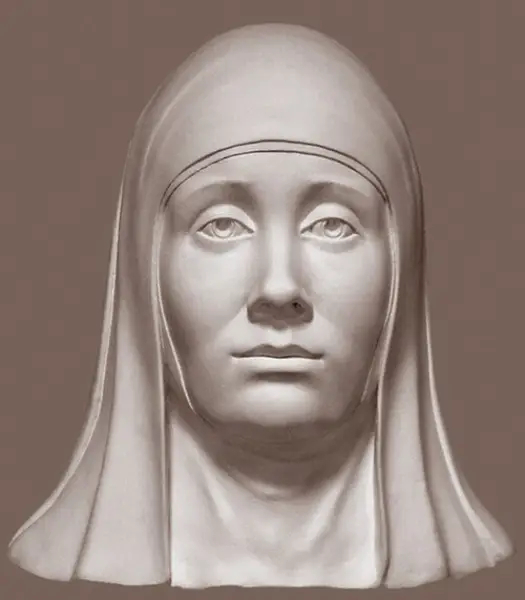
Overview
Eudoxia of Moscow, known in Russian as Evdokia Dmitriyevna and after her tonsure as Euphrosyne, was grand princess of Moscow from 1366 to 1389 as the wife of Dmitry Donskoy, the prince who broke the Mongols at the Battle of Kulikovo. Born in 1353 a daughter of Dmitry Konstantinovich, grand prince of Suzdal and Nizhny Novgorod, she was married at about thirteen and bore at least twelve children, including Vasily I of Moscow. She endured the siege of Moscow by Tokhtamysh in 1382, being briefly detained by the townspeople when she tried to leave. Influenced by Metropolitan Alexius, she turned her widowhood into a religious vocation: she established the Ascension Monastery by the Kremlin's Spasskaya Tower in 1387, raised the church honoring the Virgin's Nativity in 1393, today the oldest building standing in Moscow, and in 1395, by tradition, arranged the translation of the Vladimir Icon to Moscow during Tamerlane's invasion. Late in life she took the veil at her own monastery as Euphrosyne and died there on 7 July 1407. The Russian Orthodox Church canonized her, and her relics, lost when her convent church was destroyed in 1929, were recovered in 2002 and placed in the Kremlin's Archangel Cathedral.
The Complete Life
A Princess of Suzdal
Eudoxia was born in 1353 into the uppermost rank of the northeastern Russian princely world. Her father was Dmitry Konstantinovich, who ruled as grand prince of both Suzdal and Nizhny Novgorod, and her mother was Vasilisa of Rostov, daughter of Prince Konstantin Vasilievich of Rostov and of Maria of Moscow. Through her grandmother Maria, the child was a great-granddaughter of Ivan I of Moscow, the Kalita whose collecting of lands had begun the rise of the Muscovite house. The marriage prospects of such a girl were matters of dynastic policy, and it was Muscovy, the ascending power of the region, that claimed her. No details of her upbringing survive; she enters history as a name, a birth year, and an illustrious double descent from the houses of Suzdal and Rostov. It was an inheritance that joined the old princely families of the Volga lands to the new ambitions of Moscow, and in 1366, when she was about thirteen, that joining was made flesh in her wedding. The alliance she represented would prove durable, for her own descendants ruled Moscow for generations.
§ Biography
Grand Princess of Moscow
On 18 January 1366 Eudoxia married Grand Prince Dmitry Donskoy of Moscow, and her tenure as grand princess ran until his death in 1389. The union bound Suzdal to Moscow at the decisive moment of Dmitry's struggle with the Golden Horde, and Eudoxia bore him at least twelve children. These included Vasily I, who succeeded his father as grand prince; Yury of Zvenigorod and Galich, who later claimed the Moscow throne against his nephew; and Andrei of Mozhaysk, Piotr of Dmitrov, and Konstantin of Pskov, alongside daughters married into the houses of Ryazan, Kholm, and the Lithuanian service nobility. Her princesshood was no ceremonial idleness. In 1382, with her husband absent and the army of khan Tokhtamysh bearing down on the capital, she stayed in Moscow itself. After the birth of her son Andrei she attempted to leave the endangered city, but the Muscovites detained her, and only long negotiations persuaded them to let her go. The episode pictures a princess who belonged to her people in danger as much as in triumph, and it foreshadowed the depth of her attachment to the city whose church she would one day join as a nun.
§ Biography
Builder and Patron
Eudoxia's public legacy took shape in stone and paint. Under the influence of Alexius, Metropolitan of Kiev and the leading churchman of her husband's reign, she directed her wealth and standing toward the enrichment of Moscow's religious life. In memory of her husband's triumph on the Kulikovo field she commissioned an icon of the Archangel Michael, which became the patronal icon of the Kremlin's Archangel Cathedral. In 1387 she established the Ascension Monastery beside the Frolovskaya Tower, the Kremlin gate known today as the Spasskaya Tower, founding the house in which the princesses and noblewomen of Moscow would be buried for centuries. In 1393 she erected the church honoring the Virgin's Nativity, choosing that dedication because the Marian feast was the very day on which Dmitry overcame the Tatars at Kulikovo; that church survives as the oldest building standing in Moscow. Then, according to tradition, during Tamerlane's invasion of southern Russia in 1395, she had the wonderworking Vladimir Icon of the Mother of God brought to Moscow for the city's protection. Founder, donor, and intercessor, she stitched her family's military deliverance into the sacred topography of the capital.
§ Religious works
The Piety of the Widow
The death of Dmitry Donskoy in 1389 transformed the widowed grand princess into one of the conspicuous holy women of Moscow. She became known for her piety after her husband's death, and legend credited her with a gift of healing, drawing the sick and the hopeful to the princess in her mourning. Her spirituality had long been organized around the Theotokos and the warrior archangel, the heavenly patrons of her family's deliverance, and her foundations gave that devotion permanent public form. But its mature expression was monastic. Later in life, having discharged her dynastic duties and raised her great family, Eudoxia withdrew from the world entirely: she took the veil at the Ascension Monastery she herself had founded, receiving the name Yefrosiniya, or Euphrosyne, and remained within its walls until her death. In this she set a pattern, for she is remembered as the first noblewoman of Moscow to enter monastic life. The path from the throne to the cloister, so often walked by Byzantine and Russian princesses after her, was pioneered in the capital by the woman who had held the throne longest and most fruitfully.
§ Religious works
Death, Burial, and the Fate of Her Relics
Euphrosyne's earthly course ended on 7 July 1407; her body was laid to rest in the Ascension Convent, the house by the Kremlin wall that she had founded twenty years earlier and where she had ended her days as a nun. There her body rested while the convent became the traditional burial place of Moscow's princely women. Her afterlife in the flesh proved more troubled than her afterlife in memory. In 1929 the Soviet authorities ordered the destruction of the convent church, and her relics were lost; for seven decades the saint's grave shared the fate of the thousands of Kremlin shrines demolished in those years. In 2002 the relics were uncovered, recovered from the wreckage of the atheist century, and transferred to the Cathedral of the Archangel within the Kremlin, itself the dynastic mausoleum whose patronal icon she had commissioned six centuries before. The translation thus closed a circle, returning the princess-nun to the cathedral of the archangel whom she had honored after Kulikovo. By then the Church had long since reckoned her among the saints, and the recovery of her remains gave the pilgrims of post-Soviet Moscow a tangible focus for a devotion that the destruction of 1929 had failed to extinguish.
§ Religious works
Among the Saints of Russia
Eudoxia of Moscow was canonized by the Russian Orthodox Church, which honors her under her monastic name of Euphrosyne together with her princely identity, as St. Euphrosyne the Princess of Moscow. Her cult unites two strands that Russian sanctity rarely joins so completely: the faithful consort who bore a dynasty and stood by it through invasion and war, and the ascetic who exchanged the grand princess's finery for the nun's habit in her own monastery. The date and circumstances of her glorification by the Church are unrecorded, but her veneration had deep roots in her tomb at the Ascension Convent, where the women of the dynasty followed her into the earth for generations. Her recovery of relics in 2002 and their enthronement in the Archangel Cathedral gave her cult a modern center at the heart of the Kremlin, within sight of the tower beside which she had built her monastery. In the calendar of the revived Russian Church she stands as the ancestress in holiness of Moscow's noblewomen, the first of her class to take the veil and the one whose name the Church's own decorations would later bear.
§ Religious works
The Order of St. Euphrosyne
Six hundred years after her death, the Russian Orthodox Church made Eudoxia the namesake of one of its highest honors for women. On 15 August 2007 the Holy Synod instituted the Order of St. Euphrosyne, created to commemorate the sixth centenary of the saint's repose in 1407. According to the synod's ukase, the decoration is awarded to women whose labors strengthen the spiritual and moral fabric of society and advance the Church's social ministry, for maintaining relations between Church and state and between Church and society, and for other work that serves the betterment of the Orthodox faith. The new order became the second women's decoration in the gift of the Russian Orthodox Church, following the older Order of Saint Olga, and its choice of patron was deliberate. Eudoxia had been the first of Moscow's noblewomen to embrace the monastic state, a woman who had joined political eminence to personal sanctity, and the order bearing her name is meant to recognize precisely that union of faith and public service. Her memory thus remains active in Russian life, invoked whenever the Church honors women whose labors knit together the Gospel, society, and the common good.
§ Legacy
Timeline
- 1353
Born Evdokia Dmitriyevna, daughter of Grand Prince Dmitry Konstantinovich of Suzdal and Nizhny Novgorod and of Vasilisa of Rostov.
§ Biography
- 18 Jan 1366
Married Grand Prince Dmitry Donskoy, becoming grand princess of Moscow.
§ Biography
- 1382
Remained in Moscow as Tokhtamysh's army approached; after the birth of her son Andrey she tried to leave but was detained by the Muscovites.
§ Biography
- 1387
Established the Ascension Monastery beside the Frolovskaya (Spasskaya) Tower of the Moscow Kremlin.
§ Religious works
- 19 May 1389
Her tenure as grand princess ends with the death of Dmitry Donskoy; she becomes known for her piety.
§ Religious works
- 1393
Founded the Church of the Nativity of the Theotokos in Moscow, dedicated for the feast on which Kulikovo was won.
§ Religious works
- 1395
By tradition, arranged for the wonderworking Vladimir Icon to be carried to Moscow while Tamerlane's forces menaced the south.
§ Religious works
- 7 Jul 1407
Died as the nun Euphrosyne and was buried in the Ascension Convent.
§ Religious works
- 1929
The Soviet authorities ordered the destruction of her convent church, and her relics were lost.
§ Religious works
- 2002
Her relics were uncovered and transferred to the Cathedral of the Archangel in the Moscow Kremlin.
§ Religious works
- 15 Aug 2007
The Holy Synod of the Russian Orthodox Church institutes the Order of St. Euphrosyne, marking the 600th anniversary of her death.
§ Legacy
The Record
- Major works
- Ascension Monastery in the Moscow Kremlin (1387)·Church of the Nativity of the Theotokos, Moscow (1393)·Icon of the Archangel Michael, later the patronal icon of the Kremlin's Archangel Cathedral
- Canonization
- Canonized by the Russian Orthodox Church (date not given in the source).
Prayer
Bibliography
Show 3 sources
- "St. Euphrosyne the Princess, (Eudocia) of Moscow", Orthodox Church in America
- Byzantium, Faith and Power (1261-1557), ed. Helen C. Evans, Metropolitan Museum of Art/Yale University Press, 2004, p. 165, ISBN 1588391140
- Interfax (21 August 2007), "Russian Orthodox Church institutes another women's prize, Order of St. Euphrosyne, the first saint of Moscow", retrieved 26 August 2007
Profile text adapted from the Wikipedia article, licensed CC BY-SA 4.0.
Pray with this saint every day
Save St. Eudoxia of Moscow to your favorites, read the full profile, and get feast-day reminders in the Saints app.
Get the Saints AppFree on the App Store for iPhone and iPad