
1865 – 1918·Feast July 17
St. Eugene Botkin
Court physician and passion-bearer of the Romanovs
Overview
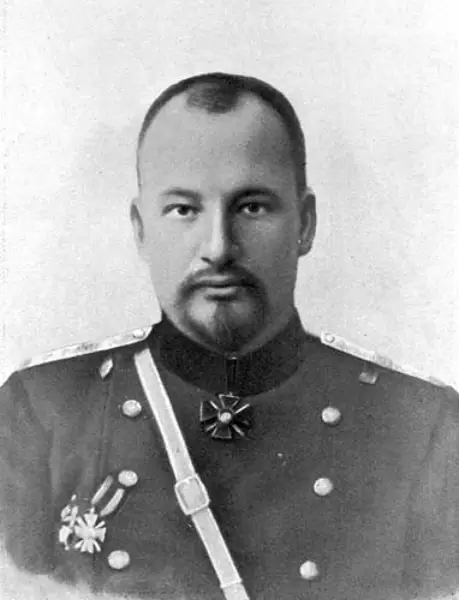
Yevgeny Sergeyevich Botkin, commonly known as Eugene Botkin, attended Nicholas II and his empress as court doctor from 1908 and one of the martyrs of the Ipatiev House. Born in Saint Petersburg in 1865, the fourth son of the celebrated medical scientist Sergey Botkin, he followed his father into medicine, taking his degree at the Military Medical Academy and pursuing further study in Berlin and Heidelberg. He served with distinction on a Red Cross hospital train in the Russo-Japanese War and became chief physician of Saint George City Hospital in 1907 before his appointment to the imperial court. Devoted to the hemophiliac Tsarevich Alexei, whom he treated in crises such as Spała in 1912, he regarded his service to the family as a sacred duty. When revolution came, he accompanied the Romanovs voluntarily into exile at Tobolsk and Yekaterinburg, though it cost him his marriage and the safety of his children. On the night of 16 July 1918 he wrote the unfinished meditation on death and faith found after his murder, and on 17 July he was shot with the imperial family and their servants. The Russian Church Outside Russia canonized him as a New Martyr in 1981; in 2016 the Moscow Patriarchate enrolled him as Righteous Passion-Bearer Yevgeny the Physician.
The Complete Life
Son of a Scientific Dynasty
Eugene Botkin was born in Saint Petersburg on 27 March 1865 into the family that stood at the summit of Russian medicine. He was the fourth son of Anastasia Alexandrovna Krylova and Sergey Botkin, who had served as court physician, or Leib Medik, since 1870 under Tsars Alexander II and Alexander III. The elder Botkin was honored as a father of Russian medical learning, the reformer who brought triage, pathological anatomy, and the diagnostics of the post mortem examination into Russian practice, and his son grew up in the shadow and the school of that achievement. The boy was educated at home before entering the fifth grade of the Second Saint Petersburg Gymnasium. His brother Peter, remembering him, described a child unlike the others: gentle to the point of breaking up dangerous fights among the neighborhood boys at risk to himself, studious and conscientious, and drawn to medicine by an unmistakable instinct to help, succour, soothe, and heal without end. The family circle was cultivated and connected, counting among its members an uncle, the art figure Mikhail Botkin, and a niece, Aleksandra Khokhlova, who would become an actress of the Soviet screen.
§ Early life and career
The Making of a Physician
Botkin followed his father into the study of medicine, obtaining his degree at the S. M. Kirov Military Medical Academy, where his scientific work dealt with the properties of blood. He then broadened his training abroad, spending periods of study at Berlin and Heidelberg from 1890 to 1892 and returning there in 1895, absorbing the medical science of Germany at its height. In 1891 he had married Olga Vladimirovna Manuilova, and in time four children arrived: Dimitri, then Yuri, Gleb, and Tatiana. His professional ascent ran through war service: aboard the St. Georgievsky Red Cross hospital train during the Russo-Japanese War he served with distinction and wrote notes on that conflict, an experience that joined medicine to military catastrophe early in his career. In 1907 he was appointed chief physician at Saint George City Hospital in Saint Petersburg, one of the capital's great institutions. A year later his life changed scale entirely, for he was named court physician to Emperor Nicholas II and Empress Alexandra. Henceforth his patients were the rulers of the largest empire on earth, and his particular, decades-long burden would be the health of the Tsarevich Alexei, whose haemophilia made every injury and every crisis a matter of state.
§ Early life and career
Physician to the Imperial Family
As court physician from 1908, Botkin served the imperial family with a devotion that consumed his private life. He sometimes treated the Tsarevich Alexei Nikolaevich for the complications of haemophilia, most memorably during the family's stay at Spała in 1912, when the heir's illness brought the court to the edge of despair. Nicholas II came to consider him a friend, a rare standing for any servant of the court, and Botkin conversed with the Empress Alexandra in her native German, acting as her translator when she received a Russian delegation. The cost of this service was paid at home. His marriage, worn down by his devotion to the imperial family and by the hours the court devoured, came apart; his wife Olga began an affair with a pharmacist, Friedrich Lichinger, and obtained a divorce in 1910. Deeper sorrows followed: Dimitri, the eldest, fell in battle in the First World War. Under these blows Botkin grew increasingly religious, and his son Gleb observed in him a developing abhorrence for the flesh. His daughter Tatiana later wrote his memoirs, preserving the voice of a father who had given his days to the most famous family in Russia and had received, in exchange, exile and a martyr's death.
§ Early life and career
Faith and Deeds in Captivity
Botkin's spirituality is best known from the extraordinary letter he wrote in his quarters at the Ipatiev House on the night of 16 July 1918, hours before his death. In it the physician, who described his voluntary confinement as restricted less by time than by his earthly existence, meditated on his own death with unsentimental clarity, calling himself dead to his children and his work yet unburied. He recorded mysterious visitations: a vision of his dead son Yuri's face as he read, and the sound of a word resembling Papulya, the voice he attributed to his daughter far away in Tobolsk. Out of this desolation came his creed. If faith without works is dead, he wrote, deeds can nevertheless live without faith, and where deeds and faith are found together, that is the special grace of God, a grace he counted himself to have received through the heavy burden of losing his firstborn child, the infant Serzhi. That grace, he believed, vindicated his final decision to orphan his own children rather than abandon his physician's duty to the end, and he likened himself to the patriarch who, at God's command, made no objection to offering up his only son. It is a document of ruthless self-examination, written by a man preparing for martyrdom.
§ Exile and death
Exile and Martyrdom
When the Russian Revolution of 1917 swept the monarchy away, Botkin held himself bound to follow the Romanovs into exile, moved equally by what he owed his patients and by what he owed his country. He went with them to Tobolsk in Siberia and then to Yekaterinburg, where the family was held in the Ipatiev House under an increasingly menacing guard. On the night of 16 July 1918 he was writing his final letter when Yakov Yurovsky, head of the guard command, knocked at his door and directed everyone in the house to dress and descend, citing shooting in the town and a supposed evacuation. In the early hours of 17 July the imperial family and their servants were murdered in the cellar; Botkin, who had volunteered to stay with them to the last, was shot with them. His body was buried with the others in an unmarked grave. When the site was discovered and his remains examined in the early 1990s, they showed bullet wounds to his legs, pelvis, vertebrae, and forehead, physical testimony to the violence of his end. He was fifty-three years old, the physician who had never left his patients, killed in their company and, in the Church's understanding, for their sake and for Christ's.
§ Exile and death
Righteous Passion-Bearer
Botkin's glorification unfolded in two stages, corresponding to the two Russian Orthodox jurisdictions of the emigration and the homeland. In 1981 the Russian Orthodox Church Outside of Russia, which had canonized the imperial family as New Martyrs, included Botkin among them, honoring the servant killed with his masters. In 2000 the Moscow Patriarchate canonized the Romanov family in a different key, as passion bearers, saints who met death with Christlike meekness rather than dying explicitly for the faith. Recognition of the physician himself followed when the ruling council of bishops of the Moscow patriarchate acted on 3 February 2016, enrolling him among a series of locally venerated saints for universal church veneration as Righteous Passion-Bearer Yevgeny the Physician. The title befits his life: not a hierarch or ascetic, but a medical man whose righteousness lay in fidelity, in the works joined to faith of which his final letter spoke, and in the meekness with which he shared his patients' doom. He stands in the calendar beside the imperial family whose servant and friend he was, the first physician of the Bolshevik terror to be raised to the altars, and his commemoration on 17 July joins him indissolubly to the martyrs of the Ipatiev House.
§ Honours and awards
Memory in Church, Honours, and Culture
Botkin's memory has been kept by the Church, by medicine, and by the arts. His service was decorated in its day: he bore the Order of St. Vladimir in the third and second classes with swords, the Order of St. Anna second class, the Order of St. Stanislaus third class, the Serbian Order of St. Sava second class, and a Bulgarian award for citizenship, distinctions that mark a career of war service and court trust. After his canonization his name entered the liturgical life of Russian Orthodoxy, and his relics, identified with the Romanov remains recovered in the 1990s, belong to the same story of forensic recovery and contested veneration that surrounds the imperial family. His afterlife in culture has been steady: he appears as a character in the Australian playwright David Logan's Ekaterinburg, which depicts the months the imperial family and their servants spent confined in the Ipatiev House, and on screen he was portrayed by Timothy West in the 1971 film Nicholas and Alexandra and by David Warner in the 1996 television movie Rasputin: Dark Servant of Destiny. But his most durable monument is the unfinished letter of 16 July 1918, one of the great testaments of conscience left by the Russian catastrophe, and the example of a physician who kept his oath to the end.
§ Representation in other media
Timeline
- 27 Mar 1865
Born in Saint Petersburg, fourth son of the physician Sergey Botkin and Anastasia Krylova.
§ Early life and career
- 1890
Studied medicine further in Germany, at Berlin and Heidelberg from 1890 to 1892 and once more in 1895.
§ Early life and career
- 1891
Married Olga Vladimirovna Manuilova; their four children were Dimitri, Yuri, Gleb, and Tatiana.
§ Early life and career
- 1907
Appointed chief physician at Saint George City Hospital in Saint Petersburg.
§ Early life and career
- 1908
Became court physician to Emperor Nicholas II and Empress Alexandra.
§ Early life and career
- 1910
His marriage ended in divorce, strained by his devotion to the imperial family and his long hours at court.
§ Early life and career
- 1912
Treated the Tsarevich Alexei for haemophilia-related complications at Spała.
§ Early life and career
- 1917
Following the Russian Revolution, voluntarily followed the Romanovs into exile, accompanying them to Tobolsk and Yekaterinburg.
§ Exile and death
- 16 Jul 1918
Writes an unfinished letter in his quarters during the night before the executions.
§ Exile and death
- 17 Jul 1918
Shot with the imperial family by guards at the Ipatiev House in Yekaterinburg.
§ Exile and death
- 1981
Canonized as a New Martyr by the Russian Orthodox Church Outside of Russia.
§ Honours and awards
- 3 Feb 2016
The Bishop's Council of the Russian Orthodox Church canonizes him as Righteous Passion-Bearer Yevgeny the Physician.
§ Honours and awards
In Their Own Words
I am making a last attempt at writing a real letter – at least from here – although that qualification, I believe, is utterly superfluous. I do not think that I was fated at any time to write to anyone from anywhere. My voluntary confinement here is restricted less by time than by my earthly existence. In essence, I am dead – dead for my children – dead for my work ... I am dead but not yet buried, or buried alive – whichever, the consequences are nearly identical
If faith without works is dead, then deeds can live without faith; and if some of us have deeds and faith together, that is only by the special grace of God. I became one of these lucky ones through a heavy burden-the loss of my firstborn, six-month-old Serzhi... This vindicates my last decision ... when I unhesitatingly orphaned my own children in order to carry out my physician's duty to the end, as Abraham did not hesitate at God's demand to sacrifice his only son.
The Record
- Major works
- Unfinished final letter written at the Ipatiev House on the night of 16 July 1918·Notes written on the Russo-Japanese War during his hospital-train service
- Canonization
- Canonized as a New Martyr by the Russian Orthodox Church Outside Russia in 1981; canonized as Righteous Passion-Bearer Yevgeny the Physician by the Bishop's Council of the Russian Orthodox Church on 3 February 2016.
Prayer
Bibliography
Show 5 sources
- King, Greg; Wilson, Penny (2003). The Fate of the Romanovs. John Wiley and Sons. ISBN 0-471-20768-3
- Kurth, Peter; Christopher, Peter; Radzinsky, Edvard (1995). Tsar: The Lost World of Nicholas and Alexandra. Little, Brown and Company. ISBN 0-316-50787-3
- Wegner, Armin T. (1930). Fünf Finger über dir. Deutsche Verlags-Anstalt, Stuttgart, Berlin und Leipzig
- Botkine, Peter. Les Morts sans Tombes. Paris: Louis Conard, 1921
- Acović, Dragomir (2012). Slava i čast: Odlikovanja među Srbima, Srbi među odlikovanjima. Belgrade: Službeni Glasnik, p. 634
Profile text adapted from the Wikipedia article, licensed CC BY-SA 4.0.
Pray with this saint every day
Save St. Eugene Botkin to your favorites, read the full profile, and get feast-day reminders in the Saints app.
Get the Saints AppFree on the App Store for iPhone and iPad