
1793 – 1873·Feast April 12
St. Eugene Hackmann
First Metropolitan of Bukovina and builder of Czernowitz
Overview
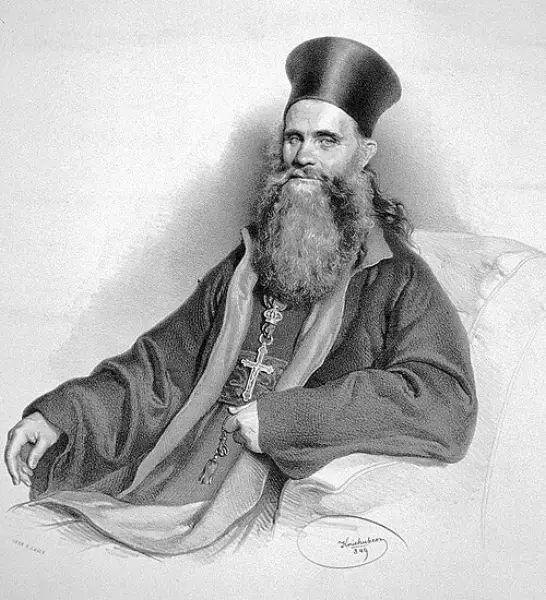
Eugene Hackmann, born Eftimie Hacman, was a Romanian Orthodox cleric who served as Bishop of Bukovina from 1835 and became, in the last months of his life, the first Archbishop of Czernowitz and Metropolitan of Bukovina and Dalmatia. Born in 1793 at Wasloutz into a peasant family from the Hotin region, he studied at the Theological School of Czernowitz and the University of Vienna, where as a student he taught Romanian to Archduke Ferdinand of Austria. Taking monastic vows at Dragomirna Monastery in 1823, he rose through teaching to the episcopate by imperial appointment. As bishop he promoted confessional education, reopened Romanian primary schools, founded a Normal School, and presided over the building of the Holy Spirit Cathedral and the Metropolitan Palace of Czernowitz, while supporting the founding of the city's university. He combined church office with public service as a deputy in the Imperial Senate, Real Privy Councillor, and first Marshal of the Duchy of Bukovina. His preference for the Ruthenians and for German in administration embittered many Romanians, who called him Eugene the Schismatic. Elevated to metropolitan rank on 23 January 1873, his death came suddenly at Vienna on 12 April 1873, before he could be enthroned. The Orthodox Church of Ukraine canonized him on 11 May 2026.
The Complete Life
From a Peasant Village to Vienna
The man who would become the first Metropolitan of Bukovina was born on 16 March 1793 at Wasloutz, in the Kingdom of Galicia and Lodomeria of the Habsburg Monarchy, a village that lies in present-day Ukraine. His family were peasants originally from the Hotin region, and their unusual surname preserved the memory of a forebear who had once carried a hatman's dignity, a commander's dignity later adapted in Bukovina into the forms Hackmann or Hacman. The boy, baptized Eftimie, showed gifts that carried him far beyond his village: after completing his secondary education he entered the Theological School of Czernowitz, and from there he passed to the University of Vienna, graduating in 1823 from the Faculty of Roman Catholic theology. His Viennese years gave him an imperial breadth unusual for an Orthodox village boy; during his student days he even taught the Romanian language to Archduke Ferdinand of Austria, the future emperor. The trajectory from hatman's blood and peasant fields to the lecture halls of the capital foreshadowed a career spent between two worlds, the Romanian Orthodox East and the German-speaking imperial state, and it was precisely that double position that would define and embitter his episcopate.
§ Biography
Monk, Professor, Bishop
In 1823, the year of his graduation, Hackmann took monastic vows and was ordained hierodeacon and afterwards hieromonk at Dragomirna Monastery, the great monastic house of Bukovina. His gifts were immediately turned to teaching. He served as catechist at the Trivial School, and from 1827 to 1835 he was professor of Biblical Studies at the Theological Institute of Czernowitz, forming the clergy of the diocese in the Scriptures. His learning and his imperial connections recommended him to higher things: in 1835 the Emperor appointed him Orthodox Bishop of Bukovina, and he governed that see for thirty-eight years. He was no retiring prelate but a figure of the whole public order of the province. He was elected Marshal of the Duchy of Bukovina, its first holder of that office from 1862 to 1864, served as a deputy in the Imperial Senate or House of Lords, and was named a Real Privy Councillor, while belonging politically to the Constitutional Party. Churchman and statesman at once, decorated as a Commander of the Order of Franz Joseph and honored as an honorary citizen of Czernowitz and Siret, he embodied the alliance of altar and throne that the Habsburg East prized, and was judged by it, in life and after death.
§ Biography
A Builder's Episcopate
Hackmann's episcopate transformed the face of Bukovina. In education he championed parish and confessional teaching, making Romanian the tongue of instruction at Czernowitz's theological institute in Latin's stead, even as he resisted the new Latin alphabet. The Romanian village schools, closed for years, reopened in 1837 at his instigation; a Normal School followed in the provincial capital in 1848; and in 1860 a secondary school began work at Suceava. That many of these institutions were converted by 1869 into state schools teaching in German was a defeat his policy could not prevent. In architecture his achievement was permanent: during his episcopate the Holy Spirit Cathedral rose in Czernowitz between 1844 and 1864, and the Metropolitan Palace between 1864 and 1882, the two buildings that still crown the city he served. In the political arena, his presence as a deputy in the House of Lords supported the establishment of a university in Czernowitz, an institution that reshaped the province's intellectual life. He lent his support to Ruska Besida, the Ruthenian cultural society, and gave steadily to the needy, and he left money at his death for an almshouse in Czernowitz and for a church in his native village, extending his building zeal beyond his own life.
§ Biography
The Shepherd and His Contested Flock
Hackmann's spiritual legacy is inseparable from the bitter nationality politics of his diocese. As bishop he governed a church of Romanians and Ruthenians, the ancestors of today's Ukrainians, and his choices systematically favored the latter: he preferred German in administration, supported the Ruthenians over Romanians in church appointments, and backed their cultural association Ruska Besida. When he allowed the cathedral itself to hold services in Ruthenian, Romanians responded with protest in 1866 and again the year after, and the writer George Sion lamented the lack of national pride among the Romanian professors of the seminary under his rule. Among Romanians he became known, as Archpriest Mihai Ivasiuc recorded, as Eugene the Schismatic. Yet the same record shows a pastor of conventional and genuine piety: a regular donor to the poor, a founder of almshouses, a monk whose incorrupted remains were reported when his grave was opened in 1914. His election in 1863 as president of the Romanian Reunion, the leading cultural society of the Bukovinian Romanians, shows the esteem he still commanded even among those whose cause he had wounded, though he neglected its duties and left the actual leadership to his vice-president, Gheorghe Hurmuzachi, until his formal departure in 1865.
§ Biography
The Metropolitanate That Almost Was
The great struggle of Hackmann's last decade was over the structure of Orthodox life in the empire. Many Romanians of the empire's provinces longed for one metropolitanate to gather all the Orthodox of their nation; Hackmann stood against the scheme, pressing instead for Bukovina to possess a metropolitan see of its own. His own clergy had already decided the question in 1861, when the diocese voted for elevation. In 1862 the empire's leading Romanians, Eudoxiu Hurmuzachi among them, approached Emperor Franz Joseph I asking for a united Orthodox metropolitanate freed from Serbian oversight; Andrei Șaguna of Transylvania wished to see Bukovina joined to such a union, but Hackmann would not yield. His course carried the day. On 23 January 1873 the see was raised to metropolitan dignity and joined with two Slavic dioceses of Dalmatia, and he was named Archbishop of Czernowitz and Metropolitan of Bukovina and Dalmatia, the first to hold a title he had spent three decades shaping. The office went unexercised: he passed away unexpectedly at Vienna on 12 April 1873, in his eightieth year, still awaiting enthronement. His funeral was attended by the Austrian minister of education, Karl Ritter von Stremayr, and he was buried in the Holy Spirit Cathedral he had built.
§ Metropolitan of Bukovina and Dalmatia
A Long Road to the Altars
Hackmann's canonization was more than a century in the making. The first moves came in the closing years of the nineteenth century. In 1880 the Ruthenian protopope Vasyl Prodan appealed to Metropolitan Silvestru Morariu-Andrievici, who convened a commission of inquiry; nine years later Omelian Popowicz, the head of Ruska Besida, added an appeal of his own. Metropolitan Vladimir de Repta took the matter up afresh in 1903, though he never brought it to completion. When the bishop's tomb was unsealed in 1914, the body within was found to be free of corruption, a sign that strengthened his cause, but under Soviet rule, in 1976, the authorities removed his relics from the Holy Spirit Cathedral, and their whereabouts have been unknown ever since. In 2024 the Orthodox Church of Ukraine renewed its efforts, and on 11 May 2026 the synod of that church formally canonized him, with the act taken by Theognostus, Metropolitan of Chernivtsi and Bukovina. The reception of the decision traced the fault lines of his memory exactly. The Romanian press viewed it with reluctance; Ukrainian historian Andriy Boyda, who calls Hackmann the Sheptytsky of Bukovina, praised the gesture, arguing that he shielded Ukrainians from Romanian abuses so that the Bukovinian Ukrainians escaped assimilation. Few modern canonizations have been so thoroughly contested by the neighbors of the saint himself.
§ Canonization
Memory Contested and Built in Stone
Hackmann's legacy is a study in divided memory. To Ukrainian historiography his pro-Ruthenian policies have made him appear an Orthodox cleric of Ukrainian origin, a claim Romanian historians contest, insisting he was a pure Romanian; his very ethnicity remains an argument. The empire he served remembered him more simply: one of Czernowitz's streets carried the designation Bischof-Hackmann-Gasse throughout the monarchy's lifetime, his portrait presides before the Chernivtsi Metropolitan Cathedral as a statue, and a monument has been raised to him in the Zastavnivtsi region. His material works proved more durable than his reputation. The Holy Spirit Cathedral, begun under him in 1844, became the burial place of the metropolitans and remains the architectural symbol of Chernivtsi; the Metropolitan Palace houses the university whose founding he furthered; the schools he planted seeded the educational life of the province. In 2026 his canonization by the Orthodox Church of Ukraine placed him among the saints of a church his own ecclesiastical statecraft helped make possible, the separate Bukovinian metropolitanate he insisted upon becoming, in time, part of the Ukrainian Orthodox inheritance. Whether he is honored as enlightener or resented as schismatic, both traditions must argue over the same cathedral, the same palace, and the same indelible half-century of building.
§ Canonization
Timeline
- 16 Mar 1793
Born at Wasloutz, in the Kingdom of Galicia and Lodomeria of the Habsburg Monarchy, into a peasant family from the Hotin region.
§ Biography
- 1823
Graduated from the Faculty of Roman Catholic theology at the University of Vienna; took monastic vows and was ordained hierodeacon and later hieromonk at Dragomirna Monastery.
§ Biography
- 1827
Appointed professor of Biblical Studies at the Theological Institute of Czernowitz, where he taught until 1835.
§ Biography
- 1835
Appointed by the Emperor as Orthodox Bishop of Bukovina.
§ Biography
- 1837
Reopened Romanian primary schools in the diocese.
§ Biography
- 1844
Construction of the Holy Spirit Cathedral in Czernowitz began under his episcopate, completed in 1864.
§ Biography
- 1848
Founded a Normal School in Czernowitz.
§ Biography
- 1860
A high school opened its doors in Suceava.
§ Biography
- 1861
Clergy of Bukovina voted in favor of raising their bishopric to metropolitan dignity.
§ Metropolitan of Bukovina and Dalmatia
- 1862
Became the first Marshal of the Duchy of Bukovina, serving until 1864; Romanian leaders petitioned Franz Joseph I for a unified Orthodox metropolitanate.
§ Metropolitan of Bukovina and Dalmatia
- 1863
Elected president of the Romanian Reunion organization, formally leading it until 1865 while Gheorghe Hurmuzachi acted as de facto leader.
§ Biography
- 1866
His favoring of Ruthenian services at the Metropolitan Cathedral provoked Romanian protests in 1866 and 1867.
§ Biography
- 23 Jan 1873
The Diocese of Bukovina is elevated to metropolitan rank; he becomes Archbishop of Czernowitz and Metropolitan of Bukovina and Dalmatia.
§ Metropolitan of Bukovina and Dalmatia
- 12 Apr 1873
Dies suddenly in Vienna, before enthronement, and is buried in the Holy Spirit Cathedral he had built.
§ Metropolitan of Bukovina and Dalmatia
- 1880
Ruthenian protopope Vasyl Prodan petitioned for his canonization; Metropolitan Silvestru Morariu-Andrievici formed a commission to examine the case.
§ Canonization
- 1889
Omelian Popowicz, who led Ruska Besida, added a petition of his own.
§ Canonization
- 1903
Metropolitan Vladimir de Repta reopened the canonization process, but it was never completed.
§ Canonization
- 1914
His tomb was unsealed, and what lay within was described as incorrupt.
§ Canonization
- 1976
Under Soviet rule his remains were removed by the authorities from the Holy Spirit Cathedral; their whereabouts have been unknown since.
§ Canonization
- 2024
The Orthodox Church of Ukraine renews efforts toward his canonization.
§ Canonization
- 11 May 2026
The synod of the Orthodox Church of Ukraine formally canonized Hackmann.
§ Canonization
In Their Own Words
The Orthodox churches in Ukraine present him as a spiritual leader, enlightener, and defender of the Orthodox faith – qualifications that the Romanian community has never shared.
he protected Ukrainians from Romanian abuses
The Record
- Major works
- Holy Spirit Cathedral in Czernowitz (1844–1864)·Metropolitan Palace in Czernowitz (1864–1882)·Normal School founded in Czernowitz (1848)
- Patron of
- patron of Bukovina
- Canonization
- Canonized on 11 May 2026 by the synod of the Orthodox Church of Ukraine, at the initiative of Theognostus, Metropolitan of Chernivtsi and Bukovina.
Prayer
Bibliography
Show 7 sources
- "ПЦУ ухвалила історичне рішення: канонізовано творця архітектурного символу Чернівців (фото)", 2025-05-11
- Deaconu, Petru (2021). "Experiența academică a primului Mitropolit al Bucovinei – Eugen Hacman (1835–1873)", Studia Theologica Orthodoxa Doctoralia Napocensia, pp. 233–245
- "Довгий шлях до канонізації Євгена Гакмана", Збруч, 2026-05-15
- "Rolul bisericii ortodoxe Române din Bucovina în politica Austriacă" (PDF, in Romanian), archived from the original on 2025-04-18
- "Sfânt pentru ucraineni, trădător pentru români — PȚU l-a canonizat pe mitropolitul Eugenie Hacman", Bucpress, 2026-05-13
- "Вшанування митрополита Євгена (Гакмана): Історія незакінченої канонізації"
- "Die historische Entwicklung der Rumänischen politischen Parteien in der Bukowina und ihre bedeutesten Vertreter im Reichsrat und Landtag (1861–1914)" (PDF, in German), archived from the original on 2016-03-09
Profile text adapted from the Wikipedia article, licensed CC BY-SA 4.0.
Pray with this saint every day
Save St. Eugene Hackmann to your favorites, read the full profile, and get feast-day reminders in the Saints app.
Get the Saints AppFree on the App Store for iPhone and iPad