
died 735·Feast September 16
St. Eugenia of Alsace
Abbess of Hohenburg and niece of St. Odile
Overview
Eugenia of Alsace was a noblewoman of the seventh and eighth centuries who became the second abbess of Hohenburg Abbey, the monastery on the mountaintop now known as Mont Sainte-Odile. She was the daughter of Adalbert, Duke of Alsace, and the niece of St. Odile, the abbey's founder and first superior. Taking up the office in 721, she led the community for roughly fifteen years, governing both the monastery and its convent in the spirit established by her aunt. Her name appears in a charter of 722, one of the few contemporary traces of her tenure. Under her care the houses drew young women from the leading families of Lower Alsace, who exchanged comfortable lives for a discipline of prayer and penance, and the mount became a noted destination for pilgrims. She died of natural causes on 16 September 735 and was buried in the abbey's chapel of St. John the Baptist, close to the tomb of Odile. Her remains rested there undisturbed for nearly nine centuries until Swedish soldiers desecrated the grave during the Thirty Years' War in 1622, scattering her bones; surviving relics were later gathered and distributed to churches at Oberehnheim and Willgottheim in Alsace. She is honored as a saint in both the Eastern Orthodox and Roman Catholic traditions, with a feast kept on the day of her death.
The Complete Life
A Ducal Daughter on the Holy Mountain
Eugenia was born into the highest rank of Alsatian society, the daughter of Adalbert, Duke of Alsace, in the generation after the region's Christian institutions had taken firm root. Her family's destiny was bound to the mountain monastery founded by her aunt, St. Odile, the blind-born woman whose sight was famously restored at baptism and who became the first abbess of Hohenburg. Odile died around 720, and in 721 Eugenia stepped into her place as the community's second superior. The choice was natural in an age when noble families gave daughters to the religious life as leaders as well as members, but it was also a spiritual inheritance: Eugenia had before her the example of a woman whose holiness had made the mountain itself a place of pilgrimage. Like Odile, she became a model of every virtue for the community entrusted to her. Contemporary memory preserves her name in a document of 722, where her signature appears as abbess of Hohenburg — a small trace of a life otherwise known through the community's continuing reputation. Under her rule, the monastery and its convent flourished together, and young women of the first families of Lower Alsace continued to come up the mountain, surrendering comfortable and pleasant lives for the practices of penance and common prayer.
§ Biography
Fifteen Years of Governance and a Quiet Death
Eugenia governed the Hohenburg houses for fifteen years, from 721 until her death in 735. The sources describe a leadership of example rather than of drama: the devout spirit of the founding mother still ruled both houses, and the spectacle of wellborn virgins renouncing ease for penance was accounted edifying throughout Lower Alsace. On 16 September 735 she died of natural causes — a peaceful end that stands in contrast to the violent fates of many early saints, and one that belongs to a tradition of holy abbesses whose sanctity was worked out in daily governance. She was laid to rest in the convent's chapel of St. John the Baptist, beside the tomb of her aunt St. Odile, so that the two women who had led the community in succession remained together in death. There her remains rested for almost nine hundred years. The peace of the tomb was broken only in 1622, when the Thirty Years' War brought Swedish troops to the convent; the soldiers opened her grave and scattered the bones. The nuns were able to collect only a few relics. Some bones were carried that year to the church of Oberehnheim in Alsace, and other relics were later transferred to the parish church of Willgottheim, where they remain objects of local veneration.
§ Biography
Memory on Mont Sainte-Odile
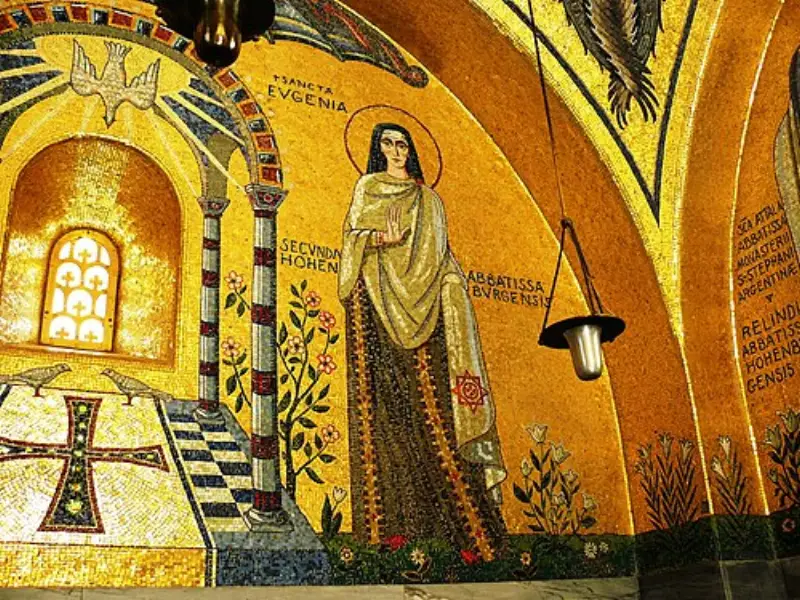
Eugenia's memory has remained attached to the holy mountain she governed. Her face endures in the mosaic of the Chapel of Tears at the convent of Mont Sainte-Odile, one of the most visited pilgrimage sites in Alsace, where her face keeps company with the memory of the aunt whose name the mountain bears. Veneration of Eugenia never depended on formal canonization processes: she was recognized as a saint by the continuous devotion of the churches, and she is honored today in both the Eastern Orthodox and Roman Catholic traditions. Her feast is kept on 16 September, the anniversary of her death in 735, in accordance with the ancient custom of celebrating a saint's birth into heaven on the day of earthly passing. The dispersal of her relics in the seventeenth century, far from extinguishing her cult, spread it: the churches of Oberehnheim and Willgottheim became new centers of remembrance alongside the abbey itself. She belongs to that Alsatian line of holy women — Odile, Attalus, and their kin — whose family sanctity shaped the Christianity of the Upper Rhine, and her story preserves the witness that the conversion of a people was carried not only by bishops and monks but by abbesses of noble blood who ruled with patience and died in peace.
§ Eugenia of Alsace
Timeline
- 721
Becomes the second abbess of Hohenburg Abbey in Alsace, succeeding her aunt St. Odile and serving until 735.
§ Introduction
- 722
Her signature as abbess of Hohenburg appears in a document of that year.
§ Biography
- 16 Sep 735
Dies of natural causes at Hohenburg on 16 September after governing the monastery for about fifteen years; her feast keeps this date.
§ Introduction
- 735
She is laid to rest in the convent chapel dedicated to Saint John the Baptist, close to where Saint Odile herself lies buried.
§ Biography
- 1622
Swedish troops invading during the Thirty Years' War open her tomb and scatter her bones; the nuns collect a few remaining relics.
§ Biography
- 1622
Some of her bones are moved to the church of Oberehnheim in Alsace; other relics later reach the parish church of Willgottheim.
§ Biography
The Record
- Major works
- Governance of Hohenburg Abbey and its convent (721-735)
- Patron of
- Venerated as a holy abbess of Alsace
- Symbols
- Depicted in mosaic in the Chapel of Tears at Mont Sainte-Odile·Abbess's habit
- Canonization
- Pre-congregation canonization; venerated as a saint since antiquity in the Eastern Orthodox and Roman Catholic Churches
Prayer
Bibliography
Show 6 sources
- "Latin Saints of the Orthodox Patriarchate of Rome". www.orthodoxengland.org.uk. Retrieved 2024-12-07.
- "Sainte Eugénie d'Alsace". Nominis (in French). Retrieved 2023-09-25.
- "Saint Eugenia of Hohenburg". Catholic Saints. 2022. Retrieved 2023-09-25.
- "Card. Parolin marks 1,300th death anniversary of St. Odile - Vatican News". www.vaticannews.va. 2021-07-05. Retrieved 2023-09-26.
- "Santa Eugenia di Hohenburg". Santiebeati.it (in Italian). Retrieved 2023-09-26.
- "Eugenia, St. | Encyclopedia.com". www.encyclopedia.com. Retrieved 2023-09-25.
Profile text adapted from the Wikipedia article, licensed CC BY-SA 4.0.
Pray with this saint every day
Save St. Eugenia of Alsace to your favorites, read the full profile, and get feast-day reminders in the Saints app.
Get the Saints AppFree on the App Store for iPhone and iPad