
died c. 258·Feast December 25
St. Eugenia of Rome
Virgin martyr of the Valerian persecution
Overview
Eugenia of Rome, said to have died around AD 258, is honored as an early Christian virgin martyr, though modern scholars regard her story as largely legendary. According to her Life, she was the daughter of Philip, a distinguished official sent to govern Egypt under Commodus, and grew up in Alexandria as a beautiful and studious young woman. Reading the letters of Paul and the Acts of Paul and Thecla, she sought out the bishop Helenus, was baptized with her servants Protus and Hyacinth, and lived as a monk in male disguise under the name Eugene, eventually being chosen to lead her community. The legend recounts her escape from the false accusation of the matron Melanthia, the conversion of her own family, and, decades later under Emperor Valerian's persecution, her arrest in Rome for converting the noblewoman Basilla. Refusing sacrifice to Diana, she suffered a series of miraculous deliverances before being beheaded after a dream foretold her death at the Feast of the Nativity. Scholars note that she is absent from the earliest Roman martyrological lists, and classify her Passion as a hagiographic novel of recognition composed in Italy between 450 and 499. Nevertheless her cult spread early and widely: she appears in fifth- and sixth-century mosaics at Ravenna and Parenzo, was celebrated by Avitus of Vienne and Venantius Fortunatus, entered the Golden Legend, and her relics were reportedly carried north to Fulda in 838.
The Complete Life
A Senator's Daughter in Alexandria
The legend places Eugenia's childhood in the highest circles of the Roman Empire. Her father Philip, described as a man of illustrious rank, was said to have been dispatched to govern Egypt under the emperor Commodus, and he traveled from Rome with his wife Claudia and their children Sergius, Avitus, and Eugenia, settling in Alexandria. There Eugenia grew into a remarkable young woman — beautiful, virtuous, and devoted to learning. At sixteen she was studying Greek and Latin literature and had won the admiration of philosophers for her gravity of character. Her father, following the custom of his class, wished to arrange an advantageous marriage and presented her with a series of suitable candidates, but Eugenia rejected them all, judging good morals of more worth than high birth. The turning point of her life came by chance, as the story tells it: copies of a letter of Paul and of the Acts of Paul and Thecla fell into her hands, and she read them with keen attention. Permitted to ride out in a covered litter over the family's country estate, she weighed the two books in conversation with Protus and Hyacinth, the eunuchs reared beside her since childhood who shared her pagan upbringing, concluding that all pagan religious writings were hollow beside them.
§ Legend
Baptism and the Monk Eugene
Seeking the Christians whose books had unsettled her, Eugenia and her companions first heard Bishop Helenus of Heliopolis and his flock chanting the psalm that brands every idol of the nations a demon — the reply, she decided, to her questions. She resolved to return the next day, but only once her two servants had shorn her hair and clothed her as a man, after the pattern set by Thecla herself. At the second meeting the Christians were singing from Isaiah, and Helenus accepted the three converts for baptism, seeing through the disguise but not questioning it. All three then became monks, Eugenia taking the male name Eugene. Among the brothers she won renown for piety and for powers of healing. When the abbot died two years later, the community unanimously chose her as his successor; she refused obstinately until an opening of the Scriptures to the Gospel words on discipleship and service convinced her to accept. It was as abbot that she healed the noble matron Melanthia with the sign of the cross. Melanthia's returning devotion turned to obsession: after Eugenia refused her proposals, the spurned woman accused the 'monk' of attempted rape before Philip's tribunal in the amphitheater. Forced to answer, Eugenia tore her tunic, revealed herself, and named her father — whereupon her whole family embraced her and, by the legend's account, the crowd was converted.
§ Legend
Martyrdom under Valerian
Fifty years after her conversion, with persecution renewed under Emperor Valerian, Eugenia was living in Rome as an elderly woman, converting maidens who were often soon martyred themselves. Her conversion of Basilla, the emperor's niece, enraged Gallienus, who condemned her and ordered a sacrifice to Diana. Entering the temple, Eugenia prayed before the cult image, which crumbled to dust. A series of judicial torments followed, each ending in marvel: thrown into the Tiber tied to a block of stone, she floated, submerged only to her knees; condemned to be scalded in the great baths, she found the furnaces extinguished at her arrival; shut in a cave without food or water, she was kept alive by Christ in brilliant light. Her old companions Protus and Hyacinth were beheaded on September 11, 258. Then Christ appeared to Eugenia in a dream, promising her the martyr's palm at the Nativity feast; she was beheaded that same year. Afterward she showed herself to her mother, who had come to the tomb in tears, foretold Claudia's approaching end, and urged her conversion; the mother died that very Sunday, and her sons Avitus and Sergius laid her to rest, took up the evangelization of the Romans, and themselves died as saints.
§ Legend
A Story That Travelled
Whatever the historical facts, Eugenia's tale proved one of the most adaptable in Christian hagiography. The earliest source, a Latin Life surviving as the Passion of the Martyr Saints Protus and Hyacinth, took its final shape in Italy in the later fifth century and belongs to the recognized genres of the hagiographic novel of recognition and the story of the woman disguised as a monk. Greek versions appeared repeatedly in the seventh century, and Symeon the Metaphrast reworked it into elegant Greek in the tenth, and rendered into Syriac, Armenian, and Ethiopic. Scholars observe that the story spoke to a remarkable range of audiences: readers of Virgil and secular novels, pious women, monks and nuns seeking edifying reading. Within it Eugenia plays many roles — learned noblewoman, converted teenager fleeing her family, another Thecla, champion of purity flanked by two eunuchs, innocent victim of calumny, performer of a daring recognition scene. Modern historians, following Delehaye, judge her a legendary figure: she is absent from the Chronograph of 354's Depositio martyrum, from Pope Damasus's epigrams, and from Prudentius, and her story appears to have been anchored to history by attaching real names — Philip, Basilla, Protus and Hyacinth — to a narrative of epic type.
§ Historicity
From Ravenna to Fulda
Eugenia's cult was in full flower within two centuries of her supposed martyrdom. She appears in the fifth-century mosaics of Sant'Apollinare Nuovo in Ravenna and in sixth-century mosaics at the Eufrasiana in Parenzo, and she was mentioned and celebrated by Avitus of Vienne and Venantius Fortunatus — firm evidence that her name was honored across the Latin West long before her Life reached its surviving form. In the thirteenth century her story entered the Golden Legend, the great medieval collection of saints' lives, and an edition of the Life was printed at Milan before 1478 by Boninus Mombritius in his Sanctuarium, later republished with improvements by the monks of Solesmes. Her relics were part of the medieval traffic in sacred bodies: on April 5, 838, the monk Felix arrived at Fulda on 5 April 838 bearing Eugenia's bones together with relics of Cornelius, Callistus, Agapitus, and a host of other saints, a transfer recorded in Patrick Geary's study of relic thefts. In northern Portugal, a village named Santa Eugenia preserves a church showing her dressed as a boy in Roman attire, with a local legend that she passed that way on the old Roman road, and a hilltop tomb at Barcelos bears her name. Her feast is kept on December 25 by Roman Catholics, December 24 in the Byzantine tradition, and January 23 among Armenian Christians, and she has more recently been invoked as a figure of transgender holy memory.
§ Veneration
Timeline
- 192
By legend, her father Philip was appointed governor of Egypt under Commodus and settled the family in Alexandria.
§ Legend
- 11 Sep 258
Protus and Hyacinth, her longtime eunuchs, were put to death by the sword in Rome.
§ Legend
- 25 Dec 258
Foretold in a dream that she would die at the Nativity feast, Eugenia was beheaded in Rome.
§ Legend
- 400
She figured among the fifth-century mosaics of the Basilica of Sant'Apollinare Nuovo in Ravenna.
§ Sources
- 450
Her Latin Life, the Passion of the Martyr Saints Protus and Hyacinth, was composed in Italy sometime in 450–499.
§ Sources
- 500
Her image joined the sixth-century mosaics of the Eufrasiana at Parenzo.
§ Sources
- 600
Her Life was rendered into Greek several times around the seventh century.
§ Sources
- 5 Apr 838
A monk named Felix brought her remains, together with many other saints' relics, to Fulda.
§ Veneration
- 900
Symeon the Metaphrast produced an elegant Greek retranslation of her Life in the tenth century.
§ Sources
- 1200
Her story was included in the Golden Legend during the thirteenth century.
§ Sources
- 1477
Boninus Mombritius printed an edition of her Life at Milan shortly before 1478.
§ Sources
The Record
- Major works
- Passion of the Martyr Saints Protus and Hyacinth (BHL 2667), the Latin Life recounting her legend
- Patron of
- Invoked in matters of chastity and conversion
- Symbols
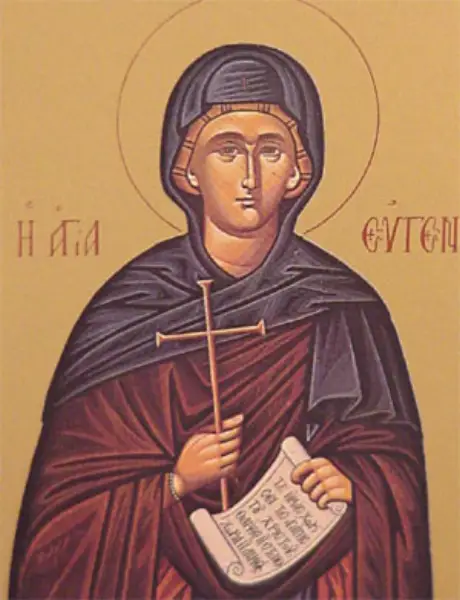
- cross·scroll·depicted in male monastic dress
- Canonization
- Pre-congregation canonization; venerated as a martyr since late antiquity
Prayer
Bibliography
Show 10 sources
- "Commemoration of the Virgin Eugine, her father - Philippus, her mother Klothia and her two servants". Araratian Patriarchal Diocese of the Armenian Apostolic Church. Retrieved 4 January 2014.
- Passio sanctorum Proti et Hyacinthi martyrum, éd. Mombritius, II (1978), p. 397, 37-38.
- P. Boulhol, Anagnorismos (1996).
- C. Lanéry, "Hagiographie d'Italie (300-550), I : Les Passions latines composées en Italie" (2010), p. 126-138.
- John Anson, "The female transvestite in early monasticism : the origin and development of a motif", in Viator, 5 (1974), p. 1-32.
- Évelyne Patlagean, "L'histoire de la femme déguisée en moine et l'évolution de la sainteté féminine à Byzance", in Studi Medievali, 3rd series, 17 (1976), p. 597-623.
- Stephen Davis, "Crossed texts, cossed sex : intertextuality and gender in early christian legends of holy women disguised as men", in JECS, 10/1 (2002), p. 1-36.
- Patrick J. Geary, Furta Sacra: Thefts of Relics in the Central Middle Ages (Princeton: Princeton University Press, 1990), 48.
- E.G. Whatley, "More than a Female Joseph" (2012).
- Hippolyte Delehaye, Les légendes hagiographiques (3e édition, Bruxelles, 1927), p. 26-28 and 59.
Profile text adapted from the Wikipedia article, licensed CC BY-SA 4.0.
Pray with this saint every day
Save St. Eugenia of Rome to your favorites, read the full profile, and get feast-day reminders in the Saints app.
Get the Saints AppFree on the App Store for iPhone and iPad