
died c. 305·Feast January 21
St. Eugenios of Trebizond
Martyr and heavenly patron of Trebizond
Overview
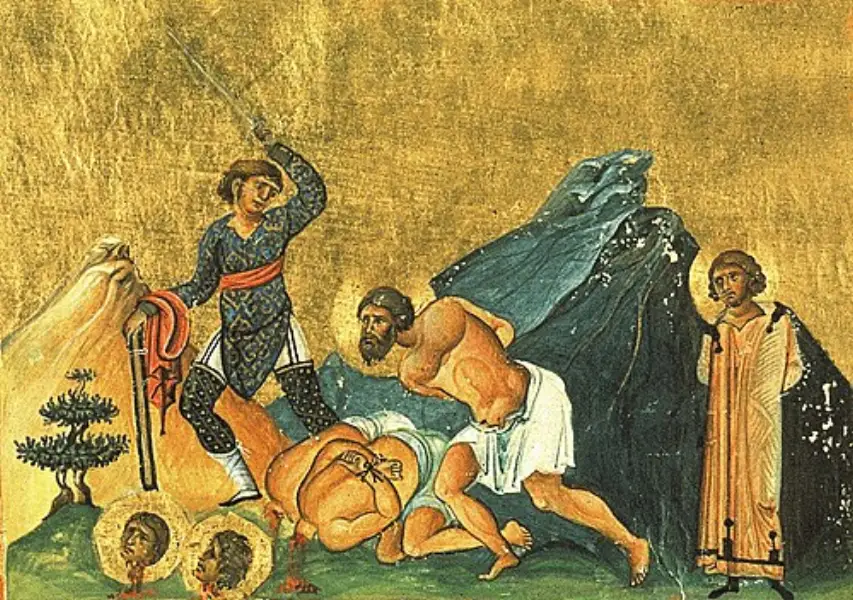
Eugenios of Trebizond was a martyr of the Great Persecution whose cult made him the special patron of the Black Sea city whose name he bears. With his fellow martyrs Candidus, Valerian, and Aquila, he was hunted during the reigns of Diocletian and Maximian. The four took refuge in the heights above Trebizond, but their hiding place was found, and they were hauled before the regimental commander Lycius, who had them flogged, tortured with fire, and finally beheaded. Eugenios was also credited with destroying the pagan image on the 'gray hill' overlooking the city, the site later known as the Mithratis. Devotion to him grew steadily in his native city: a monastery dedicated to him on Mount Minthrion, with a church and a metochion inside the walls, existed by at least the ninth century, and a typikon of 1346 preserves details of its community's life. The Komnenian emperors of Trebizond adopted Eugenios as patron of their realm, crediting him with helping to repel a Seljuk siege of the city in 1224, and stamped his image frequently on their coins. In the fourteenth century John Lazaropoulos, Metropolitan of Trebizond under the name Joseph, gathered the saint's miracles into a single book, though his cult never spread far beyond Trebizond's borders.
The Complete Life
Martyrdom in the Mountains Above the City
Eugenios suffered in the great persecution that the emperors Diocletian and Maximian unleashed on the Church at the turn of the fourth century. He was not alone: with Candidus, Valerian, and Aquila, he belonged to a company of Christians in the Pontic city of Trebizond who refused to abandon their faith. When the storm broke, the four went into hiding in the mountains above the city, a flight that speaks both of their prudence and of their determination to survive so long as survival did not cost them their confession. They were eventually found and dragged before Lycius, the regimental commander, who put them through the full rigor of the persecutor's art. They were flogged, tortured with fire, and at last beheaded, sealing their witness with blood. Alongside this passion, tradition assigns Eugenios a more particular feat: the destruction of the idol that stood on the 'gray hill' overlooking Trebizond, on the site afterward known as the Mithratis. Whether read as history or as legend, the deed frames the saint as one who overthrew the old gods of the city in order to give it a new patron — and in time the city agreed, taking him as its own.
§ Eugenios of Trebizond
Feast and Veneration
Eugenios was never canonized by any formal process; he belongs to the first generations of martyrs whose veneration arose spontaneously from the gratitude of the churches that remembered them. The Eastern Orthodox Church honors him together with his companions Candidus, Valerian, and Aquila on 21 January, and counts him among the passion-bearers who triumphed in the age of Diocletian. His cult was from the beginning a local one, rooted in the city of Trebizond and its surrounding mountains, and it never developed in any substantial way beyond the city's borders. Yet within that sphere his place was secure: the liturgical texts composed for him ask God, through the martyr's sufferings, to grant him the incorruptible crown and to save the souls of those who invoke his intercession. The survival of his feast through the centuries, and the care with which his monastery recorded its own observances, show how deeply the memory of the martyr was woven into the religious life of the Pontic coast — a memory that the emperors of Trebizond would later raise to the level of a national cult.
§ Eugenios of Trebizond
Patron of an Empire
The Komnenian rulers of the Empire of Trebizond, the Greek realm that survived on the Black Sea after 1204, adopted Eugenios as the patron of their country, and his cult became a mark of Trebazuntine identity. His image appears frequently on the empire's coins, struck beside those of the emperors — a rare civic honor for a martyr of the early fourth century. His miracles were credited with saving the city itself: when the Seljuk Turks besieged Trebizond in 1224, the saint was believed to have assisted in the city's repulse of the attack. The center of his cult was the monastery dedicated to him on Mount Minthrion, which consisted of a structure on the mountain with an associated church and a metochion within the city walls; the community is documented from the ninth century onward, and a typikon drawn up in 1346 sets out the details of its daily life. In the fourteenth century John Lazaropoulos, Metropolitan of Trebizond under the monastic name Joseph, collected the traditions of the saint's miracles into a single book, preserving for posterity the hagiographic dossier of a saint whose pilgrimage cult, for all its local limits, sustained an empire's devotion for over a thousand years.
§ Legacy
Timeline
- 284
The persecutions in which Eugenios died began under the emperor Diocletian.
§ Eugenios of Trebizond
- 305
Eugenios, Candidus, Valerian, and Aquila were flogged, tortured with fire, and beheaded before commander Lycius.
§ Eugenios of Trebizond
- 850
A monastery dedicated to Eugenios on Mount Minthrion is attested as existing by at least the ninth century.
§ Legacy
- 1224
Eugenios was credited with assisting Trebizond to repel a siege by the Seljuk Turks.
§ Legacy
- 1346
A typikon composed this year recorded the daily life of the saint's monastic community.
§ Legacy
- 1380
John Lazaropoulos, Metropolitan of Trebizond, gathered the miracle traditions of St. Eugenios into a single volume.
§ Legacy
In Their Own Words
Your holy martyr Eugene, O Lord, Through his sufferings has received an incorruptible crown from You, our God. For having Your strength, he laid low his adversaries, And shattered the powerless boldness of demons. Through his intercessions, save our souls!
The Record
- Major works
- The monastery of St. Eugenios on Mount Minthrion at Trebizond
- Patron of
- patron of the Empire of Trebizond·patron of the city of Trebizond
- Symbols
- martyr's cross·depicted on Trapezuntine coins·incorruptible crown
- Canonization
- Pre-congregation canonization; venerated in the Eastern Orthodox Church since antiquity
Prayer
Bibliography
Show 4 sources
- Miller, William (1926). Trebizond: The Last Greek Empire of the Byzantine Era, 1204-1461. Argonaut Publishers.
- Rosenqvist, Jan Olof, ed. (1966). The Hagiographic Dossier of St Eugenios of Trebizond in Codex Athous Dionysiou 154. Uppsala. ISBN 9155437877.
- "Martyrs Eugene, Candidus, Valerian, and Aquila, at Trebizond". Orthodox Church in America.
- Jan Olof Rosenqvist, "Local Worshipers, Imperial Patrons: Pilgrimage to St. Eugenios of Trebizond," Dumbarton Oaks Papers, 56 (2002), pp. 193-212.
Profile text adapted from the Wikipedia article, licensed CC BY-SA 4.0.
Pray with this saint every day
Save St. Eugenios of Trebizond to your favorites, read the full profile, and get feast-day reminders in the Saints app.
Get the Saints AppFree on the App Store for iPhone and iPad