
c. 289 – 303·Feast February 12
St. Eulalia of Barcelona
Thirteen-year-old virgin martyr of Diocletian's persecution
Overview
Eulalia of Barcelona was a young Roman Christian, born around 289, who was martyred at the age of thirteen during the persecution of Diocletian and Maximian. According to the tradition preserved by the Orthodox Church in America, she was the daughter of a noble family living near Barcelona. When the governor Dacian arrived to enforce the persecuting edicts, Eulalia left her home, walked into the city, and publicly confronted him over his treatment of the Christians. The governor answered her defiance with a cascade of torments — stripping, flagellation, and other tortures — in the midst of which she begged God to receive her into heaven, expiring from her injuries. Tradition holds that her sufferings culminated in crucifixion on an X-shaped cross, the saltire that became her emblem, though some scholars argue she was instead tortured to death on an X-shaped frame and displayed, with later art mistaking the instrument for a cross. Devotion to her took deep root in Barcelona: her body, first buried at Santa Maria de les Arenes, was hidden during the Moorish invasion of 713, recovered in 878, and in 1339 moved to an alabaster sarcophagus beneath the crypt of the city's cathedral, consecrated in her honor together with the Holy Cross. Canonized by Pope Vitalian in 633, she remains a patron saint of Barcelona, of sailors, and is invoked against drought.
The Complete Life
A Noble Child of Barcino
Eulalia was born around the year 289 into a noble family whose lands lay near the city the Romans called Barcino — the Barcelonum of Hispania Tarraconensis, the settlement that would grow into Barcelona. She belonged to the third Christian generation of the city's small church, raised in a faith that was still legally precarious throughout the empire. Her parents gave her the formation of a Roman girl of her class, but the tradition remembers her chiefly for what came later: a child with the convictions of a mature believer. In 303 the emperor Diocletian and his co-emperor Maximian issued the edicts that unleashed the last and most systematic of the persecutions, and in Spain its instrument was the governor Dacian, who traveled through the province compelling Christians to sacrifice. Eulalia was then about thirteen — old enough to know what she believed, young enough that the empire expected nothing of her. The Sequence of Saint Eulalia, the Old French poem of around 880 that preserves her memory, names the 'pagan king' Maximian as the author of her sufferings, and places her among the earliest and youngest witnesses of the Spanish church.
§ History
Confrontation with Dacian
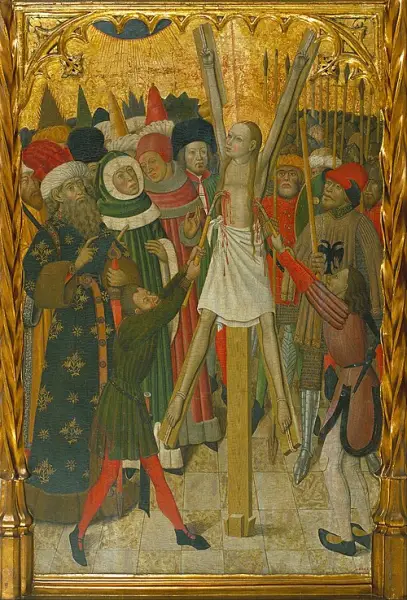
The account handed down by the Orthodox Church in America tells of a girl who refused to wait out the storm. When Dacian arrived in the city to carry out the persecutions, Eulalia went out from her home into the city and openly challenged the governor about his persecution of the Christians — a remarkable act for any subject of the empire, extraordinary in one of her age. Dacian's answer was the persecutor's logic made visible: he sentenced her to be stripped and put to many tortures, scourging among them, hoping to break in a child the defiance the courts could not argue away. Eulalia bore the torments, praying for God to take her to heaven, and expired from her injuries, her prayer understood as granted. Later tradition shaped the scene into its lasting form: her tortures culminated, it was said, in crucifixion on an X-shaped cross, the saltire that artists have always placed beside her. Modern scholars have proposed a grimmer reading — that she was publicly tortured to death on an X-shaped frame and her body left on display, and that artistic depictions of the display gradually persuaded the devout that she had been crucified. Either way, the instrument became her badge, and the dove that legend saw rising from her at death became her sign of the spirit that no tormentor could reach.
§ History
Raised to the Altars
Eulalia's veneration began where her body lay. She was buried in the church of the Sands, Santa Maria de les Arenes, which today is called Santa Maria del Mar — in the city whose confession she had sealed, and her grave quickly became a place of prayer. The formal recognition of her sanctity came in 633, when Pope Vitalian canonized her, an early instance of papal canonization and a mark of how far the fame of the Spanish child martyr had traveled beyond her own province. Her name entered the universal calendars of the Church: Roman Catholics keep her feast on February 12, the anniversary of her passion, while the Orthodox churches, which formally added the saints of Spain and Portugal to their liturgical calendar in recent years, commemorate her on August 22 and December 10. She is honored across the whole spectrum of Western Christianity — Roman Catholic, Anglican, Lutheran, and Eastern Orthodox — one of the ancient martyrs whose cult predates the divisions of the Reformation. A disputed question has never been settled: whether she is identical with Eulalia of Mérida, since the two stories are so alike that some traditions count one martyr where others count two.
§ Eulalia of Barcelona
The City of Saint Eulalia
No saint is more present in Barcelona than Eulalia, its co-patron and, in popular affection, its own. Her body, hidden in 713 when the Moorish invasion swept over the city, was recovered in 878 and in 1339 placed in an alabaster sarcophagus below the crypt of the then-new Cathedral of Santa Eulalia, whose double dedication joins her name to the Holy Cross. There the sarcophagus remains the heart of the cathedral, above a Gothic choir raised over the martyr's rest. The city tells her story in its very streets: the lane called Baixada de Santa Eulalia — 'Saint Eulalia's descent' — marks the place where tradition says she was shut in a barrel studded with shards of glass and rolled downhill, one torment among many that local memory attached to her passion. Statues and street names throughout Barcelona recall her, and each year the city keeps the festival of its saint for a week around her feast day of February 12, with the streets filled in her honor. Artists have returned to her repeatedly — most famously Bernat Martorell, whose Martyrdom of Saint Eulalia, painted in 1442-1445, hangs today in the Museu Nacional d'Art de Catalunya. Patron of Barcelona and of sailors, invoked against drought, she remains the child who stood up to an empire and whose city never forgot it.
§ Veneration
Timeline
- 289
Was born around this year into a noble family living near Barcelonum in Hispania Tarraconensis.
§ Introduction
- 12 Feb 303
At thirteen she confronted Governor Dacian over the persecutions and died from her tortures.
§ History
- 12 Feb 303
By tradition her torments ended in crucifixion on an X-shaped saltire, though some scholars doubt this.
§ History
- 633
Was canonized by Pope Vitalian, according to the article's infobox.
§ Introduction
- 713
Her body, first buried at Santa Maria de les Arenes, was hidden during the Moorish invasion.
§ Veneration
- 878
Her hidden remains were recovered after the Moorish threat had passed.
§ Veneration
- 880
The Sequence of Saint Eulalia, a French hagiographic poem preserving her memory, is dated to this year.
§ See also
- 1339
Her remains were translated to a sarcophagus of alabaster in the crypt of the city's new cathedral.
§ Veneration
- 1442
Bernat Martorell painted his Martyrdom of Saint Eulalia between 1442 and 1445.
§ Introduction
The Record
- Patron of
- Barcelona, Spain·sailors·against drought
- Symbols
- saltire (X-shaped cross)·stake·dove
- Canonization
- Canonized in 633 by Pope Vitalian
Prayer
Bibliography
Show 7 sources
- Haliczer, Stephen (2002). Between exaltation and infamy: Female mystics in the Golden Age of Spain. New York City: Oxford University Press. p. 236. ISBN 978-0-1951-4851-0.
- "Virgin Martyr Eulalia of Barcelona". Orthodox Church in America. Retrieved 14 February 2025.
- "Santa Eulalia de Barcelona". Your Questions About the Saints (in Spanish). Retrieved February 14, 2025.
- "Santa Maria del Mar". The New York Times Travel Guide.
- "Festes de Santa Eulàlia". City of Barcelona. Retrieved 14 February 2025.
- Vázquez Montalbán, Manuel (1992). Barcelonas. London: Verso. p. 42. ISBN 978-0-8609-1353-5.
- "Russian Church officially adds saints of Spain, Portugal to liturgical calendar" (Press release). Orthodox Christianity. 9 January 2019.
Profile text adapted from the Wikipedia article, licensed CC BY-SA 4.0.
Pray with this saint every day
Save St. Eulalia of Barcelona to your favorites, read the full profile, and get feast-day reminders in the Saints app.
Get the Saints AppFree on the App Store for iPhone and iPad